




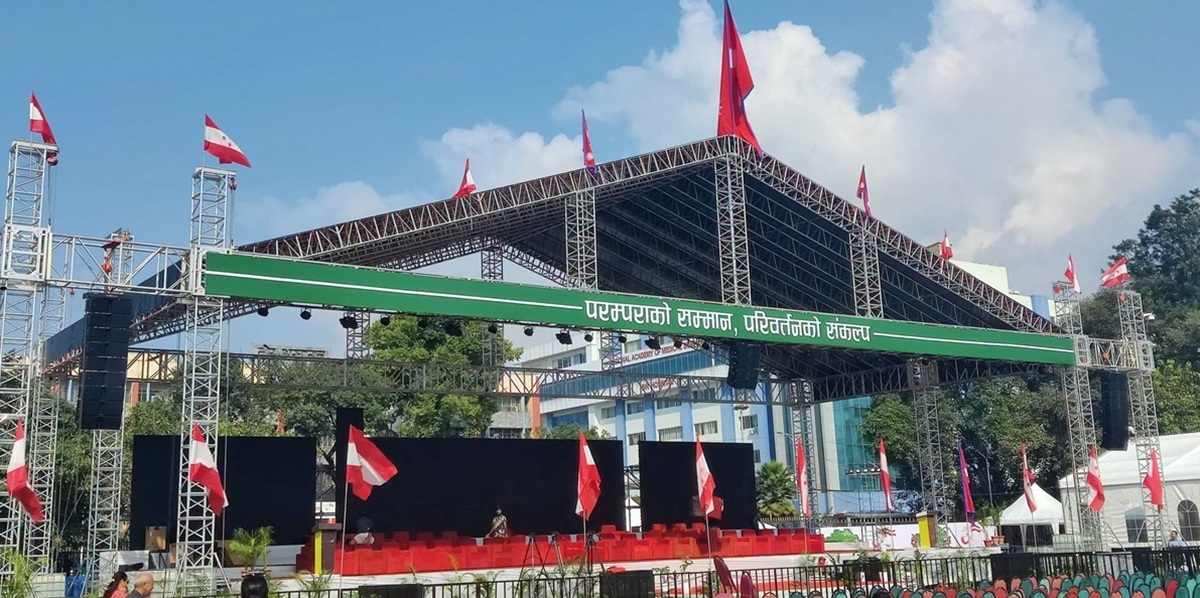
KATHMANDU: The Nepali Congress’ 15th General Convention has begun at Khulamanch in Tundikhel, Kathmandu, with around 7,500 representatives participating in the party’s largest gathering of its kind.
Party President Gagan Kumar Thapa inaugurated the convention amid the participation of senior Nepali Congress leaders and representatives from across the country and abroad.
The convention will hold its closed sessions over the next two days, while elections for the party’s new leadership are scheduled for October 7 and 8.
The party has formed 15 committees to oversee various aspects of the convention. Separate halls have been prepared at Khulamanch for the closed sessions, along with a media centre and a primary healthcare unit.
According to NC spokesperson Devraj Chalise, the closed sessions will be held in three halls named Himal, Pahad and Terai-Madhesh. Party President, Vice-President, General Secretary and Treasurer will present separate reports, which will be discussed in three panels based on geographical regions. Participants will be able to access the reports through digital boards installed at the venue.
Representatives from across the country and abroad have arrived in Kathmandu for the convention. The Accommodation Management Committee has appointed coordinators for each electoral constituency, district and province to arrange lodging for participants.
Accommodation has been arranged in areas including the Tribhuvan International Airport area, Gaushala, Sundhara, Thamel, Lazimpat, Kalanki and New Bus Park. Details have been shared with participants through WhatsApp messages, AI numbers and SMS.
According to the accommodation committee, breakfast, lunch and dinner are available in the Bhrikutimandap area.
The General Convention Central Election Commission told RSS that around 7,500 representatives are participating in the convention. It is the first time in the party’s history that such a large number of representatives have been elected to participate in a general convention.
Historic venue
The convention is being held at Tundikhel, a site of historical significance to Nepal’s democratic movement. It was here that Nepali Congress founder and Nepal’s first elected prime minister, BP Koirala, delivered his first public address after returning from exile.
Tundikhel was also where another founding leader of the Nepali Congress, Ganeshman Singh, proclaimed the success of the 1990 People’s Movement, which ended the Panchayat system.
According to spokesperson Chalise, the convention is historic for the party, with around 44,000 young people from the new generation having assumed responsibilities and more than 7,000 representatives selected from among them participating in the convention.
The convention follows the Nepali Congress’ second Special General Convention, held at Bhrikutimandap from January 12 to 17.
Low-key publicity
In view of the significant loss of life and property caused by the August 26 floods, the Nepali Congress has decided to hold the convention in a simple manner and avoid extravagant publicity.
Information about the convention has been disseminated through around 100 digital boards installed in major cities across the country, including the Kathmandu Valley.
Candidates contesting the convention elections have been directed to use only digital platforms for campaigning. The party has also adopted an environmentally friendly campaign policy.
“Placing, pasting or distributing flex boards, banners, posters, pamphlets or any other printed promotional materials at the convention venue or in surrounding areas is strictly prohibited,” said Raju Katuwal, member-secretary of the Election Committee.
According to the Election Committee, candidates can register their nominations at Rastriya Sabha Griha from 2 pm to 6 pm on Monday, October 5.
Under the new provisions, the Nepali Congress Central Working Committee will have 232 members, of whom 171 will be elected and 61 nominated by the party president. The number of joint general secretaries has also been increased from eight to 11.
The new provisions provide for representation from inclusive groups, while some positions will be filled through presidential nomination.
Parking arranged at eight locations
The Transport Management Committee has arranged parking facilities at eight locations for delegates and participants attending the convention.
According to committee coordinator Bijay Bahadur Swar, designated parking areas include the underground parking facility at Dharahara, the premises of Salt Trading Corporation near Baggikhana, the old bus park area, the one-way road outside Bhrikutimandap, the premises of Rastriya Sabha Griha, Nepal Academy and the Annapurna Hotel at Durbar Marg.
Coordination has also been established with the Traffic Police and Kathmandu District Police Range to manage roadside parking between Maitighar Mandala and Bhadrakali for buses transporting delegates from outside the Kathmandu Valley, Swar said.
Parking at the Dharahara underground facility and the Annapurna Hotel will be charged, while parking at the other designated locations will be free.
Health desk provides emergency services
A health desk staffed by 30 health workers has been established at the convention venue to provide medical services to delegates.
Dr Kedar Narsingh KC, coordinator of the Health Committee, said the health desk has been set up on the western side of Khulamanch.
General health check-ups and emergency medical services will be available through five service stalls.
Greater youth and inclusive representation
One of the key features of the 15th General Convention is the increased representation of young people in the party’s leadership structures. The party statute provides for greater youth participation from the ward level to the central level.
As part of the provision, 21 people below the age of 35 will be elected to the Central Working Committee. Youth representation has also been ensured through provincial and open categories.
At least one-third representation of women has been guaranteed in the party’s working committees at different levels, with the aim of increasing women’s participation from the ward to the central level.
The party has also opened leadership opportunities to people with professional, business and other specialized expertise.
Six central members will be elected from among general convention representatives nominated through Nepali Public Relations Committees, creating a formal channel for Nepali citizens living abroad to participate in the party’s central structure.
The Central Working Committee will also include representation from people with disabilities, minorities and communities from disadvantaged areas, as well as workers, democracy activists, families of martyrs and conflict victims.
Although preparations had been made to introduce electronic voting, technical and managerial challenges prevented its implementation this time.
Besides electing new party leadership, the convention will discuss the Nepali Congress’ political direction, organizational reforms and the role of the new generation in the party.




Comment