




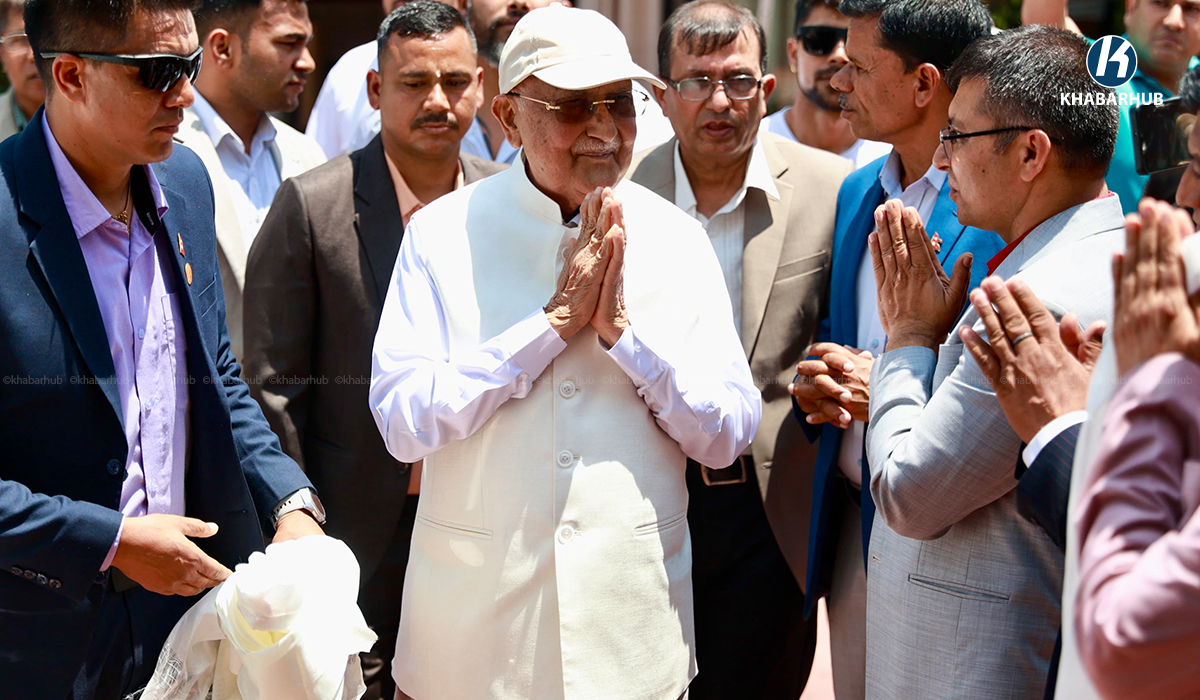
KATHMANDU: CPN-UML Chairman KP Sharma Oli, who has been facing growing calls for leadership change within the party after the March 5 elections, is now at the center of a new controversy over the future of Koshi Province Chief Minister Hikmat Kumar Karki.
Party insiders say Oli has shifted his focus toward removing Karki, once considered one of his closest allies and a leader from his home province. Former Koshi Chief Minister Sherdhan Rai has reportedly been mobilized to build support for Karki’s replacement.
According to sources, Rai has been meeting UML lawmakers in Biratnagar and urging them to back a leadership change. Oli is said to be considering Til Kumar Menyangbo, deputy leader of the UML parliamentary party, as Karki’s successor.
When asked whether Karki would be removed, Rai said party members should follow the central leadership’s instructions. “The leadership has concluded that opportunities should not remain with only one individual but should also be given to other colleagues,” Rai said. “It would have been better if the Chief Minister had respected the party’s directive and voluntarily paved the way.” Menyangbo has also said he would accept whatever decision the party leadership makes.
Divisions within UML
The proposed leadership change has exposed divisions inside the UML. Leaders advocating leadership change, generational transfer, and party transformation are believed to be rallying behind Karki, while many lawmakers from Koshi, Oli’s political stronghold, are reportedly supporting the move to replace him.
The UML currently has 39 members in the Koshi Provincial Assembly. The Nepali Communist Party (NCP), which has 17 members, has indicated that it will support whatever decision is taken by the party’s central leadership.
Supporters of Karki argue that there is no two-thirds majority within the UML in favor of removing him, although party insiders claim that a majority of UML provincial lawmakers now oppose his continuation.
Pressure to resign
The UML central leadership is reportedly intensifying pressure on Karki to step down. Rai has been collecting signatures from UML provincial assembly members in support of a new chief minister.
“The provincial assembly members themselves have taken the initiative to bring in a new Chief Minister,” Rai said. “It would be better if the current leader voluntarily paved the way.” Karki, however, has firmly rejected the pressure.
Constitutional dispute
Karki argues that because his government was formed under Article 168(5) of the Constitution, he cannot be removed merely through internal party pressure. He maintains that he became chief minister on the basis of the individual support of provincial assembly members rather than a formal party decision.
“If I am to be removed, there must be an official decision from the party’s central leadership,” Karki reportedly told Rai. “The chairman himself has not even called me and asked me to step down.”
Karki also argued that any attempt to remove him through the current process would be unconstitutional and that another political force could potentially claim the chief minister’s post if the situation escalates. Under Article 168(5), a provincial government can be formed when no party commands a clear majority, and lawmakers exercise their individual constitutional rights rather than acting under a party whip. Karki says he can only be removed if the lawmakers who supported him withdraw their confidence.
No-confidence motion faces hurdles
After Karki refused to resign, the Rai faction began preparing a no-confidence motion. Some lawmakers have reportedly signed in support of the proposal, including two ministers from Karki’s cabinet: Internal Affairs Minister Indramani Parajuli and Water Supply Minister Tilochan Pathak.
Leaders close to Karki argue that the Constitution prevents a no-confidence motion from being moved within two years of a vote of confidence. Karki secured such a vote, meaning two years will be completed only on Asoj 3, 2083. The Nepali Congress, which is part of the Congress-UML alliance in Koshi, has not withdrawn its support from Karki.
Efforts to win over lawmakers
Amid the standoff, there are reports that dissatisfied UML lawmakers are being approached with promises of ministerial positions. One UML lawmaker from Morang claimed he received a phone call from leaders close to Oli offering a ministerial berth in exchange for supporting Menyangbo.
“The chairman spoke to me over the phone and said the ministry would be managed, but for now we should support Til Kumar,” the lawmaker said. Rai is also said to have met nearly all UML lawmakers in Koshi to discuss changing the chief minister.
NCP urges quick settlement
NCP parliamentary party leader Indra Bahadur Angbo said his party would not interfere in the UML’s internal dispute but urged the UML to resolve the issue quickly. “We are not in favor of cooperating on issues such as a no-confidence motion,” Angbo said. “You should settle your internal differences and decide who will become the Chief Minister.” He added that Menyangbo could become chief minister only if Karki resigned.
Wider implications for UML leadership
The Koshi dispute is increasingly being viewed as part of a broader power struggle within the UML. Party insiders say Karki has gained the backing of several UML vice-chairpersons who believe any decision to replace him should be taken collectively by the party Secretariat rather than by the chairman alone.
Critics argue that Oli has a history of sidelining leaders who challenge him. They point to earlier disputes involving Bhim Rawal, Madhav Kumar Nepal, Ghanshyam Bhusal, and Bidya Bhandari.
The controversy has also become linked to the ongoing debate over leadership change, generational transfer, and party transformation within the UML. Central committee member Pradeep Gyawali has cautioned against prolonging the Koshi dispute.
“The Koshi issue should not be dragged out further,” Gyawali said. “The debate on reorganization, generational transfer, and transformation should be discussed through the party’s institutional mechanisms.”
Meanwhile, UML Secretary Mahesh Basnet has defended the central leadership, saying party leaders should accept whatever decision is taken by the party center.





Comment