




The violence that erupted in Sunsari and spread across the southern Terai is not just another security incident. It is the latest sign of a deeper institutional crisis that Nepal has repeatedly failed to confront. Every life lost, every citizen injured, and every community divided is first a failure of governance, and only then a failure of policing.
The deaths of Om Prakash Mehta, Jaya Prakash Mehta, and Ganesh Yadav are not isolated tragedies. They reveal a profound failure of governance. Every injured civilian, every wounded security officer, and every terrified family is paying the price for decisions made far above the streets where the violence broke out.
A democratic state is judged not by how forcefully it responds after violence begins, but by how effectively it prevents violence from happening in the first place.
The deaths in Sunsari and Siraha demand justice. They also demand honesty. Nepal cannot keep treating each crisis as an isolated event while refusing to fix the structural failures that keep producing the same outcomes.
Constitutional duty and accountability
The Constitution requires the State to protect public order while fully respecting fundamental rights. These are complementary obligations, not competing ones. Anyone who incites communal hatred or violence must face the law. Equally, any allegation that state actors used disproportionate or unlawful force must be examined through an independent, impartial, and transparent investigation. Public confidence cannot be restored by internal assurances alone.
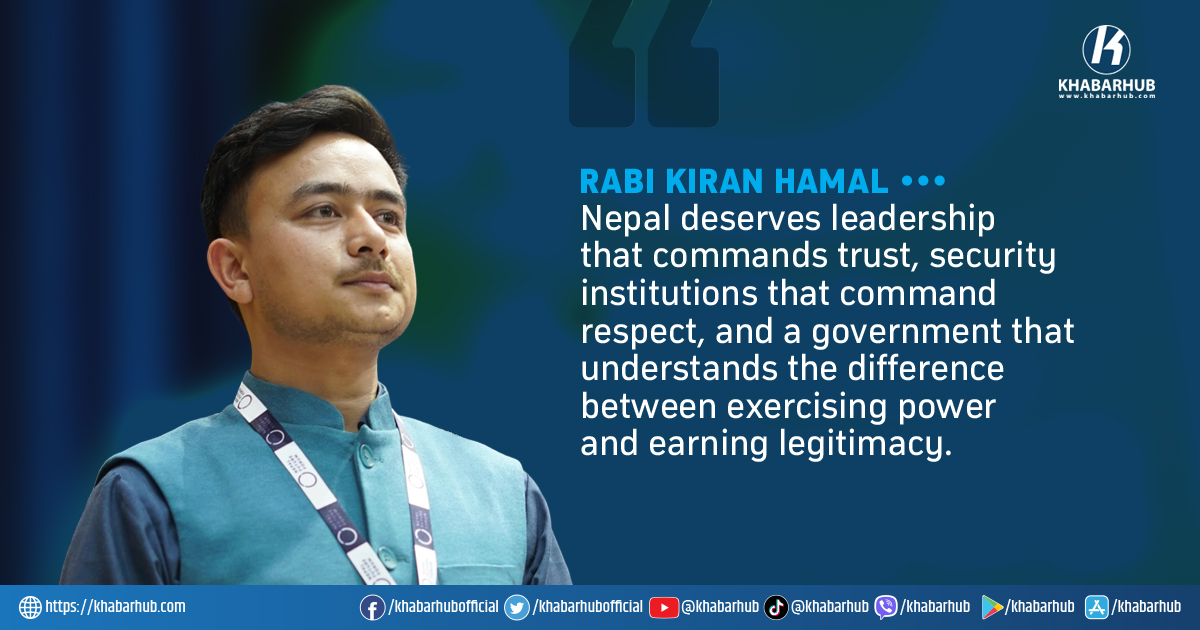
Nepal deserves leadership that commands trust, security institutions that command respect, and a government that understands the difference between exercising power and earning legitimacy.
Operational accountability, however, is only one part of the problem. The larger question is political leadership.
The Ministry of Home Affairs: A critical institution
The Ministry of Home Affairs is not an ordinary ministry. It is one of the most sensitive institutions of the State. It carries constitutional responsibility for internal security, policing, national intelligence, disaster management, and the protection of constitutional order. Leadership of this ministry demands the highest standards of integrity, impartiality, crisis-management capability, administrative competence, and, above all, the confidence of the public across all communities.
Regrettably, that public confidence has been profoundly undermined.
During the GenZ Movement, the National Human Rights Commission raised serious concerns about Sudhan Gurung’s handling of the protests and the role that allegedly contributed to the escalation of violence, heightened tensions, and the derailment of what began as a peaceful youth-led movement. It is deeply troubling that an individual whose conduct during that period has been the subject of such serious public scrutiny is now entrusted with leading Nepal’s most sensitive internal security institution.
Equally concerning is the government’s failure to ensure transparency regarding allegations raised publicly about the Home Minister’s alleged financial dealings and unexplained accumulation of assets, including reported links with the controversial intermediary Dipak Bhatta. Although an investigation committee was reportedly formed, its findings have never been made public.
Withholding such a report undermines the very principles of transparency and democratic accountability that the government claims to uphold. Entrusting the Ministry of Home Affairs to someone facing unresolved public questions of this magnitude is deeply unacceptable and further erodes public trust in the State.
What must happen now
For these reasons, an independent inquiry must examine not only the operational decisions taken during the Sunsari violence, but also the political decision-making, command responsibility, and institutional preparedness that preceded it.
Pending that inquiry, the Home Minister should step aside. This is not a presumption of guilt. It is a constitutional safeguard designed to protect the credibility of the investigation and reinforce the principle that no public office is immune from accountability.
The case for security sector reform
More fundamentally, Nepal must finally undertake comprehensive security sector reform.
The GenZ Movement exposed serious weaknesses in intelligence gathering, risk assessment, crowd management, operational discipline, command accountability, human rights compliance, and civilian oversight. Sunsari shows that those warnings were not adequately addressed.
Nepal needs a modern security architecture that prioritizes prevention over reaction, dialogue over confrontation, and de-escalation over force. Intelligence capabilities must be strengthened so that communal tensions are identified before they turn into violence. Human rights training should be mandatory throughout the chain of command. Independent oversight mechanisms must become stronger, and operational accountability must be swift, credible, and transparent.
Professional security institutions exist to protect citizens, not merely to restore order after governance has already failed.
A defining test for the Prime Minister
Prime Minister Balendra Shah now faces a defining constitutional responsibility.
This moment demands leadership that places institutions above personalities, accountability above political convenience, and national unity above partisan interests.
The Prime Minister should ensure that the Home and Defence ministries are entrusted to individuals whose competence, integrity, and public credibility are beyond question. Internal security is too important to be compromised by political expediency. These ministries safeguard the Constitution itself.
Force must always remain the last resort, never the first response.
The deployment of the Nepal Army underscores the gravity of the current crisis. In any democratic state, the military is the nation’s ultimate security institution. It should be mobilized only in exceptional circumstances, when constitutionally necessary, and only after civilian mechanisms have been exhausted.
Rushing to deploy the Army in response to every internal crisis risks exposing weaknesses in political leadership and civilian security institutions. More importantly, it raises a fundamental question: if the state’s final line of defence is deployed and still fails to restore stability, what option remains?
Military mobilization can never substitute for competent political leadership. Lasting peace depends on effective governance, professional civilian security institutions, timely conflict prevention, and unwavering respect for constitutional principles.
The path toward permanent peace
The path toward permanent peace requires immediate, decisive action:
Launch multi-stakeholder dialogue: Establish an immediate conflict-resolution mechanism bringing together religious leaders, civil society, local representatives, youth organizations, and security institutions to rebuild shattered community trust.
Deliver immediate relief: Provide victims and their families with rapid financial compensation, comprehensive medical care, and robust rehabilitation support.
Guarantee equal protection: Ensure equal legal and physical protection to all places of worship; temples, mosques, madrasas, monasteries, and churches alike, without bias.
Prosecute instigators: Identify and legally prosecute, without fear or favor, those responsible for inciting communal violence, spreading disinformation, or fueling religious hatred.
Enforce state accountability: Subject every allegation of excessive force or human rights violations by state authorities to an independent, credible, and public investigation.
Combat digital disinformation: Collaborate with social media platforms, civil society, and state institutions to counter dangerous misinformation while strictly respecting constitutional guarantees of free expression.
Phased de-escalation of restrictions: Continuously review curfews and extraordinary security measures, gradually lifting them as local conditions safely permit to restore normal civic life.
Final warning
Nepal cannot afford another cycle of violence followed by promises of reform that never materialize.
The lesson from the GenZ Movement was ignored. The lesson from Sunsari must not be.
This should be the final warning to Nepal’s political leadership.
Institutional failures that repeatedly cost human lives are unacceptable in a democratic republic. Every preventable tragedy weakens public trust, damages constitutional governance, and endangers national unity.
Nepal’s future depends not on stronger rhetoric, but on stronger institutions.
Nepal deserves leadership that commands trust, security institutions that command respect, and a government that understands the difference between exercising power and earning legitimacy.
Justice, not fear, must define the Nepali State.






Comment