




The significance of President Donald Trump’s May 12–15 visit to China—the first of his second presidency and his first visit since his state trip of November 2017—extends far beyond the immediate outcomes of bilateral diplomacy.
While public attention focused on trade frictions, Taiwan, technological competition, and security disputes, the summit’s real importance lies in what it revealed about the changing structure of global power.
More than a bilateral engagement, the Trump–Xi meeting offered a glimpse into an emerging international order increasingly shaped by strategic rivalry, technological competition, transactional diplomacy, and the gradual diffusion of power away from any single dominant actor.
During their meetings at the Great Hall of the People, President Trump and President Xi Jinping discussed a broad range of issues affecting the future of international stability. Although the two sides agreed to pursue a framework for “constructive strategic stability,” the summit produced few binding commitments, underscoring the difficulty of managing competition between the world’s two most influential powers.
The conflict involving Iran and its impact on the Strait of Hormuz elevated maritime security and energy supply chains to the forefront of discussions, with China reportedly exploring increased purchases of American energy exports. Taiwan remained the most sensitive issue, reflecting its growing role as a test of strategic credibility and regional deterrence.
In many respects, the future international order may depend not only on how the U.S. and China manage their rivalry, but also on whether Middle Powers like India chooses deeper alignment, selective balancing, or autonomous leadership.
The state banquet, ceremonial events, and visit to the Temple of Heaven provided diplomatic symbolism, but the summit’s lasting significance was strategic rather than ceremonial: it demonstrated that the future international system will be defined not by cooperation alone, nor by outright confrontation, but by the complex management of enduring great-power competition.
What is unfolding is not simply another chapter in U.S.–China relations. It is the acceleration of a broader transformation from the rules-based unipolar order that emerged after the Cold War toward a more fragmented, contested, and negotiated multipolar world.
The first strategic message is that the world is entering an era of managed competitive coexistence or rivalry rather than full decoupling. Despite rising tensions, neither Washington nor Beijing appears willing to embrace direct confrontation.
Economic interdependence remains too deep, integrated and interconnected supply chains, technological ecosystems too intertwined financial exposure, and shared vulnerabilities make complete separation neither practical nor desirable.
Competition will continue across artificial intelligence, semiconductors, cyber capabilities, critical minerals, and advanced manufacturing, but both sides understand that outright economic separation would impose unacceptable costs.
The emerging doctrine appears straightforward: compete aggressively in technology and strategic influence, reduce vulnerabilities in critical sectors, avoid military escalation, and preserve economic interaction where mutual benefits remain significant. This approach reflects a recognition that the costs of outright confrontation would be catastrophic for both sides and for the global economy.
The implications extend far beyond Washington and Beijing in a new form of competitive coexistence. Across Asia, Europe, and the Middle East, states are increasingly rejecting binary choices and adapting to an era of competitive coexistence.
India continues to pursue strategic autonomy; Japan combines security alignment with economic engagement; South Korea carefully balances alliance commitments with economic pragmatism; and the members of Association of Southeast Asian Nations (ASEAN) increasingly hedge among competing powers.
Meanwhile, Gulf states are deepening ties with both the U.S. and China, while Europe speaks increasingly of “de-risking” rather than “decoupling.” These trends suggest that the emerging international system will not resemble the rigid bipolarity of the Cold War.
Instead, it is evolving toward a form of networked multipolarity, characterized by overlapping partnerships, selective alignments, and flexible coalitions driven by national interests rather than ideological loyalty.
The resulting international order is likely to resemble a networked multipolarity rather than the rigid bipolarity of the Cold War.
Within this emerging system, Taiwan has become a test of strategic credibility, alliance reliability, semiconductor dominance, and regional deterrence far more than a territorial dispute.
For Beijing, Taiwan remains a core sovereignty issue.
For Washington and its allies, however, Taiwan increasingly symbolizes the reliability of alliance commitments, the security of semiconductor supply chains, maritime access in the Indo-Pacific, and the broader resilience of democratic societies under authoritarian pressure.
As a result, even subtle changes in diplomatic language have become strategically significant now carrying geopolitical consequences. A minor rhetorical adjustment by Washington regarding Taiwan could reverberate across capitals from Tokyo and Seoul to Manila and Canberra to Brussels and Riyadh. Strategic signaling now carries consequences once associated only with military deployments.
The broader lesson is clear: in the twenty-first century, strategic ambiguity has become a geopolitical instrument. Allies assess American credibility not simply by military capabilities but by consistency of commitment and clarity of signaling through its handling of Taiwan, while competitors seek opportunities to exploit uncertainty.
Taiwan is therefore not merely an East Asian issue; it has therefore evolved into a global test of deterrence, alliance reliability, and systemic stability in the wider international order.
Among the most consequential developments emerging from the summit is the reality that is increasingly shaping the international order: the rise of India as a pivotal swing power. Increasingly, the future balance of power in Asia may depend as much on New Delhi’s choices as on decisions made in Washington or Beijing.
India’s significance now is no longer merely a regional actor and extends far beyond South Asia. It has become central to Indo-Pacific stability, supply-chain diversification, technological resilience, digital governance, and the political aspirations of the Global South. Its growing economic weight, demographic advantage, technological capacity, and geopolitical location make it indispensable to any long-term vision of regional stability. Yet India’s approach remains rooted in strategic autonomy rather than alliance dependency. New Delhi’s values partnership with the Washington driven by converging interests rather than ideological alignment.
If New Delhi concludes that Washington’s commitment to balancing China is becoming inconsistent, that Pakistan is regaining strategic leverage in Washington, or that alliances are increasingly subject to transactional bargaining, it is likely to double down on its independent foreign policy tradition.
Such a shift would extend well beyond India’s foreign policy. It could accelerate Brazil-Russia-India-China-South Africa Plus (BRICS-Plus) expansion, strengthen Russia-India-China (RIC) cooperation, deepen Eurasian connectivity, and gradually diversify global economic and financial governance away from exclusive Western dominance.
The broader consequence would be the emergence of a more pluralistic and decentralized international order. Ultimately, the future global balance may depend not only on how Washington and Beijing manage their rivalry, but also on how India exercises its growing strategic weight—whether through alignment, balancing, or autonomous leadership.
In many respects, the defining geopolitical question of the coming decade may be not simply the rise of China, but the choices India makes as a civilizational power in an increasingly multipolar world.
For India itself, the challenge is to transform its growing capabilities into lasting influence. To emerge as a reliable global partner, India must combine economic growth with strategic predictability. Regional trust will be as important as military strength.
The world is entering an era in which technological innovation is advancing far more rapidly than diplomatic institutions can adapt.
New Delhi’s long-term influence will depend on its ability to provide connectivity, development, technological cooperation, and strategic reassurance to its neighbors while maintaining its role as a bridge between the West, the Global South, and emerging Eurasian institutions.
In many respects, the future international order may depend not only on how the U.S. and China manage their rivalry, but also on whether Middle Powers like India chooses deeper alignment, selective balancing, or autonomous leadership.
Another striking feature of the summit discussions was the extent to which technology has replaced geography as the principal arena of great-power competition. During much of the twentieth century, geopolitical power was largely determined by territorial control, military positioning, and access to strategic waterways. Today, power increasingly depends on technological ecosystems.
Artificial intelligence, quantum computing, semiconductors, digital infrastructure, cyber resilience, critical minerals, telecommunications infrastructure and data governance have become the defining new foundations of power and influence. Cyber espionage, infrastructure penetration, and AI-enabled competition illustrate how future conflicts may occur below the threshold of conventional warfare.
The competition is no longer simply about controlling territory; it is about controlling telecommunications networks, which are becoming strategic assets, private technology companies are emerging as geopolitical actors that shape modern societies, and civilian infrastructure is increasingly viewed through a national security lens.
The distinction between peace and conflict is gradually eroding, giving rise to a condition that might best be described as persistent gray-zone competition.
Equally concerning is the quiet erosion of the global arms-control architecture-global arms-control architecture that helped stabilize the Cold War era is steadily weakening. Traditional treaties are under strain, strategic predictability is declining, and emerging technologies are introducing entirely new forms of risk.
In this environment, alliances may become more conditional, middle powers more influential, technology more geopolitical, and strategic ambiguity more consequential.
The deterioration of U.S.–Russia arms control, China’s reluctance to enter formal numerical limitations, North Korea’s pursuit of recognition as a nuclear state, and the absence of meaningful governance frameworks for cyber and space domains all point toward an increasingly unstable strategic environment. Artificial intelligence and autonomous military systems further complicate deterrence by compressing decision-making timelines and increasing the risk of miscalculation. Meanwhile, cyber, space, and artificial intelligence remain only partially governed by international norms.
The world is entering an era in which technological innovation is advancing far more rapidly than diplomatic institutions can adapt.
This creates new risks of miscalculation, accidental escalation, autonomous weapons instability, and regional nuclear competition. The greatest strategic danger may not be deliberate aggression but unmanaged instability arising from increasingly complex interactions between emerging technologies and outdated governance frameworks.
The greatest danger may not be deliberate war but unmanaged instability.
Amid these uncertainties, one of the most significant trends is the growing role of middle powers as stabilizers of the international system.
Countries such as Australia, Brazil, India, Indonesia, Japan, Saudi Arabia, South Korea, Turkey, and Vietnam are no longer passive observers of great-power competition. They are actively shaping supply chains, influencing technology standards, securing maritime routes, and mediating diplomatic tensions.
The future international order may depend less on superpowers imposing stability and more on middle powers preventing instability. This represents one of the most significant structural changes in global politics since the end of the Cold War.
Perhaps the most profound transformation, however, is psychological. The post-Cold War era was built on assumptions of predictable alliances, expanding globalization, multilateral institutions, liberal economic integration, and relatively stable international norms. The emerging system appears increasingly transactional, leader-centric, economically coercive, and strategically flexible. Those assumptions are increasingly under strain.
The central concern among many allies is no longer China’s rise alone. It is uncertainty regarding predictability itself.
Questions once considered settled are being asked again. Are alliances permanent or conditional? Are strategic commitments enduring or negotiable? Can international institutions still constrain major powers? Is global leadership increasingly dependent upon personal relationships between leaders rather than institutional frameworks?
The Trump–Xi summit may therefore be remembered not as a diplomatic event in isolation or not whether the U.S. or China will dominate the international system, but as a window into the emerging geopolitical landscape of the twenty-first century—one where the rules are still being written and where adaptation may become the most valuable strategic asset of all.
The emerging order is more transactional, leader-centric, economically coercive, and strategically flexible. Allies increasingly question the permanence of commitments. Partners wonder whether relationships are becoming conditional. Institutions appear less capable of constraining major powers than in previous decades.
The resulting uncertainty is itself becoming a source of instability.
Such uncertainty creates instability even in the absence of direct conflict.
Viewed through this wider lens, the Trump–Xi summit was less about specific agreements than about signaling the contours of the next international era. The world is moving away from a relatively stable, though unequal, unipolar order toward a fluid multipolar system in which technological dominance, strategic autonomy, and transactional diplomacy increasingly define power.
In this environment, alliances may become more conditional, middle powers more influential, technology more geopolitical, and strategic ambiguity more consequential.
The greatest challenge facing the international community is not necessarily the prospect of war between major powers, but the absence of trusted mechanisms capable of managing competition before crises spiral beyond control. Strategic ambiguity will remain a powerful instrument of statecraft, while the absence of trusted mechanisms for managing rivalry may become the greatest source of global risk.
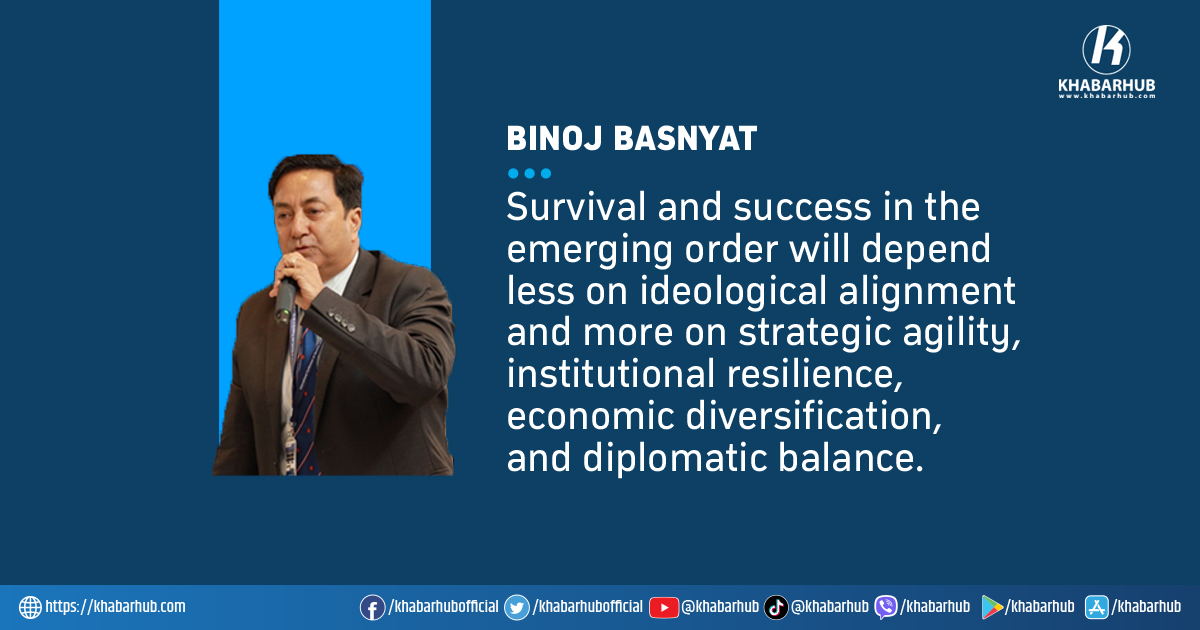
For South Asia and smaller states such as Nepal, the implications are equally significant. Survival and success in the emerging order will depend less on ideological alignment and more on strategic agility, institutional resilience, economic diversification, and diplomatic balance. The challenge will be to engage multiple centers of power without becoming dependent on any one of them.
The coming decades are unlikely to reward rigid alignment with any single power center. Instead, success will depend on strategic agility, resilient institutions, diversified partnerships, economic competitiveness, and the ability to navigate a world where influence is increasingly dispersed and power is increasingly contested.
The Trump–Xi summit may therefore be remembered not as a diplomatic event in isolation or not whether the U.S. or China will dominate the international system, but as a window into the emerging geopolitical landscape of the twenty-first century—one where the rules are still being written and where adaptation may become the most valuable strategic asset of all.
(Basnyat is a Maj. Gen. (Retd.) of the Nepali Army and a strategic affairs analyst. He is also a researcher affiliated with Rangsit University in Thailand)





Comment