




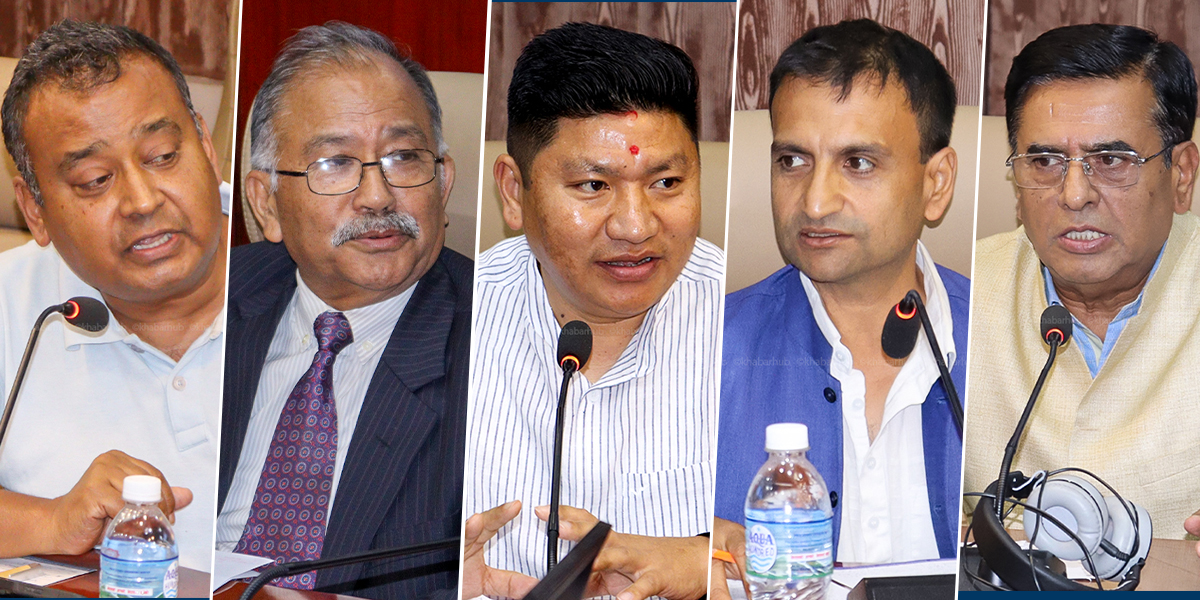
KATHMANDU: The government’s budget for fiscal year 2083/84 has received a mixed response, with representatives from most sectors expressing dissatisfaction while only a handful voiced optimism about its potential impact.
The views emerged during a budget discussion organized by the Institute for Strategic and Socio-Economic Research (ISSR) in Kathmandu on Wednesday, where stakeholders from various sectors assessed the strengths and shortcomings of the government’s fiscal plan.
Concerns over economic direction
Former Chief Justice Kalyan Shrestha said Nepal’s economy continues to suffer from low productivity and stressed that the government faces the challenge of revitalizing a struggling economy.
He questioned whether the budget’s policies genuinely support the expansion of electric vehicles or continue to favor petroleum-based transportation. He also criticized the imposition of additional service charges on private schools while public education, which the Constitution assigns as a state responsibility, remains underdeveloped.
“Problems persist in education, health and employment. The impact of this budget should become visible by Mangsir,” he said.
Real estate, healthcare and banking sectors dissatisfied
Real estate entrepreneur Deepak Kunwar said the government has neglected the property sector for years. He argued that restrictions imposed since 2019 continue to hinder property transactions and ownership transfers, while the current budget has failed to address those concerns.
Kunwar also questioned the practicality of the budget provision allowing foreign investors to lease up to 25 percent of apartment units in Nepal.
Private healthcare investor Shailesh Basnet said the budget undervalues the contribution of the private health sector. He expressed concern over the reintroduction of taxes on health services and argued that the government should have adopted a stronger public-private partnership model in healthcare.
Basnet further warned that Nepal continues to lose experienced doctors and nurses to foreign markets and urged the government to rethink its approach toward private healthcare providers.
Rajesh Upadhyay, vice-president of the Confederation of Banks and Financial Institutions Nepal (CBFIN), said although the federation welcomed the budget overall, several key banking-sector concerns remained unaddressed.
He noted that the budget does not tackle issues related to non-performing loans or provide a clear strategy for channeling excess liquidity accumulated in the banking system into productive sectors. He also argued that agriculture had not received sufficient priority.
Former vice-president of the Federation of Nepalese Chambers of Commerce and Industry, Dinesh Shrestha, said efforts to reduce the informal economy would require broader tax reforms rather than relying solely on measures such as maximum retail price enforcement and tax lottery systems.
Public transport and taxation concerns
Bhushan Tuladhar, technical advisor to Sajha Yatayat, said the government should focus on improving transport systems and infrastructure rather than increasing taxes on larger vehicles.
He argued that VAT provisions affecting public transport vehicles and electricity-related costs would increase operating expenses and slow the transition toward sustainable transportation.
Nepali Congress leader Sandeep Rana questioned whether the budget’s revenue and expenditure projections were realistic. He also criticized programs targeting farmers capable of investing Rs 20 million despite a significant portion of the population still living below the poverty line.
“Some groups may have benefited, but the question is whether the budget addresses the needs of the majority,” he said. “This is not a budget that reaches the poor.”
Some business representatives also criticized government schemes aimed at settling unpaid taxes, arguing that such measures could encourage future tax evasion.
Hydropower sector welcomes budget measures
While many sectors expressed concerns, Nepal’s private hydropower industry responded positively.
Ganesh Karki, president of the Independent Power Producers’ Association Nepal, welcomed provisions allowing immediate power purchase agreements (PPAs) for projects up to 10 MW and the adoption of take-or-pay arrangements.
He also praised efforts to address forest-related issues, environmental impact assessment procedures and other regulatory bottlenecks, while emphasizing the need for effective implementation.
Representatives from the construction sector similarly expressed cautious optimism, noting that the budget prioritizes bridge construction and continues several existing development projects. They said the government’s commitment to resolving long-standing implementation challenges offered some hope despite the absence of a major increase in capital expenditure.
Government defended budget priorities
At the event, Ashish Gajurel, chair of Parliament’s Infrastructure Development Committee, defended the budget, saying the government had focused on strengthening public finances and addressing structural issues in the construction sector.
He said the government was preparing a sunset law to resolve problems facing contractors and stressed that policy reforms would be essential to increase capital expenditure and improve the transport sector.
Economist Dr. Sudan Oli presented an analysis of the budget’s statistical framework and the current state of the economy, while ISSR Chair Shanker Das Bairagi, and Director Naresh Shrestha also shared their perspectives on the country’s economic outlook and fiscal priorities.




Comment