




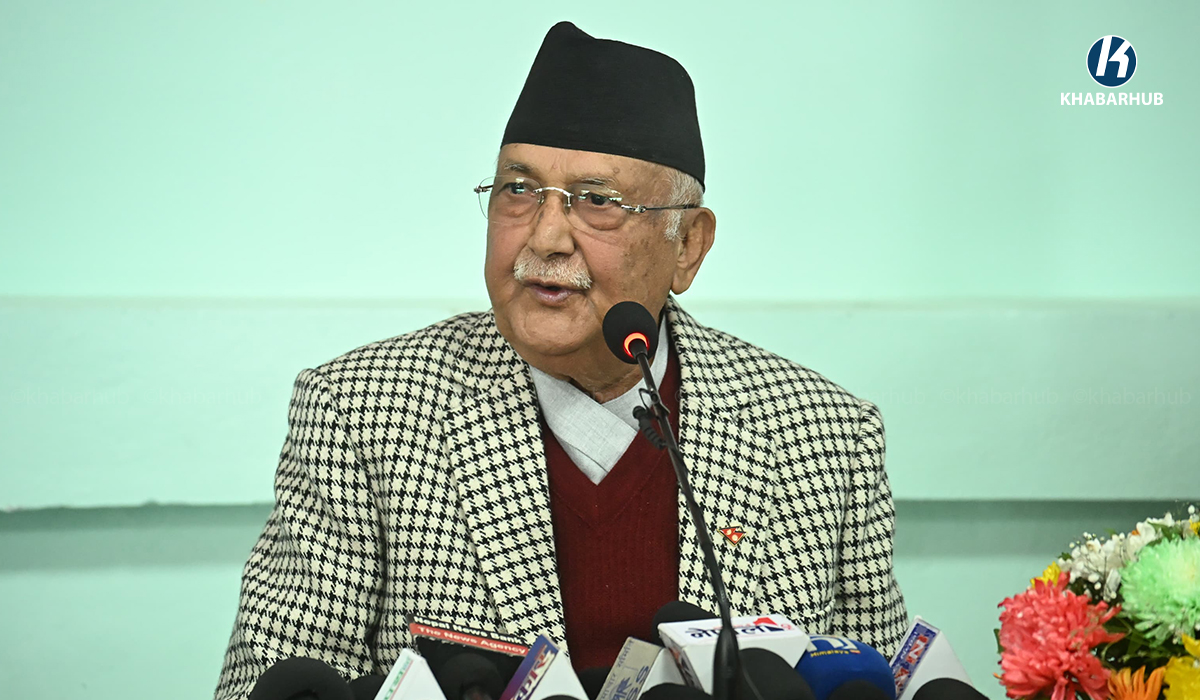
KATHMANDU: CPN-UML Chairman KP Sharma Oli is contesting elections for the eighth time from Jhapa Constituency-5. Having represented the constituency since 2048 BS, Oli now faces what many observers see as his toughest challenge yet, with Rastriya Swatantra Party (RSP) senior leader Balendra (Balen) Shah emerging as a strong contender with significant youth backing.
Following the Gen-Z movement of September 8 and 9, 2025, Oli has increasingly faced criticism, insults, and public backlash. As a result, Jhapa-5, once considered his safest seat, no longer appears secure.
Although Oli has a long record of electoral success and is often described as strong in political calculation, analysts say he appears out of sync with changing times. Compared to previous elections, he seems less aggressive and less vocal, with visible strain reflected in his demeanor.
Much of the criticism from younger voters stems from allegations that Oli played a role in suppressing the Gen-G movement during his tenure as prime minister. Political observers argue that despite the UML’s strong organizational structure and ideological base, the party could suffer losses due to Oli’s centralized decision-making style and perceived inability to adapt to the expectations, pace, and political language of the younger generation.
Former Kathmandu mayor Balen is currently active in Jhapa with the stated aim of defeating Oli in the March 5 election and ending his political career. While Shah continues to campaign nationwide, Oli has largely remained silent.
As part of his electoral strategy, Oli has appointed Devendra Dahal as election commander in Jhapa-5, assigning him the task of mobilizing one party cadre per household. Oli has repeatedly expressed confidence that he will not be defeated, citing what he calls his strength in political “mathematics,” and has claimed that UML will emerge as the largest party and that he will once again become prime minister. However, critics argue that time itself may now be working against him.
Raising doubts over the election
After the election date was set for March 5, Oli traveled to Jhapa via Chandragadhi Airport to file his candidacy. While there, he told journalists that doubts remained over whether the government would actually hold the election, remarks that many interpreted as an attempt to create mistrust around the electoral process.
Since then, Oli has repeatedly questioned the likelihood of the election taking place. During a UML-organized discussion with experts on the party’s manifesto for the House of Representatives election, he again expressed skepticism. Oli and other UML leaders have consistently accused the government of failing to create a free, fair, and impartial election environment.
At a program organized by the Okhaldhunga–Kathmandu Liaison Forum on Saturday, Oli accused the government of preparing to rig the election by making administrative changes just before polling day. He alleged that Prime Minister Sushila Karki was attempting to favor a particular party.
“If the government believes it can ensure victory for certain parties, then such an election and its results are unacceptable,” Oli said. “What is the purpose of removing officials prematurely and appointing others? Whose interests are being served? Elections must be conducted freely, fairly, fearlessly, and in a peaceful environment.”
Political analysts and leftist leaders who have worked closely with Oli say his repeated doubts indicate an attempt to avoid electoral confrontation. Analyst Shyam Shrestha said Oli’s continued skepticism about the election suggests he may be seeking to derail the process amid declining public support. “At a time when UML is facing nationwide pressure, Oli appears to be trying to create uncertainty around the election to protect himself,” Shrestha said.
Limited presence in districts
With less than a month remaining before the election, Oli returned to Kathmandu after spending only a few days in Jhapa for his nomination. UML Jhapa District Chairman Prem Giri said Oli is scheduled to return to the district soon.
Oli’s secretariat has stated that his district-level campaigning will be limited this election due to age and health concerns. “The chairman does not need to visit every district to ensure UML’s victory,” the secretariat said. “Despite external attacks, the party remains strong internally.”
UML Vice-Chairman Prithvi Subba Gurung echoed this view, saying Oli would resume district-level engagements in the coming days. “The election atmosphere has not fully developed yet,” Gurung said. “There is limited time for campaigning due to the code of conduct, and the party is currently focused on finalizing its manifesto. That is why senior leaders have not yet been mobilized extensively in the districts.”
Youth vote emerges as key challenge
UML voters in Jhapa Constituency No. 5 are currently divided over their voting choice. According to UML Jhapa District Chairman Prem Giri, the party must work closely at the grassroots level to clear voter confusion.
“I understand that there is confusion among voters about whom to support, but our organizational strength has not weakened,” Giri said. “When newlyweds arrive home, people naturally gather to see them. In a similar way, there is currently a crowd forming around the new candidate in Jhapa-5. However, our organization remains intact, though some voters are indeed confused.”
Local voter Suraj Rajbanshi said support for Oli is now largely confined to the older generation, while younger voters are openly leaning toward Balen. According to Rajbanshi, the UML is preparing to deploy one party cadre per household to counter this trend.
Social media pressure
Oli’s election commander, Devendra Dahal, said winning the election would not be difficult, citing the formation of election mobilization committees at all levels.
“We have an election mobilization committee at the central level, and similar committees at the local, ward, and neighborhood levels to reach households directly,” Dahal said. “There has been widespread propaganda on social media platforms such as Facebook and TikTok claiming certain candidates have already won. We plan to counter this by deploying one cadre per house.”
Dahal said door-to-door campaigning has already completed its first phase and that election activities will intensify after the 4th. He added that internal surveys conducted across all four local units of Jhapa-5 did not indicate a decline in UML support.
“Since our candidate cannot personally visit every household, cadres will take on that responsibility,” he said. “If Oli’s health permits, he will also campaign ward by ward.”
Addressing criticism related to the Gen-Z movement, Dahal acknowledged that confusion has particularly affected younger voters but insisted it would not impact the final outcome. “Clearing that confusion is challenging, but winning the election is not,” he said. “We believe the Gen-Z will gradually understand, and Oli’s victory will not be determined by them alone.”
Fragmented vote field
In Jhapa-5, the Shram Sanskriti Party candidate is expected to attract some votes in Kamal Rural Municipality and Damak Municipality. Meanwhile, RSP senior leader Balen is likely to receive support across all areas, while indigenous and left-leaning voters are expected to favor NCP candidate Ranjit Tamang. Observers believe the main contest will be between Oli and Balen.
UML sources say Oli has explored possible coordination with the Nepali Communist Party and the Shram Sanskriti Party, and is also open to working with the Rastriya Prajatantra Party (RPP). However, none of these parties have expressed willingness to form an alliance.
RPP Chairman Rajendra Lingden has ruled out coordination with UML in this election. Election commander Dahal also confirmed that there is currently no prospect of an electoral alliance with any party.



Comment