




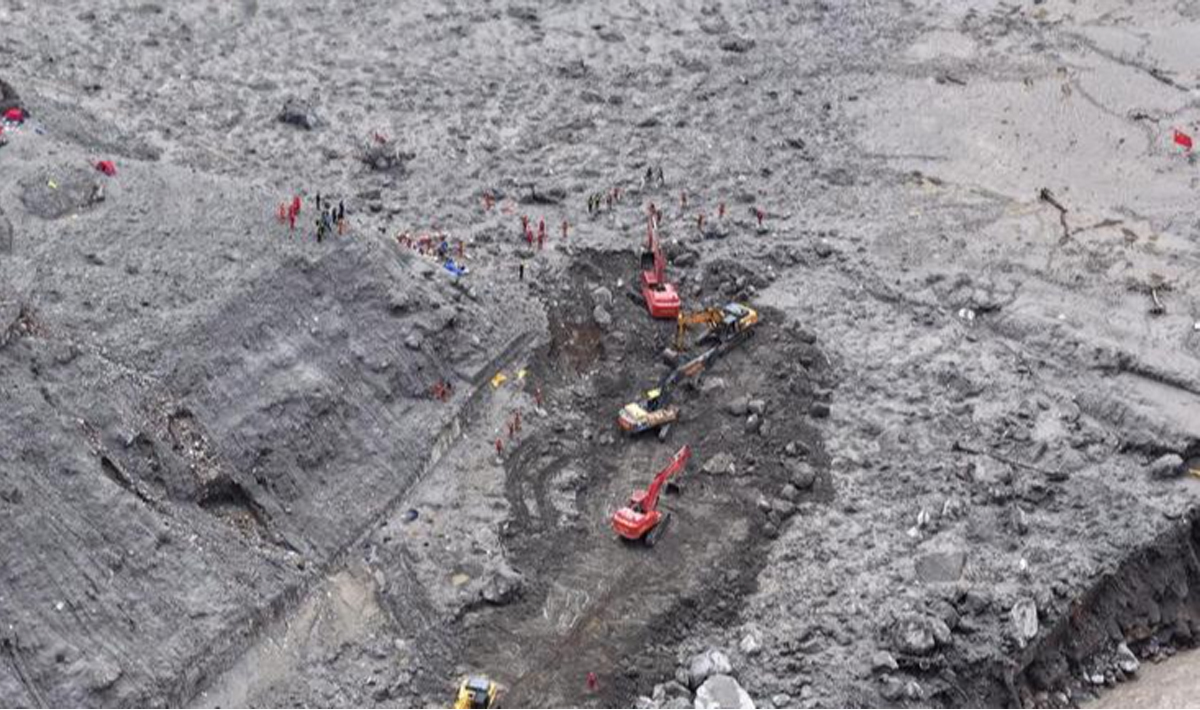
CHINA: China has reopened a major highway in the southwestern Xizang Autonomous Region within a week after it was damaged by a landslide last Wednesday, allowing rescue operations in the disaster-hit area to accelerate.
With the highway now operational amid round-the-clock rescue efforts, large vehicles and heavy equipment have reached the main affected areas via National Highway G-216, according to China Media Group (CMG) reporters stationed at the Kerung port.
The improved road access is expected to facilitate more extensive and intensive search and rescue operations for people who remain missing.
A massive flow of mud and rocks triggered by a landslide and rockslide on August 26 reached the Kerung port. Chinese authorities said that, as of 6 pm on Saturday, 16 people had died and 546 remained missing.
‘We will not leave anyone behind’
Rescue personnel have been deployed by helicopter to the worst-affected areas of Kerung port. Despite difficult conditions, rescue teams, including officers from the Xizang border police, have continued search operations.
Ye Yi, a police officer with the Shigatse Border Control Detachment under the Xizang General Border Inspection Station, said rescue efforts would be intensified.
“We will not give up, leave anyone behind, and will do everything within our capacity to find everyone who remains missing,” he said.
The search has been complicated by difficult terrain, adverse weather and the scale of the disaster. Experts said the steep terrain, rapid movement of the landslide and narrow valleys contributed to the severity of the disaster.
Thick mud covering the affected areas has also made it difficult for rescue teams to move around. Rescuers said the mud has reached knee height in some places and waist height in others, reducing the effectiveness of some conventional search and detection equipment.
Rescue teams have been using multiple methods, including manual searches, knocking and making sounds and listening for possible responses.
Two search dogs have been deployed in designated areas, while life-detection equipment and other advanced technologies are being used to locate people who may be trapped beneath debris.
According to rescuers, surface searches have been conducted across the port area in recent days, with repeated searches of the upper layers.
Communication services restored
Telecommunications companies in Xizang had restored one base station and installed 12 additional emergency stations in the disaster-hit areas by 5 pm Tuesday.
The restored communication network is expected to provide uninterrupted services for rescue command operations, search activities and the management of relief supplies.
Local telecommunications authorities have also established an integrated air-and-ground communication support system, including communication relay drones such as Wing Loong.
Health and psychosocial support for displaced people
CMG reported that temporary shelters set up for displaced residents have adequate supplies. Health workers have been deployed at the municipal, county and township levels to provide regular health checkups and psychosocial counselling.
More than 150 villagers are staying at three temporary shelters established in Jifu Village of Kerung County.
Medical teams under the Xizang Military Command of the Chinese People’s Liberation Army are continuing to provide medicines, treatment and psychosocial support to displaced residents.
Meanwhile, epidemic prevention and sanitation teams are carrying out extensive cleaning and disinfection in residential areas, public walkways and other key locations.
China sends second batch of relief, including DNA experts, to Nepal
China sent a second batch of emergency relief supplies and a team of DNA experts to Nepal on Tuesday. The first batch of relief supplies arrived in Nepal on Sunday.
The latest assistance, sent in response to Nepal’s immediate needs, includes drones, DNA testing equipment and reagents, water purification equipment and lighting equipment.
Five DNA identification experts from China’s third team of specialists also arrived in Nepal on the same flight. They proceeded to the disaster-affected areas to assist with field operations soon after their arrival.
According to Nepali officials, the death toll from the devastating floods and landslides had reached 1,068 by Tuesday, while 4,606 people remained missing.
Chinese Foreign Ministry spokesperson Guo Jiakun said Tuesday that China has continued coordinating closely with Nepal following the disaster. He said the two countries were cooperating and exchanging information in areas including meteorology, water resources, and disaster prevention and mitigation.
“As traditional friends and neighbours, China will stand firmly with Nepal and work together to overcome the difficulties,” Guo said.
He added that China was making every possible effort to search for and rescue Chinese and foreign nationals who remain missing. China’s Foreign Ministry is also coordinating closely with embassies of the countries concerned to facilitate the identification of foreign nationals and necessary procedures.






Comment