




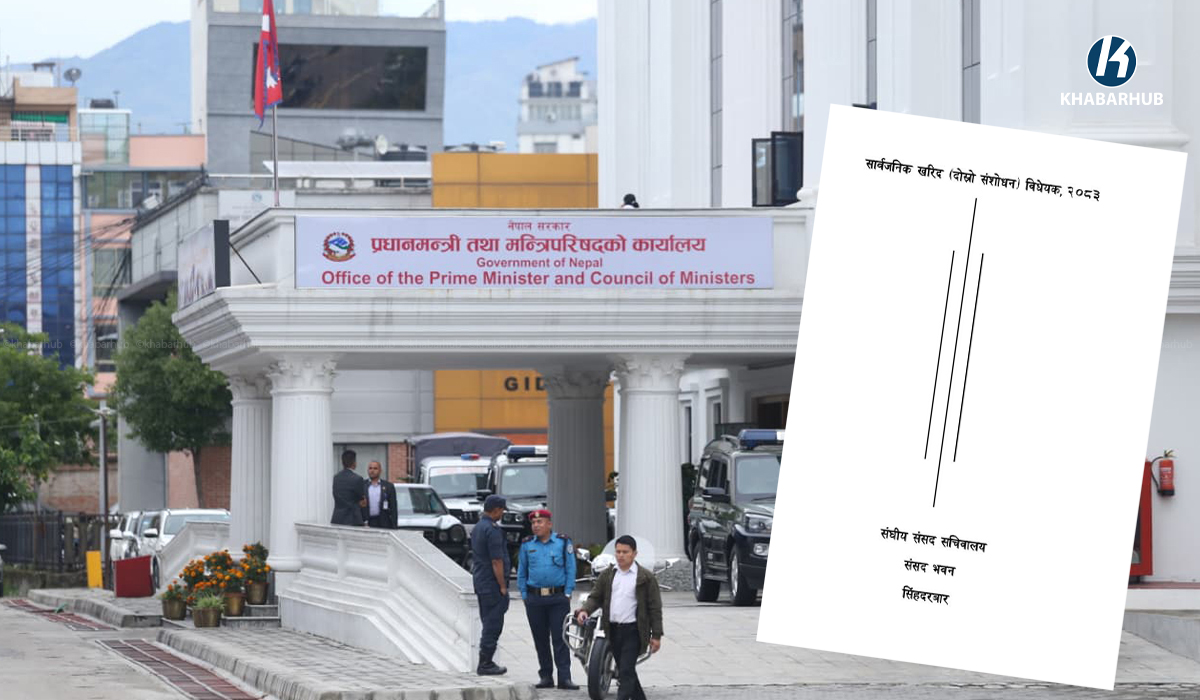
KATHMANDU: The government has introduced the Public Procurement (Second Amendment) Bill, 2026, in the Federal Parliament, proposing sweeping reforms aimed at making Nepal’s public procurement system more transparent, competitive, and results-oriented.
The bill, proposed by Prime Minister Balen Shah and tabled in the House of Representatives by Law Minister Sobita Gautam on June 28, seeks to address long-standing weaknesses in the existing Public Procurement Act, 2007, which the government says have hindered infrastructure development and project implementation.
Among the key reforms proposed in the bill are:
Shift from lowest bid to average bid evaluation
One of the most significant changes is the replacement of the long-standing practice of awarding contracts to the lowest bidder.
Under the proposed amendment, bids will instead be evaluated using an average bid price method, with the contract awarded to the bidder whose quotation is closest to the average of all qualified bids.
The bill also proposes automatically disqualifying bids that are more than 30 percent below the government’s cost estimate, a measure intended to discourage unrealistically low bids that often result in abandoned or poor-quality projects.
Mandatory project readiness before tendering
The bill makes project preparedness a legal prerequisite before any tender can be invited.
Public agencies will now be required to ensure budget availability, site clearance, land acquisition, compensation payments, tree clearance, and environmental approvals before initiating the procurement process.
The government says the provision aims to reduce delays caused by unresolved land disputes and incomplete project preparation.
Reverse auction and e-marketplace
The proposed legislation introduces two technology-based procurement mechanisms.
A reverse auction system would allow eligible procurements to be conducted online, with suppliers competing by lowering their prices within a specified ceiling.
The bill also proposes establishing a government e-marketplace, enabling public agencies to directly purchase registered goods and services without going through lengthy tender procedures for smaller procurements.
Greater preference for domestic products
The bill redefines what qualifies as a domestic product.
Only products with at least 30 percent domestic value addition would be eligible for preferential treatment in public procurement.
Products merely imported and rebranded in Nepal would no longer qualify for such preferences.
Shorter bidding deadlines
To accelerate infrastructure development, the bill proposes reducing procurement timelines.
The current minimum bidding periods of 30 days for national tenders and 45 days for international tenders would be shortened to 21–30 days for both.
Similarly, the period for re-tendering would be reduced from 15–21 days to 7–15 days.
Stronger accountability
The proposed amendment introduces stricter penalties for contractors who misuse advance payments, abandon projects, or intentionally cause losses to the state.
Such cases could now be prosecuted under criminal laws relating to fraud or forgery.
The bill also holds public officials accountable for delays in payments, extensions, or site handovers, allowing for departmental action and even suspension of government grants to non-compliant agencies.
Worker protection
Contractors would be required to enroll all employees in the Social Security Fund, while wages and other benefits would have to be paid through bank accounts.
The government says the provision is intended to strengthen labour rights and improve transparency in wage payments.
Legal framework for EPC contracts
The bill establishes a legal basis for using Engineering, Procurement and Construction (EPC), design-and-build, and turnkey procurement models for large and technically complex projects.
The Public Procurement Monitoring Office would be authorized to issue separate guidelines governing such contracts.
Easier land purchases and overseas acquisitions
The proposed amendment also allows public entities to purchase land for commercial or operational purposes, an area that lacked clear legal provisions under the existing law.
It further simplifies procedures for Nepali embassies and diplomatic missions abroad to purchase land, buildings, or apartments.
Consultant liability and professional insurance
Consultants would become legally responsible for losses caused by faulty designs or inaccurate cost estimates.
The bill requires consultants to obtain professional liability insurance to cover damages arising from professional negligence.
Incentives for timely completion
In addition to stricter penalties, the bill introduces incentives for good performance.
Contractors and government employees who complete projects on time while maintaining quality standards would be eligible for awards and certificates of recognition as part of efforts to encourage timely and efficient project delivery.





Comment