




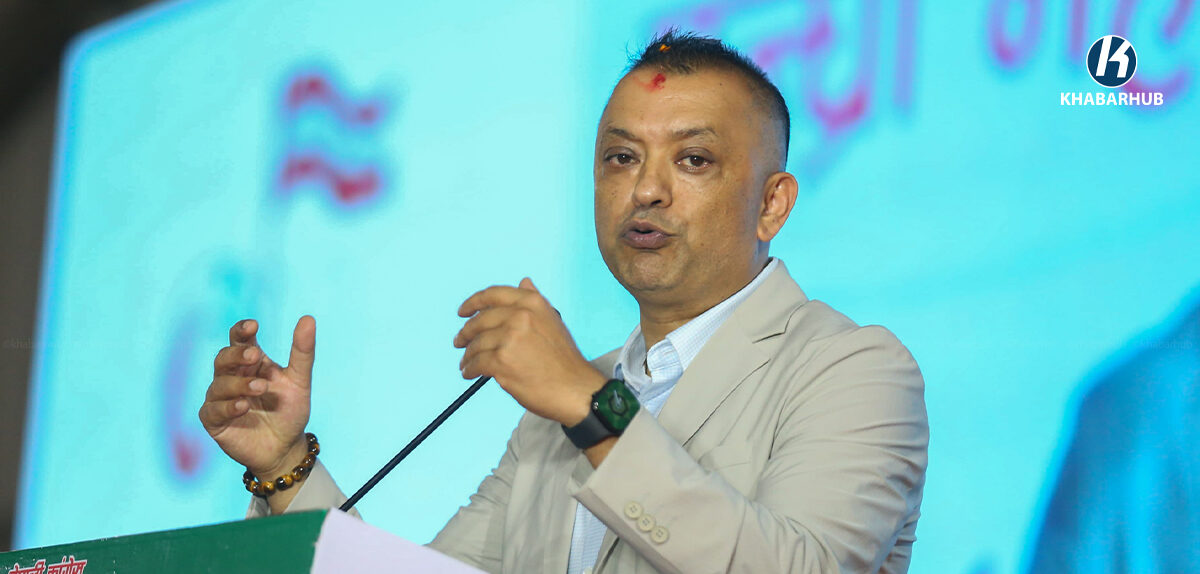
KATHMANDU: Nepali Congress (NC) President Gagan Thapa has questioned the government’s recent activities, expressing concern that certain groups within the state machinery have begun acting as though they themselves represent the state.
He criticised what he described as the arbitrary exercise of power, saying that some people in government appeared to believe that their personal wishes and decisions constituted the law. Speaking at a press conference organised at the party’s central office on Sunday, Thapa commented on the government’s recent actions, particularly the police’s handling of journalists’ arrests and other related incidents.
Referring to the arrest and subsequent release of several journalists, Thapa said the issue could not be considered resolved simply because those arrested had been freed.
“Some friends were arrested and later released, but the matter cannot be resolved that way. It is not over,” he said. “The fundamental questions are how the government understands its authority and how it views freedom of expression.”
He said recent police activities had raised serious questions about the government’s approach to exercising state power and its respect for democratic freedoms. “The police went to the media house simply because they had received orders from their superiors,” he said. “In some places, officials reportedly saw news reports in newspapers and were instructed to take action.”
Thapa also expressed suspicion that another issue might have been raised to divert public attention after protests began over the incident. Expressing concern over what he described as an emerging tendency towards arbitrary conduct within the government, he said certain groups appeared to be placing themselves above established institutions and legal procedures.
“Some small groups have started saying, ‘We are the state.’ There has been an arbitrary use of power, with people in government beginning to act as though their wishes are the law. This tendency appeared to be going too far,” he said.
Thapa said that although the Rastriya Swatantra Party (RSP) had issued a statement acknowledging that the incident was wrong, issuing a statement alone would not be sufficient. He stressed that the government must demonstrate accountability through concrete action and ensure that those responsible are held answerable.
Drawing a comparison with an earlier incident, he recalled that the RSP had also issued a statement following the incident on Asar 29, 2083 BS, when a vehicle was parked at the entrance of a media house. “The government issued a statement saying that certain action would be taken, and the action was subsequently carried out. Instructions were given at the time. But was anyone held accountable for what happened?” he asked.
Thapa made it clear that his party expected concrete action and accountability from the RSP-led government rather than statements expressing regret or acknowledging mistakes. “We want results, not statements from the RSP,” he said.
Recalling that the RSP had previously raised its voice in Parliament against alleged government misconduct, Thapa suggested that the party should now use its parliamentary strength to address the issue directly with the Prime Minister. He said the RSP’s parliamentary party should summon the Prime Minister and seek an explanation about the incidents and the government’s position. “We should call the Prime Minister to the parliamentary party and let the RSP itself explain its position to us,” Thapa said.
He emphasised that the issue was not limited to the arrest of a few journalists but concerned broader questions of government accountability, the exercise of state authority and the protection of freedom of expression.





Comment