




Severe tensions in Balochistan, Khyber Pakhtunkhwa, and Pakistan-administered Kashmir (PAK) have created a situation akin to a civil war, although a civil war has not been formally declared in Pakistan. The southwestern province of Pakistan has been in conflict for decades, and a document allegedly issued in the name of the ‘Republic of Balochistan’ has spurred new discussions.
Reportedly, eighty-five percent of the regions are under the authority of Baloch who have declared their independence. Nevertheless, the assertions stated in the purported independence paper have not yet been independently confirmed. Since 2003, there has been persistent unrest and separatist movements in Balochistan, driven by demands for independence and autonomy. The Baloch people have a distinct language and culture. They feel neglected by Pakistan’s Punjabi-dominated political and military establishment.
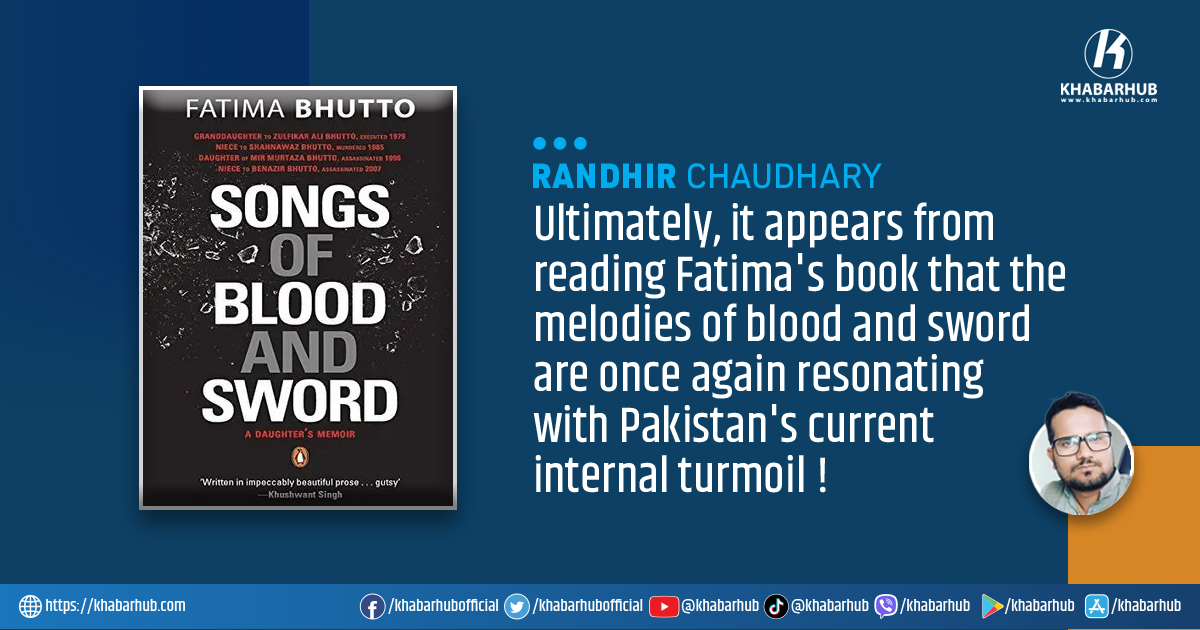
Fatima Bhutto’s book ‘Songs of Blood and Sword’ offers an engrossing historical narrative of the Baloch people’s quest for independence from Pakistan and Balochistan as a separate nation similar to Nepal. This book is mainly based on the epic story of the Bhuttos, a family of wealthy feudal landlords who rose to prominence in the newly formed state of Pakistan, is told in Songs of Blood and Sword.
It is the story of four generations of a family and the political violence that would ultimately kill them. Written by someone who has experienced it, it is the story of a family and country torn apart by murder, corruption, conspiracy, and division.
Published in 2010, this 470-page book provides a contemporary perspective on history and how it impacts the military’s political ambitions in Pakistan. Overall, this book is useful for comprehending Pakistan’s future status and course.
Independent like Nepal
Pakistan has had a significant impact on the province of Balochistan. Depending on who you ask, the Baloch people, who are tribal in their formation and groupings, are claimed to have Semitic or Iranian ancestry. Those who speak Balochi or one of the other regional languages assert that they left their lives as shepherds in Syria sometime in the first millennium and travelled nomadically throughout Central Asia before settling in the Baloch province, while those who identify linguistically with Aryans across the border claim Persian ancestry.
Shahbaz Sharif, the “de jure Prime Minister,” appears to be compelled to behave in accordance with the Pakistan Army’s strategic roadmap. Can the Pakistani elite— have suffered the anguish of Pakistan’s disintegration, stop the Baloch independence movement? Can it alleviate the severe annoyances that the people of PoK and Khyber Pakhtunkhwa are expressing?
Fatima Bhutto, in her book, discusses the independent status of ‘Nepal’ in the context of discussing the Baloch under Pakistan. For decades, Balochistanis have been fighting for independence from Pakistan, even today. During the British Raj, Balochistan was part of the Mughal, Persian, and Afghan kingdoms and was culturally, linguistically, and ethnically integrated with their populations.
By the nineteenth century, most of the four princely states there had been brought under the rule of the British Raj. Wars and imperialist struggles consolidated the large region now known as Balochistan, a province rich in mineral resources. When the subcontinent began to break up, the question was asked: where did they want to go?
The Baloch voted for neither India nor Pakistan – we wanted to be “independent like Nepal” (page 115). But for some time, Balochistan was ruled by princes there, whom the Pakistani government, which sent troops and forced them to sign an agreement with Mir Ahmad Yar Khan, the prince of Kalat, to renounce Balochistan’s claim to independence.
Fatima also mentions the context of a conversation she had with Khair Bux Mari, a Baloch leader from Pakistan’s Baloch province, to complete the prose of the book. Khair Bux, representing the Baloch spirit of independence, said, ‘Very few countries are independent. But Pakistan is still a colony of the British and American imperialists. How can there be an independent view of the colony?’
Geopolitics of that time
In the 1950s, Pakistan, like many other nations, was mired in the quagmire of the Cold War. Even then, the military junta that ruled Pakistan’s politics did not consider neutrality or non-alignment an option. On 7 October 1958, General Ayub Khan seized power from President Iskander Mirza in a “surprise coup”. The illegitimate seizure of power came at a time of great chaos and political uncertainty within Pakistan, leading most Pakistanis to resent the general’s takeover.
At the age of 30, Zulfikar Bhutto joined the then government as Minister of Fuel, Energy and Natural Resources. In 1960, Zulfikar was entrusted with the sensitive task of negotiating an oil deal with the Soviet Union. Zulfikar’s visit resulted in a loan of 120 million rubles to fund further oil exploration within Pakistan, and a promise from the Soviet Union to supply experienced experts and equipment for the program.
Meanwhile, Pakistan’s relations with the Soviet Union were slowly becoming difficult due to the Pakistani regime’s insistence on siding with the United States. As it was, Pakistan’s military dictators tended to embrace any power that promised to protect them. The then Pakistani military also saw the United States as the most enabling force for its militarism.
Already effectively modernizing its military, Pakistan signed a Mutual Defense Agreement with the United States in 1954. As part of the agreement, Pakistan was encouraged to join the Southeast Asian Treaty Organization in September 1954 and later the Central Treaty Organization in 1955. Although bilateral relations were the focus of Zulfikar’s foreign policy, there was no easy way to ignore the fact that relations between Pakistan and China had seriously deteriorated under General Ayub.
The general was constantly pushing China out to make room for the US, and against China’s wishes, relations with the US took a sharp turn in 1963, when Zulfiqar, seen as the architect of Pakistan’s bilateral foreign policy, took over as foreign minister. In 1962, anticipating Pakistan’s potential relationship with China and the young foreign minister’s socialist leanings, the US transferred Rs 300 million from the State Bank of Pakistan to a counterpart fund to begin extending credit to US commercial banks operating inside Pakistan, which was seen as a clear warning to Pakistan.
The forces that see Bangladesh through the eyes of East Pakistan are not only in present-day Pakistan but also the foreign friends of the Field Marshal. The main opposition party to the Awami League is the Bangladesh Nationalist Party, whose historical roots are in deep alliances with the Islamist party Bangladesh Jamaat-e-Islami and whose roots have been in Pakistan since 1971.
Zulfikar’s Radical Thought vs. Zia’s Junta
Zulfikar was facing setbacks towards the end of his political reign. Henry Kissinger, who publicly described Zulfikar as a capable and intelligent politician, gave him a major reprimand for advancing Pakistan’s nuclear ambitions. Zulfikar amended the 1973 constitution several times, allowing the federal government to ban political parties.
He curbed the power of the judiciary. In an effort to secure his political position, Zulfikar amended the constitution to define the criteria for ‘who is a Muslim?’ and made peace with the small but powerful religious parties out of fear. He banned alcohol and drove the entertainment industry underground.
He declared Friday prayers a public holiday. In 1974, Zulfikar organized the second summit of Islamic countries, which Mohammad Reza Pahlavi, alias Shah-of-Iran, was not ready to attend, and Idi Amin arrived uninvited.
While declaring the success of the summit, which was attended by 38 Islamic countries, Zulfikar had said, ‘We Pakistan will give our blood for Islam.’ Pakistan will not let any Islamic country in the world feel a lack of support. However, nothing like that happened. When the US attacked Pakistan’s neighbors Iran and Afghanistan, Pakistan humbly opened its skies. Fatima says – If Zulfikar were alive, he would have felt disgusted by Pakistan’s move.
In 1976, when General Tikka Khan, known as the “Butcher of Bengal”, was retiring from the army, Zulfikar replaced him with Zia-ul-Haq, bypassing the five senior generals. Zulfikar considered Zia to be his subordinate, although Zia was cunning, ambitious and cruel.
General Zia began to develop the judiciary in favor of the junta (a military or political group that rules a country after seizing power by force).
After widespread political unrest and allegations of electoral fraud following the 1977 general elections, General Zia led a military coup and overthrew the democratically elected government of Bhutto.
By 1979, judges who showed a lack of enthusiasm for the military in the government were quickly dismissed and replaced.
Sharia courts and military tribunals were created to enforce the regime’s orders, along with the curtailment of the powers of civilian courts. Zia’s rule was not only extremely brutal, it introduced the practice of public flogging and hanging, and made the five-time daily prayer mandatory in all offices, business places, and schools in Pakistan.
Despite national and international appeals for clemency, the Supreme Court upheld the death sentence in 1979. When Zulfiqar was sentenced to death, a demonstration against the newly introduced party-less Panchayat system in Nepal turned into a large rally, with students marching towards the Pakistani embassy in Kathmandu. Zulfiqar’s hanging is often cited as a political event in the history of Nepal’s referendums.
Allah, Army, and Adalat
Without addressing the political appetites of the Pakistani Army, no understanding of Pakistan and its politics would be complete. A popular narrative about Pakistan is— the army rules the country and seizes control of the courts in the name of Allah. Last year, the 27th Amendment to the Pakistani constitution brought in some serious changes, granting expanded powers to the Pakistani Army and its top leadership, especially the army chief.
Pakistan is a country that can still be seen engaged in a ‘wrestling of selfishness’, whether it is used or abused by the superpowers. Even though Pakistan’s Prime Minister is Shahbaz Sharif, the reins of power have been under the control of the Pakistani Army.
Shahbaz Sharif, the “de jure Prime Minister,” appears to be compelled to behave in accordance with the Pakistan Army’s strategic roadmap. Can the Pakistani elite— have suffered the anguish of Pakistan’s disintegration, stop the Baloch independence movement? Can it alleviate the severe annoyances that the people of PoK and Khyber Pakhtunkhwa are expressing?
Ultimately, it appears from reading Fatima’s book that the melodies of blood and sword are once again resonating with Pakistan’s current internal turmoil!





Comment