




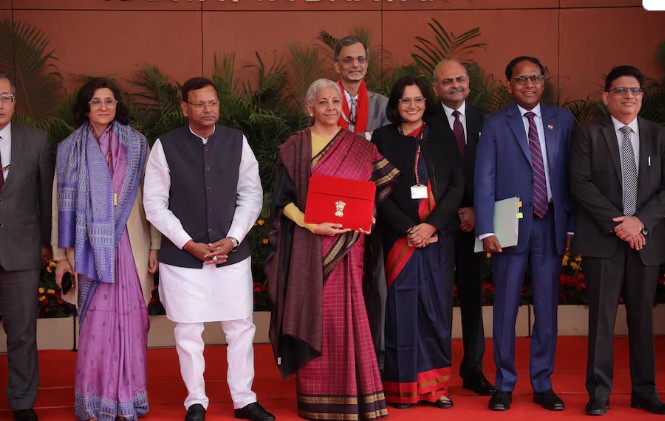
NEW DELHI: India’s annual budget placed renewed emphasis on boosting the manufacturing sector, yet the Modi government’s reform agenda fell short of market expectations amid global economic shifts influenced by the Trump administration.
The absence of bold reforms, coupled with a sharp increase in the transaction tax on derivatives, rattled equity markets, which fell roughly 1% during a special trading session on Sunday following the budget announcement, according to Reuters.
India continues to be one of the fastest-growing major economies, with GDP expected to expand 7.4% in the fiscal year ending March 31, 2026. Despite this growth, foreign investors have pulled a record $22 billion from Indian equities since last January, and the rupee has weakened to historic lows.
Finance Minister Nirmala Sitharaman emphasized strengthening the country’s manufacturing sector and outlined priorities to accelerate growth in Asia’s third-largest economy amid global uncertainty.
The government also plans to improve fiscal health, aiming to reduce the federal debt-to-GDP ratio to 55.6% from 56.1% and the fiscal deficit to 4.3% from 4.4% in the current year. To support this, it will borrow ₹17.2 trillion from bond markets, which have seen yields rise due to high government borrowing.
Economists described the budget as cautious. “It’s a non-adventurous budget likely to keep bond markets uneasy because fiscal consolidation is slower than expected,” said Dhiraj Nim of ANZ Mumbai. The unexpected increase in the Securities Transaction Tax (STT) was particularly unwelcome for equity investors. The STT on futures trading was raised from 0.02% to 0.05%, and on options from 0.01% to 0.15%.
Following the announcements, India’s benchmark Nifty 50 index dropped about 1%, with declines across sectors including banking, infrastructure, defense, and capital markets. Nifty’s capital market index fell nearly 6%. Indian bond and forex markets were closed on Sunday.
(Inputs from Reuters)






Comment