




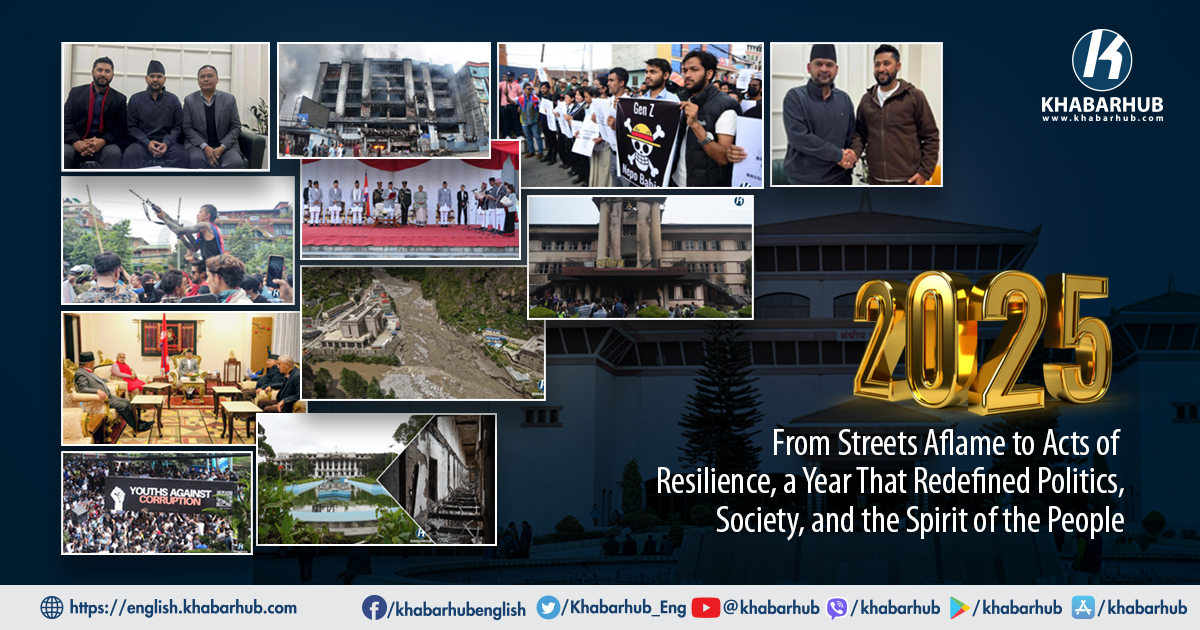
KATHMANDU: Nepal experienced some of the most significant political unrest in decades — mass protests largely led by Generation Z (Gen-Z) erupted nationwide. The immediate trigger was the government’s ban on 26 major social media platforms, which was widely interpreted as censorship and an attempt to stifle dissent.
Nepal in 2025 emerged as a year of profound challenge and transformation, marked by widespread political unrest, social mobilization, and repeated tests of national resilience. From the outset, the country faced mounting pressures arising from governance failures, economic strain, labor dissatisfaction, and growing climate-related disasters.
These tensions steadily intensified over the months, ultimately culminating in historic, youth-led protests that reshaped Nepal’s political landscape. As natural calamities and civic movements unfolded alongside deepening political divisions, 2025 came to be widely regarded as a watershed year, one that exposed structural weaknesses while also demonstrating the determination and resilience of the Nepali people in the face of unprecedented turmoil.
January began with growing concern over public safety and disaster preparedness as fire incidents surged across the country, particularly in densely populated urban and semi-urban areas. Media and government data highlighted a worrying rise in house fires during the winter months, causing multiple deaths, injuries, and significant property damage. At the same time, political discourse early in the year already showed signs of tension, with opposition parties criticizing the government over governance failures, inflation, and unemployment.
As the year ended, analysts widely described 2025 as a watershed moment for Nepal, defined by youth-driven political upheaval, climate-related disasters, and a profound challenge to established power structures, while also highlighting emerging signs of political recalibration and renewed strategic planning among major parties.
Meanwhile, February saw increasing labor-related unrest and civic dissatisfaction. Teachers’ unions, civil servants, and health-sector workers staged demonstrations in different parts of the country, demanding better working conditions and protesting proposed policy reforms. Although these protests were largely peaceful, they signaled widening frustration among public sector employees and contributed to an atmosphere of political unease.
In March, Nepal experienced a notable surge in political tension when pro-monarchy groups organized large demonstrations in Kathmandu and other cities. Protesters called for the restoration of the monarchy and the declaration of Nepal as a Hindu state. These rallies led to clashes with security forces, resulting in two deaths, dozens of injuries, and the imposition of curfews in parts of the capital. The events reignited national debate about Nepal’s republican system and exposed lingering divisions over the country’s political identity.
Similarly, April was marked by sustained nationwide protests by public school teachers opposing proposed education reforms. Schools across many districts were disrupted as educators accused the government of ignoring previous agreements and undermining job security. The movement gained public sympathy and added pressure on an already embattled government, reinforcing the broader narrative of declining trust in state institutions.
In May, natural disasters once again highlighted Nepal’s vulnerability to climate-related risks. A glacial lake outburst flood in Humla district damaged infrastructure, displaced local residents, and disrupted livelihoods. The incident renewed calls from environmental experts and humanitarian groups for stronger disaster-risk mitigation and early-warning systems in Himalayan regions.
Likewise, June brought the onset of the monsoon season, accompanied by landslides, localized flooding, and road blockages in several hilly and mountainous districts. While the scale of damage was initially moderate, early monsoon impacts strained local administrations and emergency response systems. Political tensions continued to simmer in the background, with criticism intensifying over economic management and youth unemployment.
Similarly, July proved especially devastating due to severe flooding in Rasuwagadhi and surrounding areas, where flash floods destroyed the Friendship Bridge and disrupted cross-border trade with China. Loss of life, damaged vehicles, and stranded goods made the floods one of the most economically disruptive disaster events of the year. The incident underscored Nepal’s exposure to extreme weather and its regional trade vulnerabilities.
Meanwhile, August became a turning point as youth-led activism intensified nationwide. Frustration over corruption, lack of opportunity, and restrictions on digital freedoms, especially the government’s moves to regulate and ban major social media platforms, sparked growing protests among students and young professionals. Demonstrations expanded rapidly from campuses to city centers, setting the stage for a major national confrontation.
Additionally, September proved to be the defining and most turbulent month of 2025. What began as youth-led demonstrations rapidly escalated into nationwide Gen-Z–driven protests, drawing tens of thousands of participants across Kathmandu and major cities. As tensions intensified, clashes broke out between protesters and security forces, leading to widespread violence.
Key state symbols and political centers were targeted, with multiple government buildings, political party offices, and administrative complexes vandalized or set on fire. Notably, parts of the Singha Durbar complex, Nepal’s main administrative headquarters, were affected by arson, an event widely seen as symbolic of public rage against entrenched political power. In response, authorities imposed curfews, deployed additional security forces, and enforced emergency restrictions across several districts.
While political uncertainty remained high, sporting and cultural events, particularly major national cricket tournaments, offered moments of relief and national pride.
The unrest resulted in at least 78 deaths and hundreds of injuries, making it one of the deadliest episodes of civil unrest in Nepal’s recent history. The scale of destruction, loss of life, and breakdown of public order underscored the depth of public anger and marked a turning point in the country’s political trajectory.
Amid mounting pressure, Prime Minister K. P. Sharma Oli resigned, leading to the appointment of Sushila Karki as interim prime minister. Parliament was dissolved and early elections were announced, marking a historic political shift driven largely by youth mobilization.
In the aftermath of the September unrest, October was dominated by efforts to stabilize the nation and rebuild public trust. The newly formed interim government, led by Prime Minister Sushila Karki, quickly focused on restoring law and order, lifting curfews in affected areas, and initiating investigations into the violence. Compensation programs were announced for families of victims, and emergency relief measures were deployed to those injured or displaced during the unrest.
Simultaneously, the interim cabinet was formed with a mandate to manage day-to-day governance, oversee administrative reconstruction, and ensure transparency in decision-making during the transitional period. Public discourse throughout October centered on critical issues such as police accountability, the future of digital rights in Nepal, and the role of youth in shaping the country’s democratic institutions. The month also witnessed renewed dialogue between civil society organizations and the government, signaling the beginning of a cautious political recalibration after one of the most turbulent periods in the nation’s history.
In November, political parties began repositioning themselves ahead of the announced 2026 elections. Discussions on electoral reform, coalition politics, and constitutional stability gained momentum. At the same time, disaster recovery efforts continued in flood- and fire-affected regions, though criticism persisted over slow reconstruction and relief delivery.
December 2025 closed the year on a mixed note. While political uncertainty remained high, sporting and cultural events, particularly major national cricket tournaments, offered moments of relief and national pride. On the political front, attention turned toward party realignments and unity efforts, most notably within the Rastriya Swatantra Party (RSP), where leaders such as Balen Shah, Kulman Ghising, and other key figures engaged in negotiations to strengthen internal cohesion and present a united front ahead of the announced 2026 elections.
These efforts reflected broader attempts among political groups to stabilize alliances, consolidate support bases, and prepare for the upcoming electoral contests in a year marked by unprecedented turbulence. As the year ended, analysts widely described 2025 as a watershed moment for Nepal, defined by youth-driven political upheaval, climate-related disasters, and a profound challenge to established power structures, while also highlighting emerging signs of political recalibration and renewed strategic planning among major parties.



Comment