




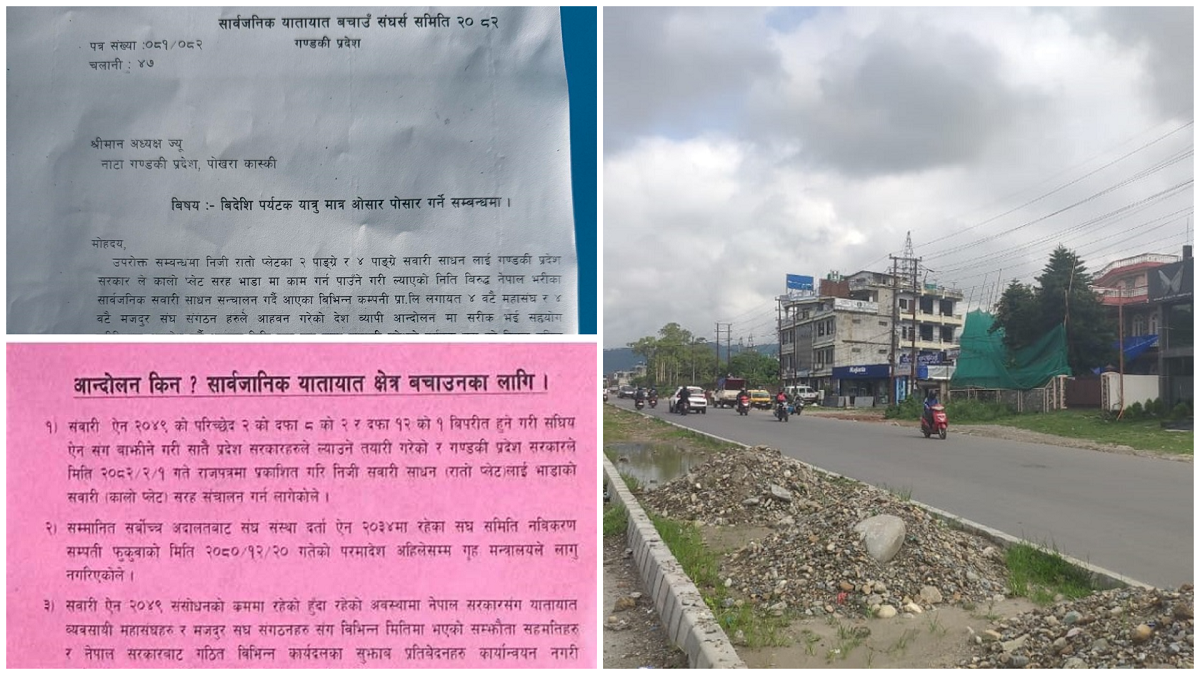
POKHARA: Public transport operators in Gandaki Province have launched a protest against the provincial government’s recent decision allowing private vehicles to operate as commercial transport. In a letter sent to the Gandaki chapter of the Nepal Association of Tour and Travel Agents (NATTA), the protesting operators have requested travel agencies to book tickets only for foreign tourists, suspending services for all other passengers.
The protest, spearheaded by the ‘Public Transport Protection Struggle Committee 2082 B.S.’ argues that the provincial government’s policy—announced via a gazette on Jestha 1—permits red-plate (private) vehicles to function similarly to black-plate (commercial) vehicles, thereby threatening the public transport sector.
The letter, signed by committee coordinator Kedar Prasad Paudel, warns that this policy violates the Motor Vehicles Act 2049 B.S. and contradicts federal laws. It adds that allocating commercial roles to private vehicles without a proper legal framework undermines the organized public transport system.
As a result, public bus services in Gandaki Province have come to a halt since Thursday, severely impacting internal tourists and local commuters in areas including Pokhara. Copies of the letter have also been sent to the Chief District Officer and the Pokhara Tourism Council.
The transport operators have further demanded the revocation of the ride-sharing regulation that enables private vehicles to operate commercially. If not addressed, they warn of intensified protests. They have already begun demonstrations, including symbolic vehicle rallies with black flags.
The protest organizers emphasize that despite a Supreme Court order in 2070 B.S. mandating the renewal and release of properties belonging to transport cooperatives under the Associations Registration Act 2034 B.S., the government has yet to comply. They allege a pattern of unilateral decision-making and disregard for past agreements between transport federations, unions, and the government—even during the ongoing process of amending the Motor Vehicles Act.
Additional grievances include lack of enforcement of weight regulations for cargo vehicles under the 2074 B.S. directive, failure to implement a social security fund for transport workers, absence of a compensation and relief fund for accidents, no implementation of a goods insurance system under the Transport Act, and no formation of a regulatory body to streamline public transport operations.
The operators have also expressed frustration over discriminatory border policies, such as a 72-hour pass for Indian vehicles at Nepali customs points—arguing that it disadvantages Nepali businesses and encourages capital flight.
If their demands are not met, the committee has announced plans for an indefinite nationwide transport strike beginning Jestha 19. Organizers include all major transport federations, workers’ unions, and associations related to the public transport sector.
The growing scale of the movement is beginning to disrupt public services across the country. Operators warn that unless the government responds urgently, the protest could escalate into a significant public pressure campaign.






Comment