




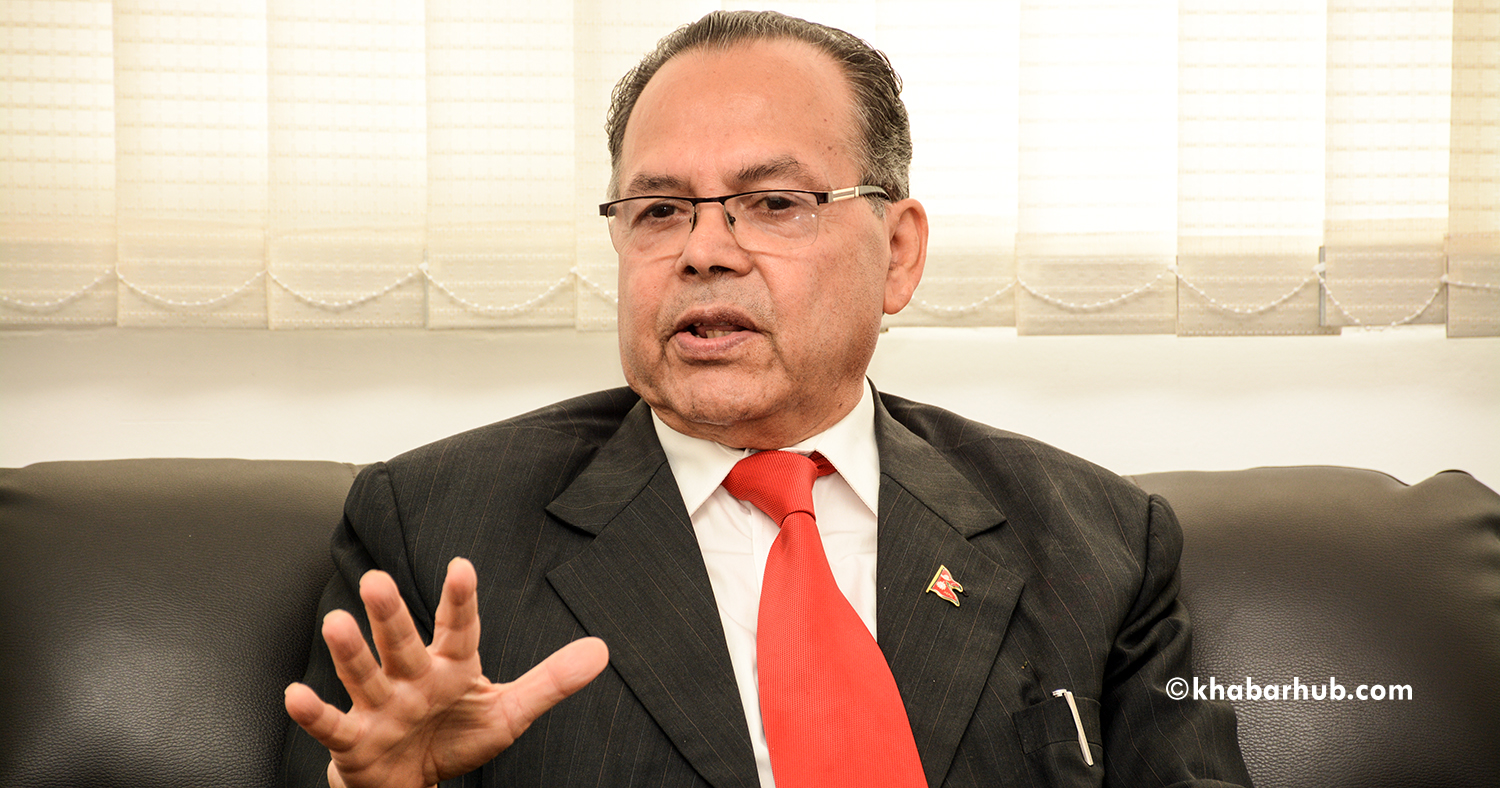
KATHMANDU: Senior leader of CPN (Unified Socialist) Jhalanath Khanal has cautioned party chair Madhav Kumar Nepal not to take the party in the wrong direction in the name of unity with the CPN (Maoist Center).
Addressing the party’s third central committee meeting underway in Kathmandu, Khanal said the idea of uniting with the Maoist Center was misguided and urged leaders to focus instead on strengthening their own organization.
“We should not move in the wrong direction in the name of unity with the Maoists. At this moment, we must think about our own party and build a strong revolutionary force,” Khanal said.
He acknowledged that the party had made several mistakes since its formation four years ago and called on leaders to conduct honest self-assessment.
“After rebelling against UML, we promised to take a revolutionary path. But the mistake began right after we left, by joining the Nepali Congress-led government in Baluwatar,” he said bluntly.
Khanal criticized the leadership for seeking positions and power instead of building the organization. “After forming the party, our leaders and cadres rushed to Baluwatar and Singha Durbar instead of expanding the organization. That’s why our party could not emerge as a credible alternative,” he remarked.
The former prime minister said the party’s ideological clarity had been eroded by its obsession with power. “We became so fixated on reaching power that we even stopped calling the Nepali Congress a party of comprador capitalists,” he said.
He added that the party had hesitated to oppose the US-backed MCC project, and missed opportunities to build alliances with forces like Upendra Yadav’s party and Pushpa Kamal Dahal “Prachanda.” “We fell prey to a right-leaning course,” Khanal observed.
Khanal openly criticized Chairman Madhav Kumar Nepal’s leadership, saying he lost his ideological footing due to personal ambition. “During the 2022 election alliance, there was an understanding that Congress would lead the government for two years, the Maoist Center for another two, and Madhav Nepal for one year. After that, Nepal stopped criticizing the Congress because he wanted to become Prime Minister,” Khanal alleged.
He further claimed that the so-called “2-2-1” power-sharing formula between Congress, Maoists, and Unified Socialist had confused Madhav Nepal’s political judgment. “That formula messed up his mind. The desire to become Prime Minister for one year distracted him from building the party,” Khanal remarked.
The veteran communist leader also objected to the recent reshuffling of the central committee, accusing the leadership of favoritism. “Only preferred individuals have been included, leaving out capable and experienced comrades. This is unacceptable. I will make the full list public tomorrow,” he warned.
Khanal stressed that the party must be run in accordance with internal rules and procedures, saying that hurried, unilateral decisions had weakened the organization. “We must now assess ourselves and define a new ideological and organizational direction,” he urged.
Recalling the history of communist unity in Nepal, Khanal noted, “During the days of the CPN (ML) and CPN (UML), we united with 35 different groups, but only after ensuring ideological, organizational, and cultural compatibility. Such a foundation is absent in today’s unification efforts.”
He cautioned that the communist movement should not be repeatedly thrown into confusion. “Unity is a positive idea, but it requires ideological clarity and organizational strength,” he said.
Khanal concluded by expressing hope that the ongoing central committee meeting would serve as an opportunity for deep reflection. “I have been in communist politics for 60 years. This meeting will be a crucial chapter in analyzing our current state and future direction,” he said.





Comment