



Where high-pitched promises often end in empty, cynical politics in the Singha Durbar corridors of Kathmandu, the new government of Nepal faces a unique opportunity to show the people of this Himalayan republic that democracy in the country is not just surviving but flourishing.
After years of instability, mistrust, and partisan politics that created deep divisions in the political landscape, confidence in democratic institutions has reached a point where even those who once believed in them are now skeptical.
Doubts about whether the state can deliver free, fair, and inclusive elections in Nepal today come from all quarters: migrant workers who have left their homeland, dissatisfied Nepalis, those frustrated in the rat race, and global audiences waiting to see how Nepalese democracy measures up.
Are they able to protect the rights and voices of their citizens? Can they address the discontentment and disenchantment with the current situation? Can they demonstrate to the world that Nepalese democracy is strong, transparent, and participatory?
The next few months are critical in this regard. This government has a chance—an opportunity, a responsibility—to rise above the politics of partisanship and leave electoral credibility as its indelible legacy. To achieve this, it will need more than logistical efficiency; it will need vision, political will, and the kind of reforms that bring Nepal’s democracy in line with both the aspirations of its citizens and global expectations.
Secure the Ballot: Best Practices from Democracies
As the saying goes, the devil is in the details. The integrity of the polling process must be preserved for the results to be accepted. Other democracies have both stumbled and succeeded in this respect, so there is much to learn from them. For instance, India—with its population of over 900 million—has had a credible election process overseen by the Election Commission, which has won praise from the international community.
A credible election requires all political actors to participate—ruling and opposition alike. Boycotts or violent protests would derail legitimacy. To avoid such crises, the government must foster dialogue, not dominance.
Clear procedures, a strong legal framework, and widespread use of electronic voting machines (EVMs) have contributed to public confidence, even in the face of political din.
Ghana, too, has made strides in improving election credibility after past instances of fraud. It has done so by introducing biometric voter registration and engaging civil society organizations in election observation. Lessons from these examples should not be lost on Nepal. Technology should not be seen as a standalone solution without the presence of independent monitoring.
The government could consider forming an independent Election Security Task Force that includes civil servants, security officials, and civil society representatives to ensure the neutrality of the process. It should also invite international observers from credible organizations such as the European Union, the Carter Center, or the Asian Network for Free Elections (ANFREL) to monitor the process and instill global confidence in it.
As former UN Secretary-General Kofi Annan said, “Elections are a necessary, but not sufficient, condition for democracy. The real test is whether they are credible and inclusive.”
Bringing Migrants and the Diaspora into the Fold
No reform is more overdue than extending voting rights to Nepal’s migrants and non-residential citizens. More than four million Nepalis live abroad—many in the Gulf, Malaysia, Korea, Europe, and North America. They send home billions in remittances annually—over 23% of GDP—yet remain disenfranchised.
Other countries have blazed the trail. The Philippines enacted the Overseas Voting Act in 2003, enabling millions of overseas workers to cast ballots through embassies and consulates. Mexico allows its diaspora to vote via postal ballots. Even Tunisia, after its Arab Spring revolution, reserved parliamentary seats specifically for its citizens abroad.
Of course, Nepal does not have embassies in every country, and that could be cited as a reason. But with the will to include them, financial strength, and proper laws in place, it is possible. In that case, no one would need to panic or resort to swallowing ballot papers.
Nepal can learn from these precedents by piloting a dual-track system: voting at embassies for those in countries with consular access, and secure electronic or postal voting for those in remote labor markets. Research by the International Institute for Democracy and Electoral Assistance (IDEA) shows that diaspora inclusion not only strengthens legitimacy but also reduces alienation. For Nepal, enfranchising migrants would send a powerful signal: democracy is not confined by borders.
Addressing Dissatisfaction: Rebuilding Trust Beyond Political Divides
The current wave of public dissatisfaction in Nepal transcends mere logistical concerns; it is a profound emotional and existential crisis. At its heart, the challenge lies in restoring citizens’ belief that their voices hold weight and that their participation in the democratic process is meaningful.
This pervasive disillusionment is fueled by deep-seated governance failures: rampant corruption, a scarcity of economic opportunities, and the stalled promise of federalism. Without a sincere effort to address these core grievances, elections risk devolving into empty, ritualistic exercises devoid of real legitimacy.
The path forward demands a fundamental shift towards a politics of genuine listening. Historical precedents offer powerful lessons. The success of South Africa’s Truth and Reconciliation Commission, for example, lay in its ability to foster a sense of being heard among a deeply divided populace, thereby rebuilding legitimacy from the ground up.
While Nepal’s specific challenges are unique, a similar spirit of open dialogue could be cultivated through a National Citizens’ Forum on Electoral Reform. This body, composed of a diverse cross-section of society—including youth groups, marginalized communities, media professionals, and academics—would serve as a vital platform for the public to air their grievances and contribute to the discourse.
The key to its success would be the government’s public commitment to meaningfully integrate the forum’s recommendations into electoral policy—an act that would serve as a powerful antidote to public cynicism.
Equally critical is a decisive and credible assault on corruption. With Nepal ranking 108th out of 180 countries in Transparency International’s 2023 Corruption Perceptions Index, citizens’ trust in the political system has been severely eroded.
Until the populace can believe that elections are not simply a gateway to kleptocracy, enthusiasm and faith in the process will continue to wane.
A concrete step in this direction would be to fast-track the establishment of dedicated anti-corruption courts, empowered to swiftly and impartially adjudicate political finance violations before elections take place. This would send an unequivocal message that accountability is paramount.
Nepal’s narrative can take the same trajectory—if leaders seize the moment. The new government needs to weave a smart, innovative, and uplifting democratic narrative. Envision a campaign that asserts: “Every Nepali Counts, Wherever You Are.”
As Abraham Lincoln’s timeless warning reminds us, “Elections belong to the people…” Nepal’s leaders must internalize this truth: the trust and participation of its citizens are not a given. They are a fragile and precious commodity that must be earned and continuously nurtured. To take the people for granted is to risk a democracy built on a foundation of blisters and disillusionment.
Building an All-Inclusive Election: Engaging Every Political Force
A credible election requires all political actors to participate—ruling and opposition alike. Boycotts or violent protests would derail legitimacy. To avoid such crises, the government must foster dialogue, not dominance.
International experience again offers lessons. Kenya’s 2007 elections, marred by violence, forced the establishment of a power-sharing agreement mediated by former UN chief Annan. While imperfect, it prevented national collapse. Closer to home, Bangladesh’s election crises underline the dangers of excluding opposition voices. Nepal cannot afford similar chaos.
A practical step is establishing a Multi-Party Electoral Dialogue
Mechanism under parliamentary oversight, ensuring all parties can raise concerns about polling, campaign finance, and voter lists. By institutionalizing dialogue, the government can shift from reactive firefighting to proactive trust-building.
Assuring the World: From Symbolism to Substance
Perception matters abroad. For a nation as aid-, investment-, and goodwill-reliant as Nepal, it cannot afford to have its elections dismissed as flawed. Symbolism must be matched with substance to persuade the world.
First, the government has to pledge publicly to international treaties such as the International Covenant on Civil and Political Rights (ICCPR), Article 25, to ensure periodic elections are substantive. Second, transparency measures—voter rolls online, live webcasting of vote counting, and disclosure of assets by candidates—would be proof positive. Third, arrangements with regional agencies such as SAARC and BIMSTEC for election observation would enhance regional credibility.
Political scientist Robert Dahl emphasized that democracy requires “effective participation” and “enlightened understanding.” By incorporating openness at every level, Nepal can show the rest of the world that it does not just hold elections—it practices democracy.
A Creative Democratic Message: Turning Crisis into Opportunity
Skepticism exists that Nepal’s democratic problems are too deeply ingrained. History defies such thinking. Sierra Leone, after its war, once epitomized instability yet transformed itself into a beacon of credible elections through international cooperation and internal reforms. Indonesia, after years of military rule, created one of Asia’s most robust democracies through stepwise institution-building and public confidence.
If Nepal’s new government embraces this vision, it can transform skepticism into hope, chaos into credibility, and democracy into a shared national pride. That is the promise of this moment—and that is the responsibility it cannot afford to fail.
Nepal’s narrative can take the same trajectory—if leaders seize the moment. The new government needs to weave a smart, innovative, and uplifting democratic narrative. Envision a campaign that asserts: “Every Nepali Counts, Wherever You Are.”
Envision leaders not only speaking about change but illustrating it through dramatic gestures—like casting historic first votes from distant districts or diaspora hubs.
This kind of creativity counts. At a moment when social media makes perception often indistinguishable from fact, symbolic gestures can compensate for substance. They can galvanize youth, inspire migrants, and placate skeptics.
Conclusion: The Choice Before Nepal
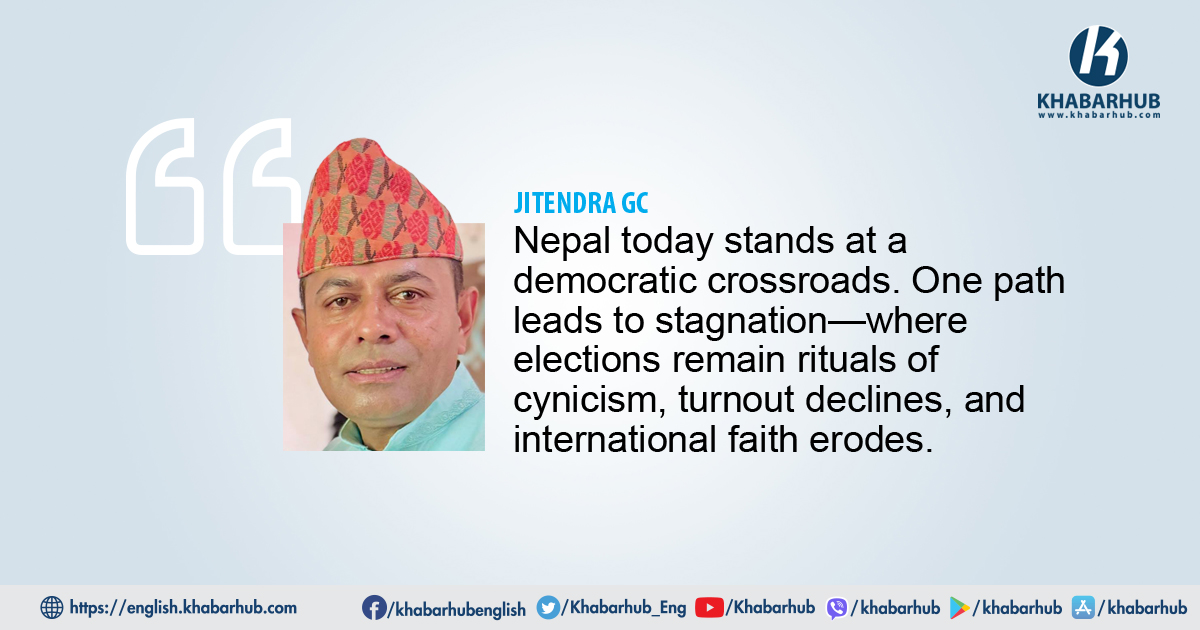
Nepal today stands at a democratic crossroads. One path leads to stagnation—where elections remain rituals of cynicism, turnout declines, and international faith erodes. The other path leads to renewal—where inclusive reforms, transparent systems, and visionary leadership rebuild trust.
The new government must choose the latter. It must secure polling through independent oversight, enfranchise migrants and non-residential citizens, address dissatisfaction with courage, engage every political force, and assure the world with transparency. The challenge is immense, but the rewards—domestic legitimacy and global respect—are greater.
As Nelson Mandela famously said, “The people’s voice is the voice of God.” Nepal’s democracy will only thrive when that voice is heard everywhere—from the hills of Humla to the labor camps of Saudi Arabia and Qatar, from the diaspora hubs of New York, London, and Tokyo to the villages of the Terai. Elections must not be mere spectacles; they must be living proof that sovereignty truly rests with the people.
If Nepal’s new government embraces this vision, it can transform skepticism into hope, chaos into credibility, and democracy into a shared national pride. That is the promise of this moment—and that is the responsibility it cannot afford to fail.




Comment