




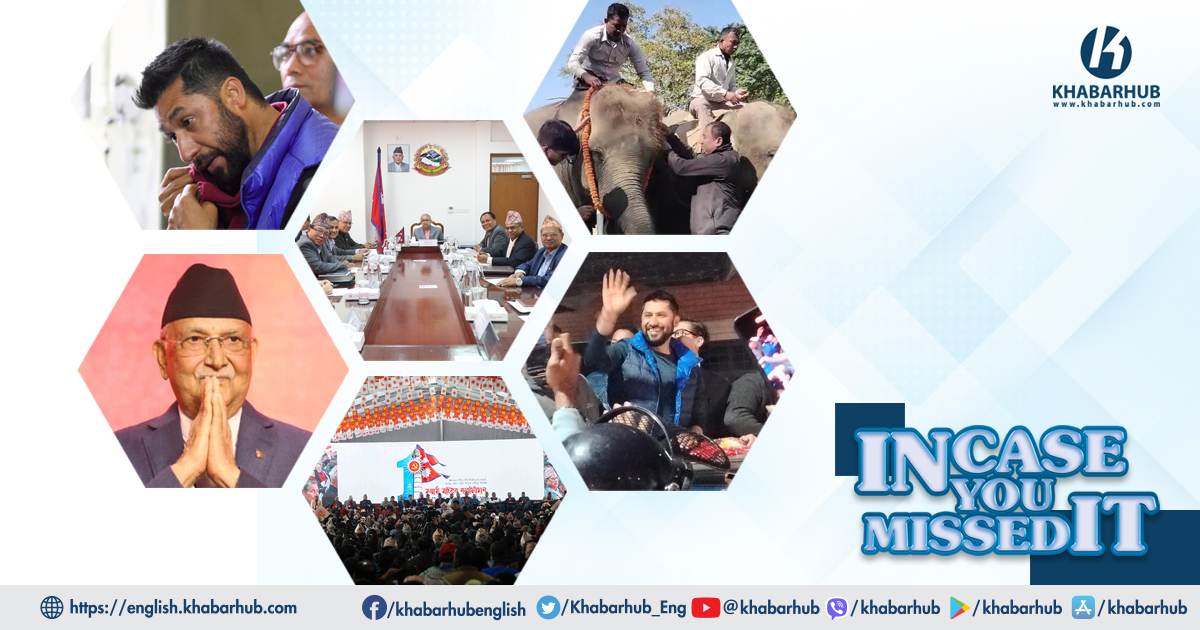
KATHMANDU: Last week unfolded as one of the most consequential weeks in Nepal’s recent political history, not because of a single dramatic event, but due to the convergence of parallel developments that together exposed the country’s political reordering, institutional strain, and generational transition.
From the surprise “Greater Unity” pact between Rabi Lamichhane and Balendra (Balen) Shah to renewed elite negotiations at Shital Niwas, from electoral preparations under an interim government to revived street-level Gen-Z mobilization, Nepal appears caught between transformation and continuity, reformist promise and old political reflexes.
At its core, the week illustrated a central paradox: while elections are being meticulously prepared, the political consensus that normally underpins democratic contests remains fragile. The system is moving forward procedurally, yet remains unsettled politically and emotionally in the aftermath of the September 8–9 Gen-Z uprising.
Rabi–Balen pact: A calculated gamble or a political watershed?
The most headline-grabbing development of the week was the formal agreement between Rastriya Swatantra Party (RSP) Chair Rabi Lamichhane and Kathmandu Metropolitan City Mayor Balendra Shah. The seven-point “Greater Unity” pact represents the most explicit attempt yet to consolidate Nepal’s alternative political forces under a single organizational and electoral framework.
This agreement is significant not merely because of the personalities involved, but because of what they symbolize. Rabi Lamichhane embodies anti-establishment populism with a media-driven mass appeal, while Balen Shah represents technocratic, urban, youth-centric governance with symbolic victories against entrenched bureaucratic inertia. Their alliance is an effort to merge charisma with credibility, protest politics with institutional ambition.
Yet, the pact is also fraught with contradictions. Naming Rabi as party chair while positioning Balen as the future prime ministerial candidate raises inevitable questions of leadership balance. Will the arrangement hold under electoral pressure? Can a mayor with no parliamentary experience transition smoothly into national leadership? And will RSP cadres accept a leadership structure that elevates an outsider above seasoned party figures?
More importantly, the pact signals a strategic recognition: fragmentation among alternative forces benefits traditional parties. By attempting unity, Rabi and Balen are acknowledging that moral authority alone is insufficient—organizational discipline and electoral machinery matter.
Still, the pact’s success depends on whether it can move beyond symbolism. Youth movements, anti-corruption rhetoric, and promises of a “middle-income Nepal in ten years” resonate deeply, but voters will ultimately judge clarity of policy, candidate selection, and crisis management. The pact has raised expectations; failure to meet them could deepen cynicism rather than renew hope.
Interim power and the politics of survival
While alternative forces sought consolidation, the interim government led by Prime Minister Sushila Karki focused on political survival and electoral legitimacy. Her decision to expand the Cabinet for the fifth time—bringing in former Nepali Army Lieutenant General Balananda Sharma as Foreign Minister—reflects both pragmatism and vulnerability.
On one hand, the appointment of a former military officer to a sensitive diplomatic post can be interpreted as an attempt to project stability, discipline, and institutional coherence during uncertain times. On the other, it raises questions about civilian political depth and the government’s reliance on non-partisan figures to compensate for limited political backing.
The Prime Minister’s meetings with Deuba, Oli, and Prachanda, followed by the President-facilitated dialogue at Shital Niwas, underscore a deeper reality: the interim government cannot govern in isolation. Despite its origin in the Gen-Z movement, it must negotiate with the very political elites that protesters sought to dislodge.
These talks were not merely procedural; they were existential. With the Nepali Congress and UML continuing to demand parliamentary restoration and the Maoist center insisting on elections, Nepal remains suspended between two constitutional narratives. The President’s intervention, therefore, was not just symbolic mediation—it was an attempt to prevent institutional paralysis from becoming systemic breakdown.
Elections as process vs. elections as trust
Prime Minister Karki’s repeated assurances that elections will be held on time contrast sharply with persistent doubts on the ground. Her appeal for unity, restraint, and collective responsibility reflects an awareness that elections conducted amid distrust and unresolved grievances risk being procedurally valid but politically hollow.
The Election Commission’s actions last week reinforced this tension. On one hand, the publication of the final voter list—with over 915,000 new voters—demonstrates administrative preparedness and democratic inclusivity. On the other, the proposed strict code of conduct on vehicle use reveals the Commission’s concern about money, muscle power, and unequal campaigning.
The vehicle restrictions, including bans on foreign number plates and limitations on campaign transport, signal an attempt to level the playing field. Yet enforcement remains the key challenge. In a country where rules often bend under political pressure, the Commission’s credibility will depend not on drafting codes, but on applying them without fear or favor.
The Army’s statement: An institution defending its space
One of the most revealing developments of the week was the Nepali Army’s detailed public articulation of its role during the September 8–9 protests. In reaffirming loyalty to the Constitution and denying political ambition, the Army was not merely responding to criticism—it was staking out institutional boundaries.
The statement reflects a military acutely aware of public scrutiny in a democratic era. By framing debate as healthy and normal, the Army attempted to depoliticize itself while simultaneously asserting the legitimacy of its actions. This balancing act is crucial. In transitional democracies, ambiguity around security institutions can quickly become destabilizing.
Yet, the Army’s call for strengthening security institutions raises broader questions. Strengthening for what purpose, and under whose oversight? As Nepal navigates political uncertainty, civilian control over security forces must remain not only constitutional but visibly operational.
Justice and accountability
The lifting of travel restrictions on former officials involved in the September incidents suggests that the inquiry process is moving forward, albeit cautiously. While procedural progress is welcome, public confidence depends on transparency and outcomes. Investigations that conclude without accountability risk reinforcing the perception that power shields its own.
Similarly, the release of Prabhu Bank CEO Ashok Sherchan on bail highlights the persistent tension between elite accountability and institutional protection. While due process must be respected, repeated instances of high-profile arrests followed by quiet releases deepen public skepticism about financial governance and regulatory enforcement.
The Gen-Z resurgence
Perhaps the most telling sign of unresolved tensions is the announcement of the “United Gen-Z” movement led by Miraj Dhungana. The revival of street politics signals a disconnect between the interim government and the very constituency that brought it to power.
The movement’s accusations, nepotism, favoritism, symbolic governance without substance, mirror the grievances that fueled the September uprising. Whether fully substantiated or politically amplified, these claims reflect a failure of communication and engagement. Governments born from protest face a unique challenge: they must institutionalize dissent without betraying its spirit.
The Gen-Z movement’s demand for an all-party government may appear contradictory, but it reflects a pragmatic realization that exclusion breeds instability. Youth activism, once ignited, does not dissipate easily; it either transforms into institutional reform or resurfaces as resistance.
Old forces reorganize
While new actors dominate headlines, traditional parties are not standing still. The unification of RPP and RPP-Nepal demonstrates how even royalist forces recognize the need for consolidation. Similarly, Gagan Thapa’s announcement of candidacy for Nepali Congress presidency signals generational contestation within legacy parties.
These developments suggest that political renewal is not confined to outsiders. Internal reform struggles within traditional parties may shape the post-election landscape as much as alternative movements.
Development amid uncertainty
Finally, the signing of MCC-related road contracts by MCA-Nepal provides a reminder that state machinery continues to function despite political turbulence. Infrastructure development, especially using new technologies, offers tangible benefits that transcend political cycles. Yet, development projects alone cannot compensate for governance deficits. Roads can be built amid instability, but trust cannot.
Conclusion: A nation between transition and choice
Last week did not resolve Nepal’s political uncertainty,, but it clarified its contours. The country stands at a crossroads where elections are inevitable, but consensus is fragile; where youth demand transformation, but institutions resist disruption; where new alliances promise change, but old habits persist.
The coming months will test whether Nepal’s political actors can move beyond tactical maneuvering toward strategic renewal. Unity pacts, dialogue forums, and election codes are necessary steps, but they are insufficient without sincerity, accountability, and public trust.
Ultimately, Nepal’s challenge is not merely to hold elections, but to restore belief that elections can still produce meaningful change. Last week showed that the struggle for that belief is far from over, but it is very much alive.





Comment