




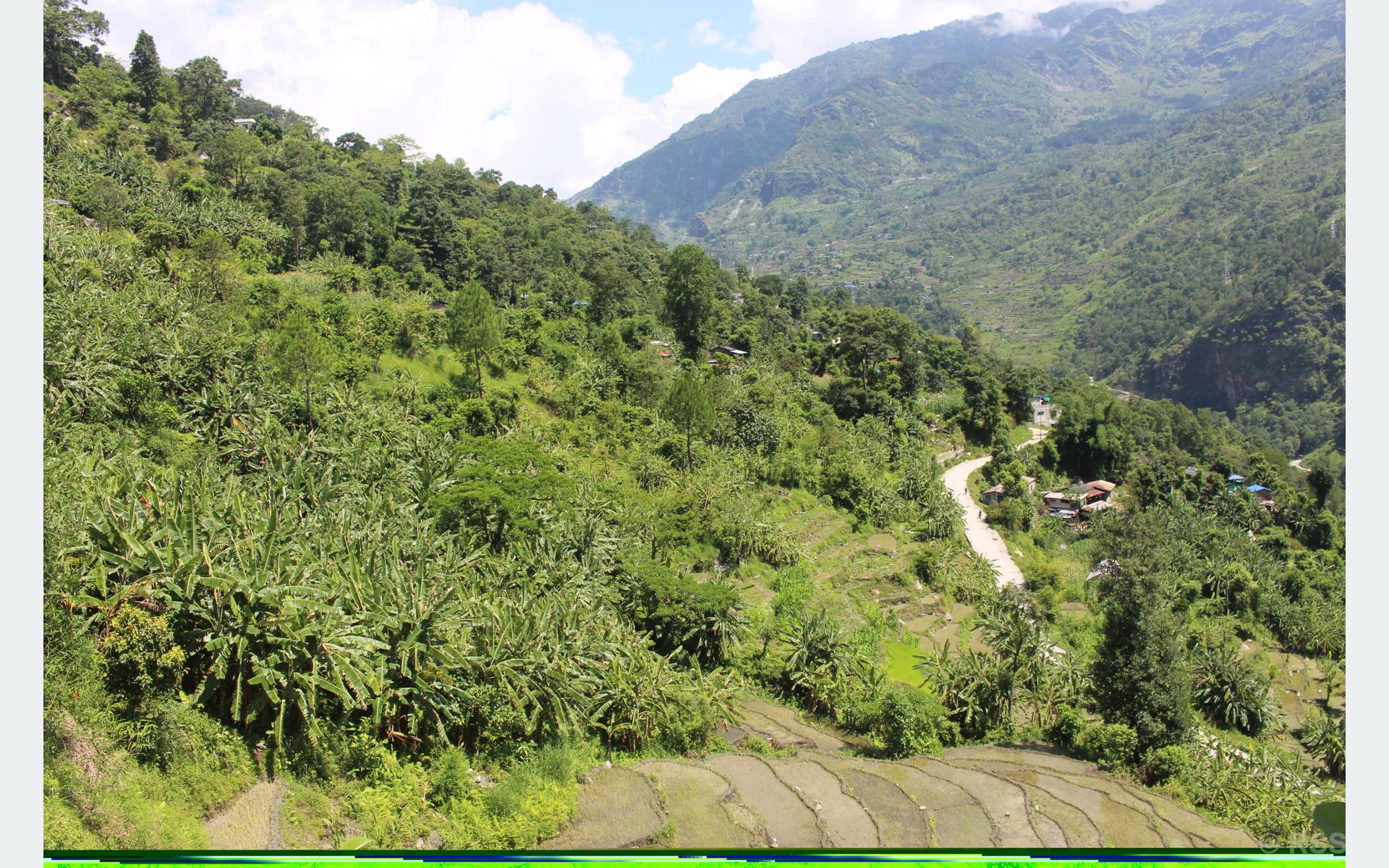
BENI: Prakash Khatri, a 40-year-old resident of Kaulegauda, Ghatan in Beni Municipality-9, has found success and self-reliance through commercial banana farming.
After returning from three years of foreign employment in Dubai, Khatri began cultivating bananas in his hometown and has since turned it into a thriving enterprise.
What began as a modest plantation on three ropanis of land has now expanded to 25 ropanis. “All of my land is now used for banana farming. I earn between Rs 1 million to 1.5 million annually, and I expect this to grow as newly planted trees begin producing,” said Khatri.
He has converted land previously used for rice, corn, and millet into banana plantations.
Khatri also raises chickens to produce organic fertilizer for his crops, demonstrating that traditional farming can be modernized and made profitable through dedication and innovation. He currently manages four banana plantations.
Banana farming has steadily grown in popularity in Kaulegauda over the past decade. Today, around 150 households in the area are engaged in banana cultivation.
Commercial banana farming is expanding in areas such as Thakan, Gauthale, Mulbari, Patarukh, Barahthan, and Tusare.
Farmers like Rudra Chokhal, Deepak Khadka, Omkar Puri, Som KC, Bhagwati Basnet, and Rudra Bahadur Basnet have also embraced commercial banana farming.
According to Punya Chokhal, Chairperson of the Kaulegauda Agricultural Group, banana farming has now expanded to approximately 400 ropanis across different parts of Kaulegauda. Chairperson Bhagwati Basnet alone has cultivated bananas on an additional five and a half ropanis of land.
In the fiscal year 2081/82, under Beni Municipality’s Banana Pocket Area Expansion Program, 3,500 new seedlings of the Hazari variety were planted across 120 ropanis in Kaulegauda.
The Kaulegauda Farmers Group, comprising 25 members, implemented the program with a Rs 1.2 million grant from Beni Municipality, matched by Rs 1.2 million in farmer contributions.
To support the project, two earthen ponds and one sloped concrete irrigation pond were constructed to collect water from local sources. A 3,500-meter pipeline has also been installed to distribute water to the fields.
Under the same program, essential farming tools—such as ladders and scythes—have been distributed to farmers. Currently, Hazari, Dhurse, and Murre varieties of bananas are being cultivated in the region.
While current irrigation is managed through local water collection, group chairperson Chokhal warned that future water shortages could arise during the winter season as commercial banana farming continues to expand.
As a solution, farmers have requested a lift irrigation project drawing water from the Raghuganga and Kaligandaki rivers.






Comment