




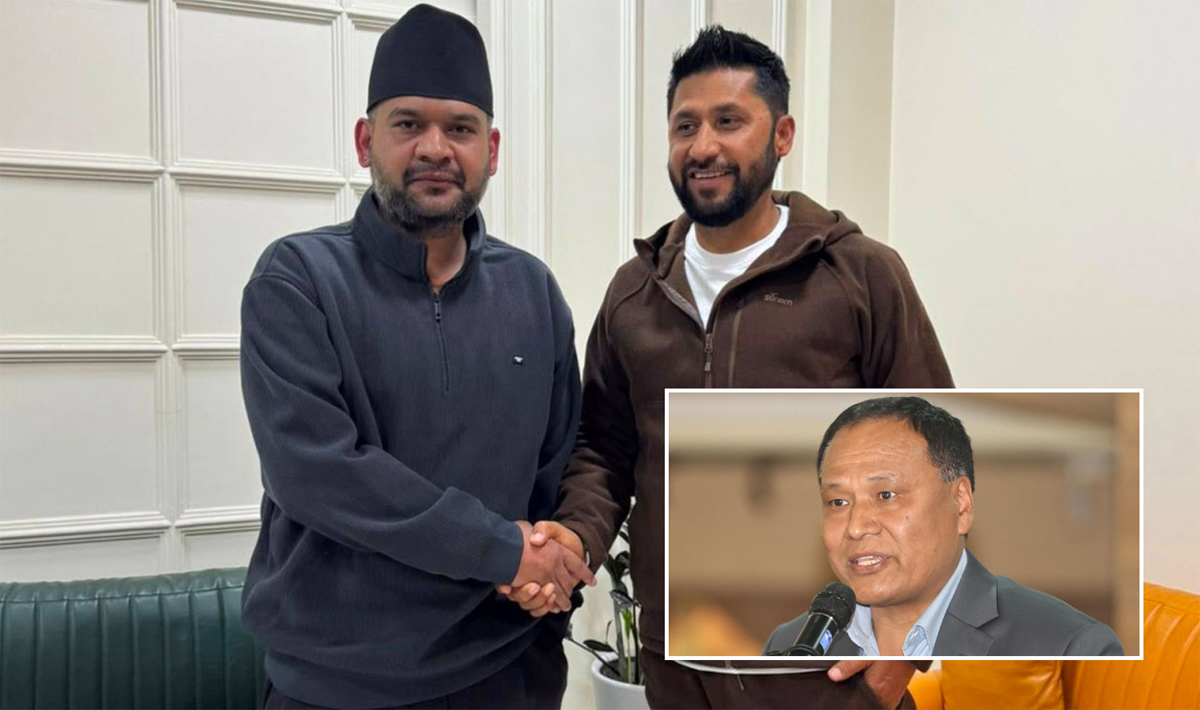
KATHMANDU: Rabi Lamichhane and Balendra (Balen) Shah formally came together to take on Nepal’s traditional political parties, signing a seven-point agreement early Sunday morning. The talks began soon after Lamichhane’s release from a nine-month prison sentence.
Discussions continued throughout Saturday, with Shishir Khanal, Dr. Swarnim Wagle, and Asim Shah from the Rastriya Swatantra Party (RSP) helping draft the agreement.
Balen’s team, including Bhupdev Shah, Kumar Ben, Sudip Dhakal, and KP Khanal, were also present. Initially, a merger seemed unlikely, but after late-night talks between Rabi and Balen, consensus was reached. Filmmaker Nischal Basnet also played an active role in facilitating the talks.
The agreement draft was prepared by Khanal and Wagle, with Balen’s aides reviewing and fine-tuning the language. Both leaders signed the agreement after reading it aloud.
Balen’s role in RSP
Balen has accepted both the RSP party affiliation and its election symbol. While no written agreement was made regarding his post, he has agreed to remain a central committee member for now. RSP Vice Chair Dr. Swarnim Wagle emphasized that Rabi Lamichhane remains the party leader. Balen’s position in the party hierarchy is considered second only to the Chairman, followed by the two vice-chairs.
A central committee meeting is expected soon to formalize Balen’s inclusion. After the upcoming elections, the party plans its first general convention, which may clarify further rankings.
Proportional Representation
The Election Commission (EC) has given the parties until Dec 29 to submit their proportional representation list. Both Rabi and Balen have the authority to select candidates from their respective teams. An aide noted that only leaders with a clean image will be included, and a selection team may be formed if necessary.
Why not Kulman Ghising?
While Balen and Rabi met with Kulman Ghising of the Ujyaalo Nepal Party twice on Saturday, immediate unity was not agreed upon. Balen had proposed a joint election contest including Kulman, but Kulman declined, leaving the current agreement between Rabi and Balen. Cooperation remains possible in the future if circumstances allow.
“Especially on Saturday, the three leaders could not meet. We waited for Kulman Ghising’s decision until midnight. But now, even if we can’t unite immediately, we are open to cooperation if necessary,” said a leader. “There was a discussion between Balen Shah and Kulman Ghising, after which Rab Lamichhane also agreed.”
Even if the parties do not merge right away, the door remains open for future cooperation with Kulman Ghising. “Balen has said the environment should remain open for collaboration with like-minded individuals, groups, and organizations. Discussions will take place if necessary,” added the leader.
Leaders from Balen’s side note that Kulman will not join the RSP unless a political change occurs before submitting the proportional representation list. Cooperation, they say, will only happen if Kulman’s Ujyaalo Nepal Party merges with the RSP.
“Balen’s influence has increased after joining the RSP. We are now ready to welcome Ujyaalo Nepal if it merges. RSP remains the fourth force in the country,” said another leader close to Lamichhane. “If Kulman had truly led the Ujyaalo Nepal Party, his party would have merged with us, or at least an election-focused collaboration could have been arranged.”
According to sources, Kulman has maintained that if he wins a majority after the election, Balen should serve as Prime Minister for a half-term. The proposed unity with Kulman fell apart after Balen rejected the offer to take the half-term Prime Ministership.




Comment