




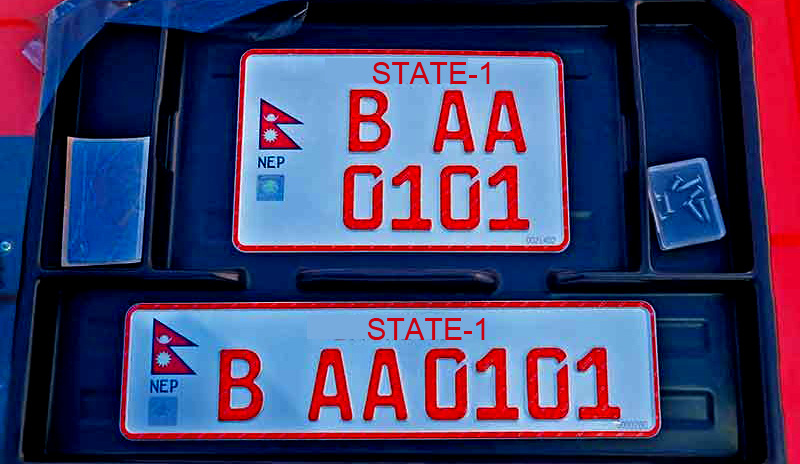
KATHMANDU: Even as Nepal’s major highways and border routes reel under floods, landslides, and chronic neglect, the government has remained fixated on enforcing an embossed number plate system for vehicles, a move that continues to draw criticism from consumers, transport operators, and rights groups.
The controversy has deepened in recent weeks. Following escalating protests, the Department of Transport on Tuesday issued a statement promising some flexibility for vehicle owners. However, the government has refused to revise pricing or language policy, the two most contentious issues, prompting continued backlash.
The embossed number plate plan, first introduced nearly nine years ago under the government’s “Digital Nepal” initiative, was supposed to modernize vehicle registration with high-security aluminum plates embedded with Radio Frequency Identification (RFID) chips. But legal hurdles, poor infrastructure, and rising costs have stalled the rollout and fueled skepticism over the government’s priorities.
In 2017, opponents challenged the scheme in the Supreme Court, arguing that the plates violated the constitution by being printed only in English. Two years later, the court upheld English as valid. Yet, in 2023 the Cabinet decided to allow both Nepali and English scripts. Now, critics accuse the government of ignoring its own decision by insisting on English-only plates.
Consumers also complain about the plates’ fragility. Made of 90–95% aluminum, they are easily damaged in Nepal’s traffic conditions. “These plates are actually less durable than the old ones,” many vehicle owners argue.
In 2016, the government signed a $33.85 million contract with Decatur Tiger IT, a US-Bangladesh joint venture, to deliver and install 2.5 million plates by 2021. Nearly a decade later, only a fraction has been distributed.
The embossed number plate system depends on RFID gates to scan vehicles. But only a handful of such gates exist, at Balaju and Thankot in the Kathmandu Valley, and a few others planned for major entry points like Pokhara and Butwal. Most remain non-operational.
“This is a system launched without infrastructure,” said Saroj Sitaula, Senior Vice-President of the National Federation of Nepal Transport Entrepreneurs. “Even where gates exist, they don’t function, and renewals are still processed using old plates.”
Complicated and costly
Vehicle owners are required to submit online applications, biometric verification, multiple documents, and photographs before being approved for new plates. For transport operators, particularly during the festival season, this has proven time-consuming and disruptive.
The government has fixed installation fees at Rs 2,500 for motorcycles, Rs 2,900 for three-wheelers, Rs 3,200 for cars, and Rs 3,600 for heavy vehicles. Previously, plates cost just NPR 100–300. Critics say the steep increase is another reason the scheme is doomed to fail.
Language remains another flashpoint. Officials argue English enhances regional compatibility, particularly for vehicles crossing into India, Bhutan, and Bangladesh. But consumer groups insist Nepali script must be included, calling the current plan a violation of national identity.
“The embossed number plate project has already failed before implementation,” said Chandra Saud, General Secretary of the Consumer Rights Protection Forum. “Unless costs are reduced and both Nepali and English are allowed, this system cannot succeed.”
On Monday, the National Federation of Transport Entrepreneurs formally called for resistance to the mandatory embossed number plate rollout. The following day, the Transport Department issued a circular softening enforcement. Yet on Wednesday, public transport operators again denounced the government’s “one-sided decision.”
For many, the dispute reflects a deeper frustration: while Nepal’s highways remain muddy in monsoon and dusty in winter, the government appears more determined to push a controversial plate system than to repair the very roads those plates will travel on.






Comment