




In Nepal’s rapidly evolving, digitizing economy—driven by increasing competitive pressures—employee well-being and productivity are gaining growing importance. The banking and information technology (IT) sectors contribute significantly to the country’s economic direction. However, both industries face critical internal challenges in cultivating a content, motivated, and high-performing workforce.
These challenges include organizational stress, ineffective human resource practices, a widening disconnect between employees and leadership, and toxic cultural norms such as nepotism and favoritism. When left unresolved, these problems erode trust, demotivate staff, and ultimately harm organizational performance.
Workplace stress is a shared concern in both the banking and IT sectors. Employees are subjected to relentless deadlines, long working hours, and unrealistic expectations—often exceeding their capacity to cope. Measures such as wellness programs and flexible work arrangements can act as vital safety valves in these high-pressure environments.
Organizations that invest in employee welfare not only mitigate the negative effects of stress but also nurture a culture of care and psychological safety. Such an environment builds emotional resilience and fosters a stronger sense of belonging, translating into productive engagement.
At the intersection of welfare, fairness, emotional intelligence, and cultural integrity lies a fundamental truth: employee productivity in Nepal is deeply human. It cannot be effectively managed through systems alone. Strategies must be paired with ethical values and inclusive processes that respect individuals not just as producers but as people.
Unfortunately, these policies remain either absent or inadequately practiced in most organizations, leaving employees feeling isolated and disconnected from their workplaces.
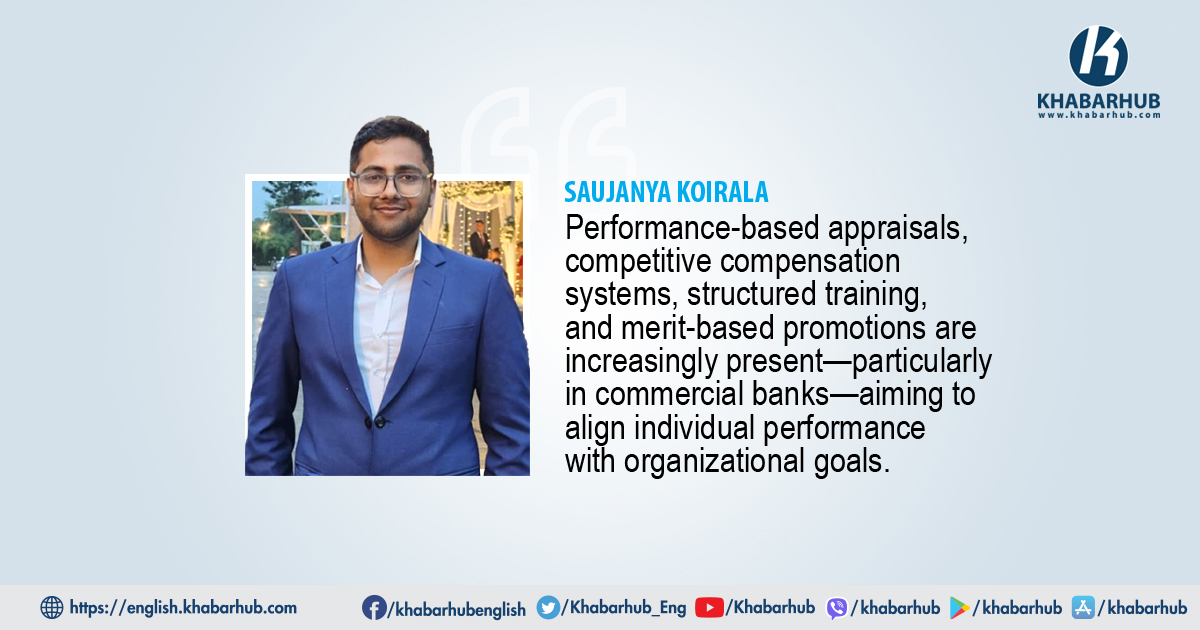
Modern human resource management (HRM) practices, when thoughtfully implemented, can significantly enhance employee satisfaction and organizational loyalty. Performance-based appraisals, competitive compensation systems, structured training, and merit-based promotions are increasingly present—particularly in commercial banks—aiming to align individual performance with organizational goals.
Among these, a healthy work environment and fair salaries have emerged as major contributors to employee satisfaction. Yet gaps remain. Many HR departments still treat training and performance reviews as checkbox exercises—generic, impersonal, and disconnected from individual developmental needs. Consequently, employees often perceive these systems as perfunctory rather than meaningful.
One of the most culturally entrenched issues in Nepali workplaces is the prevalence of nepotism and favoritism in decision-making. Promotions, rewards, and leadership opportunities are frequently allocated based on personal affiliations, family ties, or informal networks—often at the expense of merit.
This not only demoralizes competent employees but also fractures team unity. Talented individuals may lose motivation when they realize that their efforts are overlooked in favor of those with social capital. This breeds resentment and disengagement, undermining organizational cohesion.
When employees believe that success depends more on connections than competence, they are less likely to invest in their roles, contribute ideas, or commit to long-term growth.
Compounding these issues is a growing communication gap between employees and leadership, resulting in cultural disconnects. Disidentification begins when employees feel excluded or disrespected in organizational decision-making. This emotional distance—evident in reduced performance and innovation—leads to communication breakdowns and high staff turnover.
A workplace culture marked by rigid separation between management and staff stifles collaboration and organizational agility. This disconnect is particularly stark in hierarchically structured companies where decisions flow top-down and transparency is minimal. Bridging this gap requires not only policy reforms but also a shift in leadership mindset and approach.
Another emerging concern is the increasing “robotization” of HR departments. With the rise of automated systems for recruitment, performance evaluation, and monitoring, the human element is steadily diminishing. While digital tools can enhance efficiency, an overreliance on algorithms and mechanized procedures strips away empathy, context, and flexibility—crucial components of effective people management.
Employees treated as data points in a spreadsheet, rather than as individuals with unique aspirations and challenges, risk becoming dehumanized. This is especially damaging when performance reviews rely solely on metrics, with no room for qualitative feedback. Without emotional intelligence and human interaction, HR automation can exacerbate alienation rather than improve performance.
Conversely, organizations that foster emotionally intelligent leadership and a positive psychological climate tend to reap stronger outcomes. Emotional intelligence (EI) is a critical competency, particularly in Nepal’s IT sector, where innovation and teamwork are essential.
When employees feel seen, supported, and respected, they contribute not only more meaningfully but also more consistently, growing with the organization over time. For Nepali companies competing in a dynamic and demanding economic landscape, investing in such a culture is no longer optional—it is essential.
Leaders with high EI build trust, reduce interpersonal conflicts, and create psychologically safe spaces where employees feel empowered to share ideas and take ownership. A workplace culture characterized by mutual respect, transparency, and inclusion significantly enhances job satisfaction—especially among younger professionals. In high-pressure, fast-paced environments, emotional intelligence often matters as much as, if not more than, technical skills.
At the intersection of welfare, fairness, emotional intelligence, and cultural integrity lies a fundamental truth: employee productivity in Nepal is deeply human. It cannot be effectively managed through systems alone. Strategies must be paired with ethical values and inclusive processes that respect individuals not just as producers but as people.
Addressing structural problems such as favoritism and disconnection requires courage, commitment, and organizational accountability. Nepali institutions must actively dismantle informal power structures that obstruct merit-based growth and instead foster a culture where everyone has an equal opportunity to succeed, regardless of background.
Ultimately, the key to increased productivity is not just better tools or policies—it is the creation of a new workplace culture: transparent, fair, emotionally intelligent, and people-centered.
When employees feel seen, supported, and respected, they contribute not only more meaningfully but also more consistently, growing with the organization over time. For Nepali companies competing in a dynamic and demanding economic landscape, investing in such a culture is no longer optional—it is essential.






Comment