




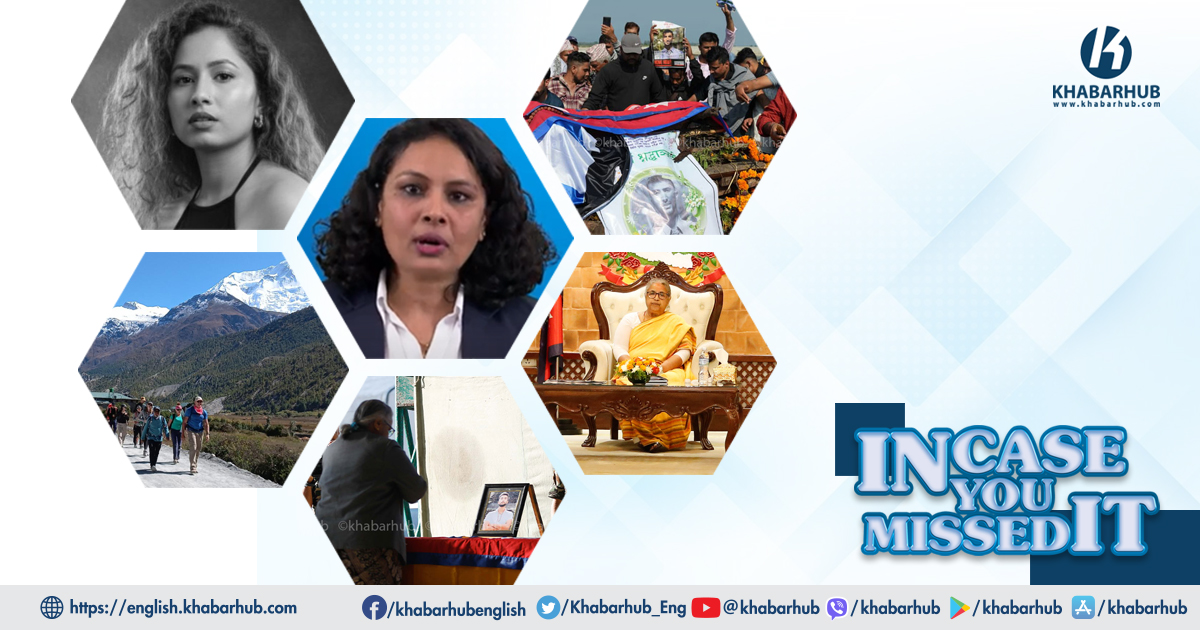
KATHMANDU: The past week in Nepal was a vivid intersection of political reaffirmation, cultural vitality, and collective mourning. From the Prime Minister’s call for unity and elections to the nation’s observance of Tihar and Mha Puja, from the exposure of a major corruption case to the cremation of a young man whose death captured international sympathy, the week captured Nepal’s state of flux — a country poised between desire for transformation and the drag of persistent dysfunctions.
This commentary examines the week’s developments as markers of Nepal’s ongoing negotiation between the old and the new — between traditional moral worlds and the evolving expectations of an assertive generation seeking transparency, equity, and accountability.
Prime Minister’s call for unity
Prime Minister Sushila Karki’s festival message served as both a symbolic gesture and a political statement. By invoking “peace, prosperity, and good governance” during the auspicious season of Tihar, Mha Puja, and Chhath, she sought to reframe the post-unrest narrative in terms of collective healing and national renewal.
The language of her address — “Let us not fall into confusion—let us come together to overcome despair and darkness” — consciously echoed the imagery of Tihar itself: a festival that celebrates the triumph of light over darkness, order over chaos.
Beyond its ceremonial tone, however, Karki’s message carried a strategic subtext. Her reaffirmation of elections within six months, specifically scheduled for March 5, 2026, was a necessary attempt to restore confidence in the democratic process after months of street protests, particularly by the Gen-Z movement. Her acknowledgment of this movement as “transformative” was politically astute — an attempt to co-opt its reformist energy into institutional channels.
By promising to “take decisive action against corruption” and to investigate “the suppression and violence during the Gen-Z movement,” the Prime Minister implicitly recognized the state’s moral crisis. The public, weary of impunity, corruption, and political stagnation, demanded more than procedural democracy. The moral authority of governance, rather than its formal legitimacy, had become the central concern.
Karki’s challenge now lies not in voicing unity, but in operationalizing it. Her ability to hold elections under a “clean, fair, and fearless environment” will determine whether her rhetoric translates into credibility. The fragility of political trust remains the critical fault line in Nepali democracy.
Institutional engagement and the vision of a ‘Green Election’
Complementing the Prime Minister’s vision, the Election Commission (EC) emphasized both modernization and sustainability by calling for a “green election.” This initiative, which seeks to replace traditional paper-based and polluting campaign practices with digital outreach, embodies Nepal’s aspiration to align with global environmental and technological standards.
Joint Secretary Yagya Prasad Bhattarai’s remarks about making elections “digital, sustainable, and pollution-free” highlight the EC’s ambition to recast democracy as not only procedural but also ecologically responsible. This shift also reflects an underlying recognition: environmental consciousness is increasingly intertwined with political ethics.
However, the practical challenges are significant. Much of Nepal’s electorate still resides in rural and semi-urban regions where digital infrastructure and literacy remain limited. The concept of “green elections” thus risks being confined to urban centers unless accompanied by substantial investment in connectivity, access, and voter education.
The registration of 122 political parties with the EC further indicates both the pluralistic vibrancy and the ideological fragmentation of Nepali politics. The proliferation of parties, many of them personality-driven or regionally confined, raises questions about the effectiveness of representation and the sustainability of coalition politics. Nonetheless, the EC’s insistence on institutional preparedness offers a glimmer of administrative stability amid political unpredictability.
Anti-corruption drive
Perhaps the most concrete development of the week was the CIAA’s corruption case against Dr. Sangita Kaushal Mishra, the former Director General of the Department of Health Services, and 13 others. The case involves Rs 140 million in irregularities related to the procurement of mammography machines — a classic illustration of systemic corruption in the health sector.
The Commission’s findings — falsified inspection reports, forged receipts, inflated prices, and collusion with private contractors — depict a bureaucratic culture deeply entrenched in institutionalized malpractice. That a public health procurement, meant to improve diagnostic services for women, became a site of profiteering underscores the moral erosion within public administration.
By seeking recovery of the embezzled amount and invoking multiple sections of the Prevention of Corruption Act, 2059, the CIAA has attempted to project institutional resolve. Yet public skepticism persists. Past experiences show that high-profile cases often dissolve into lengthy legal delays or political compromises. The outcome of this case will therefore serve as a litmus test for the government’s sincerity in delivering the “good governance” it promises.
This episode also exposes the deeper structural dilemma of post-1990 Nepali politics: while democracy expanded access to state resources, it also facilitated the commodification of governance, where administrative authority became a means of private enrichment. Unless systemic checks are institutionalized, anti-corruption efforts risk being episodic rather than transformative.
Grief and national solidarity
The return and cremation of Bipin Joshi, a 23-year-old Nepali student killed after being taken hostage by Hamas in 2023, became the emotional centerpiece of the week. His death, officially confirmed by Israel after two years, reignited national mourning and prompted rare expressions of cross-party empathy.
Prime Minister Karki’s gesture of draping the national flag over Joshi’s body at Tribhuvan International Airport was more than ceremonial; it was an act of symbolic nationhood, affirming collective grief as a binding moral force. Her words — “Bipin was the son of every Nepali mother. No one will ever forget him” — encapsulated a shared sorrow that transcended political divisions.
The funeral in Kanchanpur, attended by Israeli representatives and marked by the simultaneous display of Nepali and Israeli flags, underscored Nepal’s growing engagement with global humanitarian concerns. It also revealed the human costs of the country’s foreign labor and education programs, which send thousands of young Nepalis abroad each year in search of opportunity. Joshi’s death is thus not an isolated tragedy but a mirror reflecting the vulnerabilities of a generation caught between aspiration and precarity.
In a week otherwise dominated by bureaucratic and political news, this event reminded the nation of its shared emotional fabric — a unity that politics often struggles to achieve through policy alone.
Cultural cohesion and the philosophical depth of festivals
Amid the somber national mood, Nepal celebrated Tihar, Mha Puja, and Bhai Tika — festivals that reaffirm the spiritual and ethical foundations of Nepali identity. These observances, especially Mha Puja among the Newar community, underscore values of self-awareness, gratitude, and renewal.
As theologian Prof. Ramchandra Gautam explained, Mha Puja’s emphasis on self-worship is not egocentric but introspective, rooted in the belief that honoring the self aligns the individual with divine order. This philosophical orientation resonates with the broader theme of the week: reclaiming moral clarity in times of uncertainty.
Similarly, Bhai Tika, celebrating the bond between siblings, offered symbolic contrast to the political fragmentation and social anxieties dominating public discourse. In the ritual exchange of tika, garlands, and blessings, one witnesses Nepal’s enduring capacity for emotional renewal through tradition.
Tourism rebounds
The Himalayan district of Manang recorded more than 7,000 foreign tourists within six weeks, signaling a potential rebound for Nepal’s tourism sector. After months of decline due to protests and monsoon-related disruptions, the influx of visitors suggests a tentative economic revival.
Officials from the Annapurna Area Conservation Project (ACAP) noted that tourists from 87 countries had arrived, including a notable number from Israel, Germany, and the United Kingdom. This diversity underscores Nepal’s continued global appeal as a destination for trekking and cultural tourism.
However, as local hoteliers and entrepreneurs noted, numbers have not yet returned to pre-crisis levels. The lingering effects of political unrest and incidents such as the arson attack on a hotel have dented Nepal’s image of stability. The week’s tourism data thus reflects a fragile optimism: recovery is possible but contingent on sustained peace, security, and governance.
Violence and vulnerability
Amid the official optimism, two tragic incidents revealed deeper social undercurrents. The murder of 73-year-old priest Ramdular Sah in Saptari and the death of singer Nitu Paudel following a self-immolation attempt both drew public attention to issues of insecurity, mental health, and moral despair.
The priest’s killing — under mysterious circumstances at a rural temple — highlighted the erosion of communal safety and the persistence of lawlessness in parts of the Terai. Meanwhile, Paudel’s death in Kathmandu, reportedly linked to emotional distress, opened discussions about psychological fragility in creative professions, where economic pressure and public scrutiny often combine to devastating effect.
Together, these incidents suggest that beyond political reforms and festivals, Nepal faces a quieter but equally urgent crisis: a societal need for emotional and spiritual rehabilitation.
Between governance and grace
Taken together, the week’s developments illuminate the paradox of contemporary Nepal. On one hand, the Prime Minister’s rhetoric of renewal, the EC’s institutional initiatives, and the CIAA’s anti-corruption action project a state attempting to reform itself. On the other, the deaths, scandals, and cultural rituals of the week reveal a nation still seeking coherence between its moral ideals and its lived realities.
The Gen-Z movement, though not directly visible this week, remains a spectral presence in all these narratives — as the moral barometer against which governance, accountability, and reform are now measured. The movement’s emphasis on transparency, civic participation, and dignity continues to pressure the political establishment to modernize not only its methods but also its ethical compass.
Culturally, the week’s festivals provided moments of moral re-grounding, reminding the nation that the strength of Nepali society lies in its ability to renew itself through ritual and community. Politically, the week underscored that unity cannot be commanded; it must be earned through justice, inclusion, and tangible reform.
Conclusion: Toward a new social contract
Last week was thus not merely a series of discrete events but a collective meditation on Nepal’s direction. The Prime Minister’s appeal for unity, the administrative push for green elections, the exposure of corruption, the public mourning of a fallen youth, and the reaffirmation of ancient festivals together painted a nation struggling yet striving — torn between cynicism and hope.
The “new Nepal” that Karki envisions cannot emerge through speeches alone; it must be built upon the moral energy already evident in civil society, in mourning families, and in young citizens demanding integrity. The week’s mixture of light and shadow, of cultural joy and institutional reckoning, thus captured Nepal’s essential truth: a country still unfinished, still yearning for balance, but undeniably alive to the promise of renewal.


Comment