




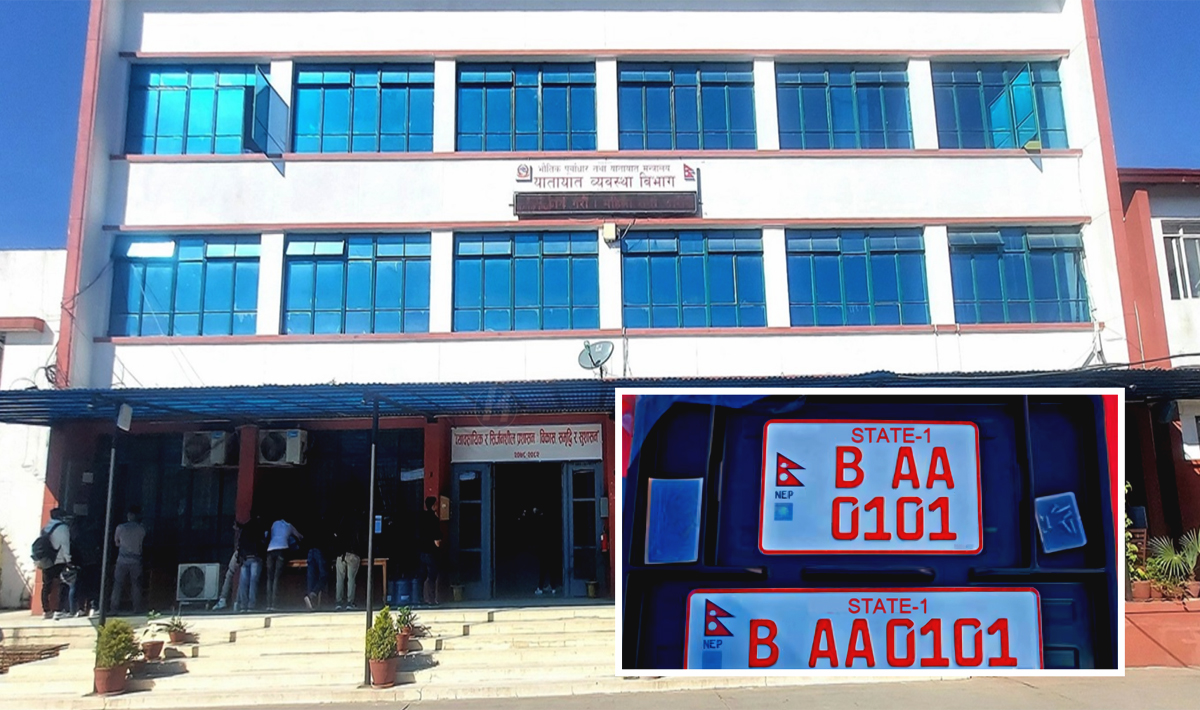
KATHMANDU: Starting from Asoj 1 (September 17), the government has mandated the use of high-security embossed number plates for vehicles across the country. However, many vehicle owners remain unaware of this decision, and the move has faced immediate pushback from stakeholders.
On Monday, the Nepal National Federation of Transport Entrepreneurs protested against the mandatory implementation, urging the government to reconsider the directive.
The Federation criticized the authorities for collecting fees for embossed number plates without establishing the necessary infrastructure. “At present, transport operators are simply renewing their tax documents under the old system, while also being charged for embossed plates,” the federation stated. “Without proper infrastructure, such revenue collection is unjustified. We call on the relevant ministry to immediately revise the directive.”
Tulsiram Koirala, a driver with 15 years of experience, voiced concern over the government’s habit of announcing policies without ensuring logistical support.
“Embossed number plates are used in India as well, but there they have a functioning system where the chip is scanned and driver information is instantly available,” he said.
“Here, there’s no data security, no clarity on which agency is tracking the vehicles. It feels like the government is more interested in selling plates than delivering services.”
“People are now being charged up to Rs 3,600 for plates they previously bought for just Rs 300. Before enforcing such a policy, the government should have explained its scientific rationale and clearly outlined the benefits to the country. That hasn’t happened, and without a strong foundation, the initiative risks failure,” he warned.
Prabhuram Sapkota from Melamchi also criticized the initiative, arguing that the government has failed to manage even basic services like traffic, and is now burdening the public with an expensive system.
“They are introducing complex systems without fixing the basics. We’re still stuck in traffic jams daily. How can we trust this system? There are also valid concerns about data privacy,” he said.
At the Department of Transport Management office in Min Bhawan, Ramhari Kunwar and Prajwal Chand from Balaju, who were there to apply for smart driving licenses, said they had no prior information about the new number plate system.
The concept of embossed number plates was introduced during FY 2072/073, with the goal of completing implementation by FY 2078. However, due to poor planning and execution, the rollout is now encountering significant resistance.
Currently, around 6 million vehicles are registered with the Department of Transport Management, though approximately 2 million are inactive. According to Director General Rajiv Pokharel, the first phase of implementation targets new, transferred, and renewed vehicles among the 4 million currently in operation.
“The legal and technical framework is now in place, so we’ve begun implementation,” said Pokharel. “However, rumors that all vehicles must immediately adopt embossed plates are incorrect. Right now, it applies only to specific categories like transfers and renewals.”
So far, around 100,000 vehicles have been fitted with embossed plates, and 600,000 more plates have been distributed to subordinate offices.
The Department, in collaboration with the traffic police, plans to install 10 Radio Frequency Identification (RFID) gates at key highway entry points in each province. “RFID gates have already been installed at Balaju and Thankot, which connect to the Nuwakot-Rasuwa corridor,” Pokharel said.
“Additional gates will be built at entry points into Kathmandu Valley and other major cities like Butwal and Pokhara. More gates will be added as needed.”
Pokharel highlighted the system’s potential benefits, including real-time data integration, vehicle tracking, theft prevention, and emergency response. “For example, during the landslide at Jhaple Khola near Thankot last year, it took days to confirm the buried vehicles. This system would significantly speed up such processes.”
He also noted the advantages for cross-border travel. “It will be easier to identify Nepali vehicles when traveling to countries like India, Bhutan, and Bangladesh.”
Currently, seven types of number plates are in use in Nepal. With the new system, there will be two colors—white and yellow—and four plate categories based on lettering.
“Previously, number plates were made based on the vehicle number. Now, plates are produced in a government facility only after detailed data about the vehicle and owner are verified and uploaded to the system,” Pokharel explained.
“The plates are tamper-proof—any attempt to remove them damages the plate—making it easier to combat vehicle theft.”
The government has already set the prices for embossed number plates across different vehicle categories. “Based on our agreement with the manufacturing company, the cost has been fixed at Rs 2,500 for motorcycles, Rs 2,900 for three-wheelers, Rs 3,200 for four-wheelers, and Rs 3,600 for large vehicles,” an official said.
While the government’s intention to modernize the transport sector through a digital system is commendable, there is little evidence to support the move as a scientifically sound decision, argues Saroj Sitaula, senior vice-president of the Nepal National Federation of Transport Entrepreneurs.
“The implementation of embossed number plates has been rushed and lacks necessary infrastructure. The scanning gates—especially at key points like Thankot and the Nuwakot-Rasuwa road section—remain non-functional. Despite fitting embossed plates, vehicle renewals and other administrative processes are still being conducted using old number plates,” he said. “It raises questions about the government’s commitment to establishing digital records.”
Sitaula also criticized the cost burden on consumers. “People are now being charged up to Rs 3,600 for plates they previously bought for just Rs 300. Before enforcing such a policy, the government should have explained its scientific rationale and clearly outlined the benefits to the country. That hasn’t happened, and without a strong foundation, the initiative risks failure,” he warned.
He suggested that the system could have gained public trust if it had been initially implemented on government and corporate vehicles, thereby setting a positive example.
On the other hand, transport infrastructure expert Ashish Gajurel called for constructive engagement instead of outright criticism.
“It’s true that the required infrastructure hasn’t been fully developed, but rather than opposing the initiative, we should help improve it. The focus now should be on expanding infrastructure to support the system. A positive and optimistic approach is necessary,” he said.
To support the rollout, the government plans to install embossed number plates on 2.5 million vehicles in the first phase. In line with this, an agreement was signed in 2073 BS with Decatur Tiger IT—a joint venture between U.S. and Bangladeshi companies. The $338.5 million project was scheduled for completion by 2078 BS.





Comment