




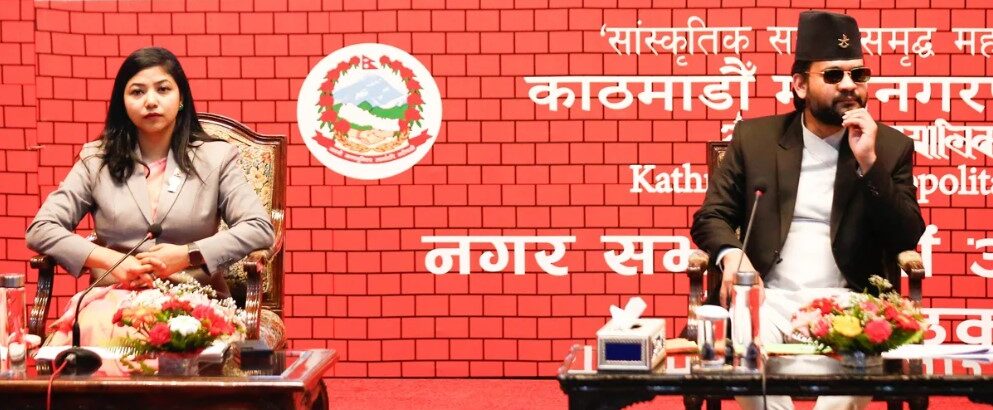
KATHMANDU: Sub-section 1 of Section 17 of the Local Government Operation Act, 2074 BS, mandates that an executive meeting of a local government be held at least once a month.
However, this legal provision has been ignored in the case of Kathmandu Metropolitan City (KMC), where no executive meeting has taken place for the past six months.
As the time approaches to discuss and set priorities for the upcoming fiscal year 2082/83 (2025/26) budget, the absence of an executive meeting has raised serious concerns. Uncertainty looms over whether the metropolis will even be able to present its annual budget.
Mayor Balendra Shah (Balen), elected as an independent candidate, has not called an executive meeting since December 2024.
Mayor’s legal obligations remain unmet
According to Clause (a) of Sub-section 4 of Section 16 of the Local Government Operation Act, the mayor is responsible for convening and presiding over both the municipal assembly and executive meetings. Sub-section (2) further states that the mayor must present the agenda to these meetings.
The Chief Administrative Officer, who serves as the member-secretary of the executive, must be notified by the mayor to convene the meeting. It is then the chief administrative officer’s responsibility to inform other members. However, Mayor Balen has not taken this step, further stalling the process.
Executive deadlock deepens
The impasse dates back to December, when Balen took action against Chief Administrative Officer Saroj Guragain, accusing him of irregularities in approving the design for Kathmandu Tower. Balen claimed Guragain approved a 19-storey structure instead of the permitted 12 floors.
Following this, Balen requested a new chief administrative officer from the federal government, which did not comply. Many believe Balen’s escalating conflict with Prime Minister and CPN-UML Chairman KP Sharma Oli has contributed to the central government’s reluctance.
During Guragain’s absence, the acting chief administrative officer was denied financial authority, bringing key operations of the metropolis to a halt. Salaries went unpaid, and development projects stalled.
The deadlock partially broke when Deputy Mayor Sunita Dangol, supported by ward chairpersons and staff, forcibly allowed Guragain to re-enter the metropolis office, overriding Mayor Balen’s orders. Since then, Guragain has resumed his duties, and halted payments—including staff salaries—have resumed.
Mayor and chief still not on speaking terms
Despite two months having passed since Guragain returned, Mayor Balen has neither met him nor officially acknowledged him as the chief administrative officer.
Without the mayor’s approval, Guragain cannot formally serve as the member-secretary of the executive, which means no executive meeting can legally proceed.
“There can be no executive meeting without a member-secretary, and that must be the chief administrative officer,” says Assistant Spokesperson Dhruv Kafle of the metropolis. “Even an acting chief administrative officer must be officially designated.”
Political imbalance in the executive
According to Article 214 of the Constitution of Nepal (2072 BS), executive authority at the local level lies with the municipal executive, subject to the constitution and laws.
Kathmandu Metropolitan City has 32 wards, with 18 ward chairpersons from the Nepali Congress, 12 from the UML, and one each from the Rastriya Swatantra Party and Maoist Centre. In addition, the municipal assembly elects five women members and three members from Dalit or minority communities.
With a clear majority in the executive, the Nepali Congress holds significant sway. If an executive meeting were to be held, decisions could easily go against Mayor Balen’s preferences.
The law states that a meeting reaches quorum with 50 percent of members present and that a simple majority can pass decisions if consensus is not reached.
This numerical disadvantage has led to speculation that Balen is deliberately avoiding executive meetings to prevent being sidelined.
Ward chairperson and metropolis spokesperson Navin Manandhar, a Congress representative, has been vocal in opposing Balen’s actions and was instrumental in allowing Guragain back into office. Since then, tensions between Manandhar and Balen have only escalated.
Assistant Spokesperson Kafle notes that the stagnation in city governance is due in part to the concentration of authority in the hands of the mayor.
“The legally designated officials work under the mayor, and their powers are defined by him. Without his coordination, operations remain paralyzed.”
Budget for the upcoming fiscal year in limbo
Kathmandu Metropolitan City is facing a state of confusion regarding the preparation of its budget for the upcoming fiscal year, as the essential pre-budget process remains stalled due to the absence of executive meetings.
The pre-budget discussion, usually coordinated by the mayor, sets the foundation for the entire budget process. A committee led by the mayor is responsible for setting resource ceilings, determining total budget limits, and drafting a budget outline based on guidelines and projected priorities.
This committee must also recommend sectoral programs and set overall direction for the upcoming fiscal year.
Following this, the budget formulation committee, coordinated by the deputy mayor, is tasked with refining the budget. The committee identifies financial resources, reviews revenue collection, and considers program and project requests.
It also evaluates which proposed programs have detailed project reports (DPRs), which projects can realistically be completed within the fiscal year, and how current year expenditures have been utilized.
As per procedure, the resource and monitoring committee must meet by Jestha 10 to ensure proper estimates of grants from the federal and provincial governments, anticipated revenue collection, and available cash balance.
This meeting plays a critical role in preparing the final draft of the budget. However, this year, none of these required meetings have taken place due to the prolonged deadlock in the metropolis’s executive leadership.
The legal provision mandates that the boundary determination committee meet by Jestha 10 to finalize the budget ceiling. The complete budget must be submitted to the municipal assembly by Asar 10 (June 24).
Between these two dates, a series of essential steps should occur: plan selection, draft preparation, budget allocation, discussion in thematic committees, and final approval by the executive.
The deputy mayor must submit the policy and program on Asar 10, which then becomes the basis for the final budget draft. If changes occur during this stage, the budget is adjusted accordingly.
Last year, preparations had begun as early as April last year. This year, however, there has been no progress at all. Spokesperson Naveen Manandhar confirmed that the process has not even begun.
According to him, the process typically starts with the executive meeting approving the date for the municipal assembly. After that, the mayor leads the boundary determination process, which then goes to thematic committees for discussion of ward-wise and sectoral plans.
Following these steps, the budget formulation committee led by the deputy mayor compiles and reviews plans submitted from each department and ward.
Once the programs are revised to match budget limitations, the executive must approve them before submission to the municipal assembly for discussion and final ratification. However, this standard process has come to a halt due to the lack of executive meetings.
Despite the absence of formal meetings, some internal work is continuing. Assistant spokesperson Dhruba Kafle explained that budget-related tasks are being carried out “offline.”
While both the resource ceiling and budget formulation committees have yet to convene, Kafle confirmed that departmental work is underway, particularly activities approved in last year’s budget and already endorsed by the municipal executive and assembly.
He added that the tasks delegated to specific departments in the previous fiscal year are still being carried out.
Once all components of the budget preparation process are complete, the draft will be presented to the municipal executive and then to the assembly for final approval.
That approved budget will then guide financial operations for the entire fiscal year. Kafle also noted that if policy-level changes are needed during the year, the authority to resolve them lies with the municipal executive, which is empowered to make necessary adjustments mid-year.
Spokesperson Manandhar believes that the mayor may still be planning to push the budget forward at the last moment. He remarked that since Asar has not yet passed, there is still time left, and the mayor might be preparing to move quickly once the process begins.
Meanwhile, there are several crucial issues that must legally be presented to the municipal executive. According to the Executive Performance Regulations issued on January 8, 2019, fifteen core agenda items are required to be tabled before the executive.
These include bills to be introduced in the assembly, the proposed annual budget, any supplementary budget estimates, borrowing proposals, and tax policy changes. The mayor’s official appointments and key decisions also need executive endorsement.
In addition, all rules, guidelines, procedures, and directives issued by the municipality, along with any new or amended policies, strategic development plans—whether short-term, medium-term, or long-term—and proposed changes to the organizational structure of municipal offices must go through the executive. Proposals for establishing sister-city relationships with national or international bodies are also subject to executive approval.
Furthermore, the executive must decide on matters related to foreign loans or grants, participation in national and international conferences, official travel or visits abroad, study and observation tours, appointments to municipal staff positions, the formulation and amendment of service-related laws, determination of public holidays, and other matters designated by prevailing legal provisions.
Until an executive meeting is convened and these mandatory items are formally discussed, the city’s budget process remains stalled and its financial future uncertain.





Comment