




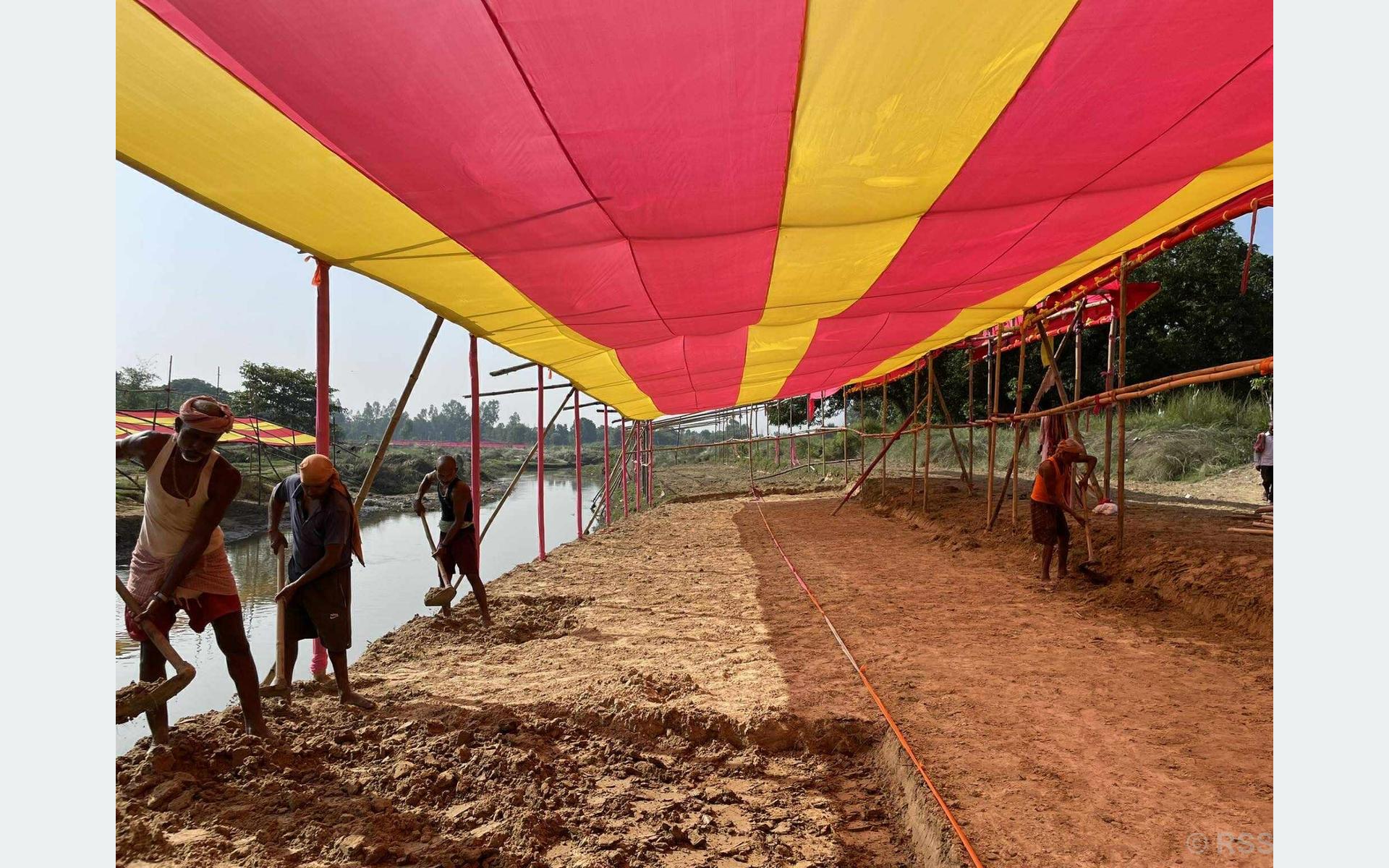
DHANUSHA: Preparations for Chhath, the festival symbolizing purity, discipline, and mutual harmony, have begun across the Mithila region. Once confined to the Madhesi community, the festival has now spread widely, including to Kathmandu and the hill regions.
The federal government has announced a public holiday on October 27 for Chhath, while the Madhesh provincial government has also declared a holiday on the following day.
According to Maithili culture expert Rambharos Kapadi, preparations are underway in all villages, towns, rivers, and ponds across Mithila, including the provincial headquarters, Janakpurdham.
Janakpurdham Sub-metropolitan City Mayor Manoj Sah said that cleaning of ponds, construction of ghats, and road repairs have begun ahead of the festival. Major reservoirs such as Gangasagar, Dhanush Sagar, and Argaja Pokhari are being cleaned and decorated with support from the local government.
As Chhath nears, local markets have become busier. Anita Devi Yadav, a resident of Kshireshwarnath Municipality–7, said banana prices have gone up this year due to increased demand, as bananas are a key offering during the rituals.
District Coordination Committee Coordinator Rajnandan Mandal said preparations are also underway at major Chhath venues in Mahendranagar, Dhalkebar, Sabaila, Godar, Shaheednagar, and Birendra Bazaar in Dhanusha district.
Chhath is regarded as one of the most rigorous and spiritually significant festivals. Dedicated to the Sun God (Surya) and Chhathi Maiya, it promotes truth, non-violence, and compassion for all beings. It is the only festival in the world where both the setting and rising sun are worshipped.
The roots of Chhath are deeply tied to Vedic traditions of sun worship. The Rigveda describes the Sun as the soul of the universe — “Surya Atma Jagatsya Sthupascha” — while the Atharva Veda portrays the Sun as the physical form of Brahma. The Surya Upanishad identifies the Sun with Brahma, Vishnu, and Rudra.
In Janakpurdham, major venues such as Gangasagar, Dhanush Sagar, and Argaja Pokhari attract between 6,000 and 15,000 devotees every year. The city’s historical ponds are cleaned and adorned “like a bride” to welcome worshippers.





Comment