



Following the failure to contain the Gen-Z-led protests on September 8 and 9, Prime Minister KP Sharma Oli resigned under pressure and was flown via a Nepali Army helicopter to an undisclosed location — later identified as a Nepali Army camp in Shivapuri. From there, he relocated to a rented residence in Gundu, Bhaktapur.
However, instead of addressing the tragic loss of 74 young lives or acknowledging the widespread destruction, Oli — Chairman of the CPN-UML — swiftly turned the narrative. He accused unnamed “foreign powers” of inciting the youth-led protests.
According to a party insider, Oli even mockingly stated, “I would rather sacrifice than bow to foreign powers,” claiming his resignation was an act of safeguarding the nation from foreign interference. Despite stepping down as Prime Minister, he firmly declared that he would not relinquish leadership of the party before its upcoming 11th General Convention. Described by those close to him as “calm and confident,” Oli showed no signs of regret over the unrest.
Sources inside the party say Oli has since been actively holding discussions with leaders of UML-affiliated organizations. One party leader who visited Gundu remarked, “From what we observed and heard, Oli clearly intends to continue leading the UML.”
This sentiment was echoed by CPN-UML General Secretary Shankar Pokharel during a private Zoom meeting last Sunday. Pokharel reportedly stated that there is currently “no viable alternative” to Oli and stressed that, during such turbulent times, the priority should be strengthening the party — not changing its leadership, and indicated some “foreign hands” in the protests.
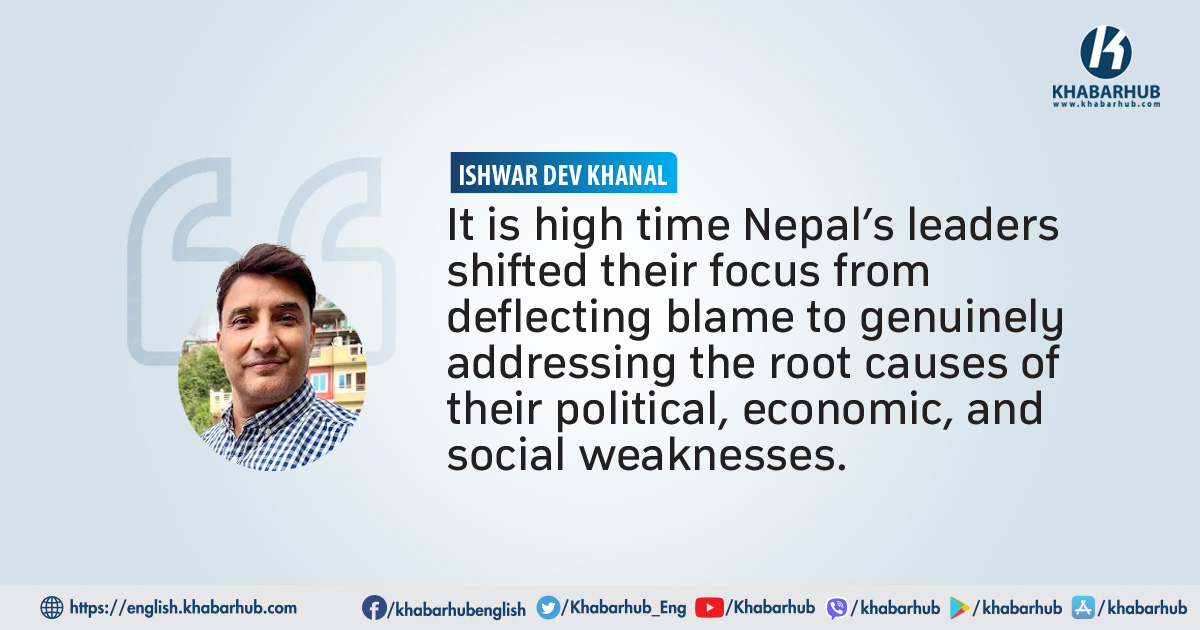
If political leaders continue to scapegoat “foreign powers” for every setback, they risk eroding public trust, alienating international allies, and avoiding the structural reforms Nepal urgently needs. It is high time Nepal’s leaders shifted their focus from deflecting blame to genuinely addressing the root causes of their political, economic, and social weaknesses.
Yet, what is once again evident in Nepal’s political discourse is a troubling pattern: political leaders — and at times, members of the intelligentsia — frequently blame “foreign powers” like India, China, or Western countries for domestic unrest, political changes, or their own failures. These claims, however, are often made without offering any concrete evidence.
The recent Gen-Z protests, which culminated in the deaths of 72 young people, are the latest example. The government’s attribution of the unrest to foreign involvement has sparked public skepticism, anger, and further provocation. As observers note, such statements appear more like diversion tactics — aimed at shifting public attention away from the leadership’s own shortcomings.
The prevailing narrative in Nepal suggests that the United States was displeased with KP Oli after he appeared on the same platform as Chinese President Xi Jinping, Russian President Vladimir Putin, Indian Prime Minister Narendra Modi, and North Korean leader Kim Jong Un at the SCO Summit in China. As a result, some speculate that the U.S. played a role in inciting the Gen-Z movement in Nepal to destabilize the Oli-led government.
Another widely circulated narrative claims that India, also reportedly unhappy with Oli’s leadership, sought a way to remove him from power and thus allegedly supported or fueled the Gen-Z protests.
Psychological studies suggest a cognitive bias known as “positive-negative asymmetry,” where individuals — especially those accustomed to power and privilege — are more likely to blame external factors rather than admit fault. This defense mechanism is frequently employed by political leaders to deflect accountability.
In Nepal, the “foreign powers” narrative has become a political crutch — invoked by leaders across the spectrum whenever they face criticism or crisis. Civil society figures and party-affiliated individuals who brand themselves as “professionals” are also not immune. Rather than engage in introspection or take responsibility, many opt for self-defensive communication strategies that stoke nationalism and suspicion.
This is not new. In September 2024, Oli publicly accused India of trying to undermine his authority, reviving old tensions with the southern neighbor. Over the years, Nepal has witnessed major political upheavals — from the 1990 democratic movement to the Maoist insurgency and the abolition of the monarchy.
Following the “Gen Z” protests, Oli stated that much of the violence was instigated by infiltrators involved in a conspiracy. He also asserted that the police lacked the type of automatic weapons reportedly used during the unrest, hinting at the possibility of external forces being involved.
Similarly, in June 2025, KP Oli openly accused foreign-funded Non-Governmental Organizations of contributing to instability in Nepal, claiming they were playing a disruptive role in the country’s internal affairs.
In January 2024, he alleged the Nepali Congress (NC), with the covert backing of certain foreign powers, was attempting to overthrow the Maoist Centre-led government before it had even secured a vote of confidence.
In each case, some political figures have pointed to foreign involvement. During the Maoist insurgency, for instance, various leaders blamed India for meddling in Nepal’s internal affairs, while some accused the United States of covertly supporting the Maoists to destabilize the country.
Nepal’s geopolitical position — wedged between two powerful neighbors, India and China — undeniably places it in a sensitive strategic zone. Its economy, heavily dependent on remittances, foreign aid, and trade, also leaves it vulnerable to external pressures. But while these realities are significant, using them as a blanket excuse for internal failure is both irresponsible and damaging.
This blame game, often masked in the language of nationalism, risks harming Nepal’s long-term diplomatic relationships. More dangerously, it hampers the nation’s ability to confront and solve its internal challenges.
If political leaders continue to scapegoat “foreign powers” for every setback, they risk eroding public trust, alienating international allies, and avoiding the structural reforms Nepal urgently needs. It is high time Nepal’s leaders shifted their focus from deflecting blame to genuinely addressing the root causes of their political, economic, and social weaknesses.
Leadership requires accountability — not convenient distractions. And in moments of dissent, leaders must choose their words — and their enemies — wisely.





Comment