




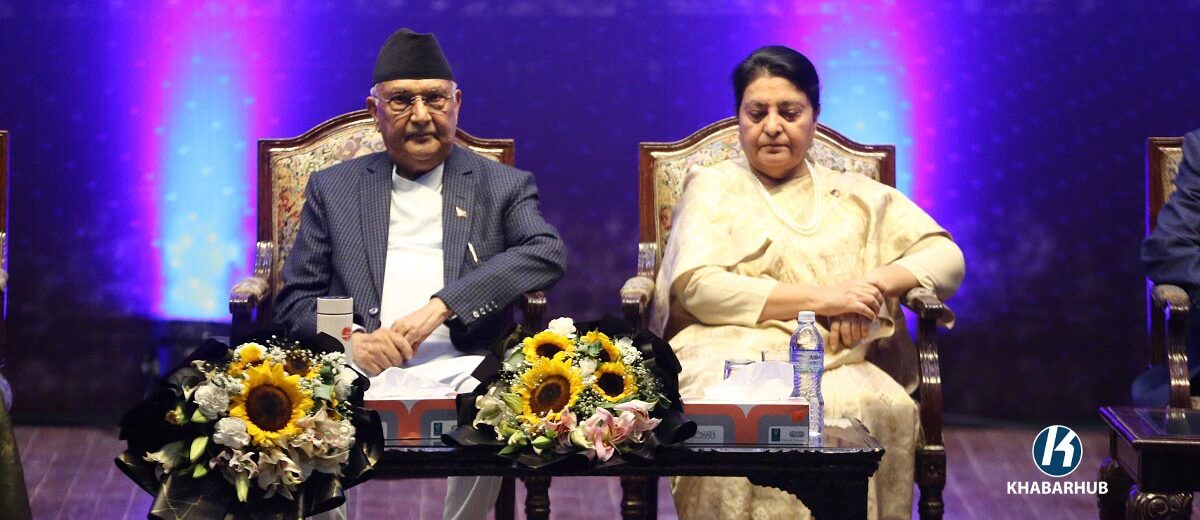
KATHMANDU: Former President Bidya Devi Bhandari has accused CPN-UML chairperson KP Sharma Oli of abandoning the very democratic values he once promoted, signaling deepening rifts within Nepal’s ruling party.
Speaking to a select group of journalists at her residence on Tuesday, Bhandari offered a sweeping narrative of her political journey post-republic and her return to active politics. But it was her pointed critique of Oli’s leadership that stood out.
Bhandari, who announced her return to active politics on June 28, described her decision as a natural continuation of her political life, motivated by the current ideological drift within UML. She revealed that despite internal resistance within the party, particularly from Oli, she had made up her mind to re-enter political life and would not back down.
In the closed-door briefing, Bhandari delivered what amounted to a political memoir, recounting her ascent to the presidency, her constitutional decisions, and her view of the party’s declining commitment to internal democracy. In doing so, she directly challenged Oli’s leadership, accusing him of undermining the very principles he once authored.
“The same Comrade KP, who once introduced a document on internal democratization of the party, now stands against it,” Bhandari said. “Everyone else now seems like a nobody to him.”
Bhandari cited the controversial UML document on party democratization, championed by Oli himself, which had advocated for age limits, term limits, and restrictions on factionalism. She implied that Oli, now clinging to the reins of the party, had become what he once opposed.
Presidential years and Oli’s interference
Reflecting on her presidential tenure, Bhandari claimed her appointment had not been born out of personal ambition but was a decision taken under party directive and in line with the legacy of Madan Bhandari’s “People’s Multiparty Democracy.”
She said the proposal had surprised her, coming only three days before the actual nomination, adding that even her daughters were against it, calling the ceremonial post insufficient for real impact.
“My daughters opposed it. They said Madan’s dream could not be fulfilled from a ceremonial position. But I accepted it for the sake of UML and its ideological continuity,” she said.
Bhandari also opened up about the events around Nepal’s 2015 constitution-making process, stating she had wanted Subas Nembang to continue as Speaker and Ram Baran Yadav to retain the presidency under a tripartite deal where the UML would claim the prime ministership and the Maoists the speakership.
That plan collapsed, she said, after the Nepali Congress backed out, leading to her eventual presidential appointment.
Parliamentary dissolution defense
Touching on the twin parliamentary dissolution moves made under Oli’s cabinet in 2020 and 2021, both of which were later overturned by the Supreme Court, Bhandari defended her actions, saying she had only acted within the constitutional mandate of the President.
“I dissolved the Parliament. The Supreme Court did its job; I did mine. My actions were within the constitutional scope of the presidency,” she asserted.
Missed opportunity for party chair
Bhandari also reflected on the 9th General Convention of UML in 2014, held in Kathmandu, revealing that she had considered running for party chair. She claimed that there had been a belief that her candidacy might prevail due to gender-based political sentiment, but circumstances changed after senior leader Bamdev Gautam backed Oli.
On returning to politics
Declaring her political comeback irreversible, Bhandari said she had renewed her party membership in April 13, 2024, and said her commitment to party reform.
“It was KP Oli who once said, ‘If the party or country needs you, you must return to politics.’ I’m acting on that same principle,” she said.
She expressed concern over the ideological erosion within UML, accusing the leadership of prioritizing factional debates and power struggles over ideological clarity. She also criticized the ongoing internal discussions about leadership changes, saying they were premature in the absence of a set date for the party’s next general convention.
“Talking about leadership without fixing the date for the 11th General Convention is inappropriate. The current meeting is focused more on power, less on policy,” she said.
Disagreement over Madan Bhandari’s legacy
In one of the more emotionally charged moments, Bhandari recounted a disagreement with Oli over the celebration of Madan Bhandari’s 75th birth anniversary. She said she had proposed forming a committee involving top UML leaders, including Oli as patron and one of the vice-chairs. However, Oli had refused.
“I suggested making Comrade KP the patron of the committee and including vice-chairpersons. But he rejected it,” she said. “Even when I proposed involving heads of party-affiliated organizations, I was told they were too busy.”




Comment