




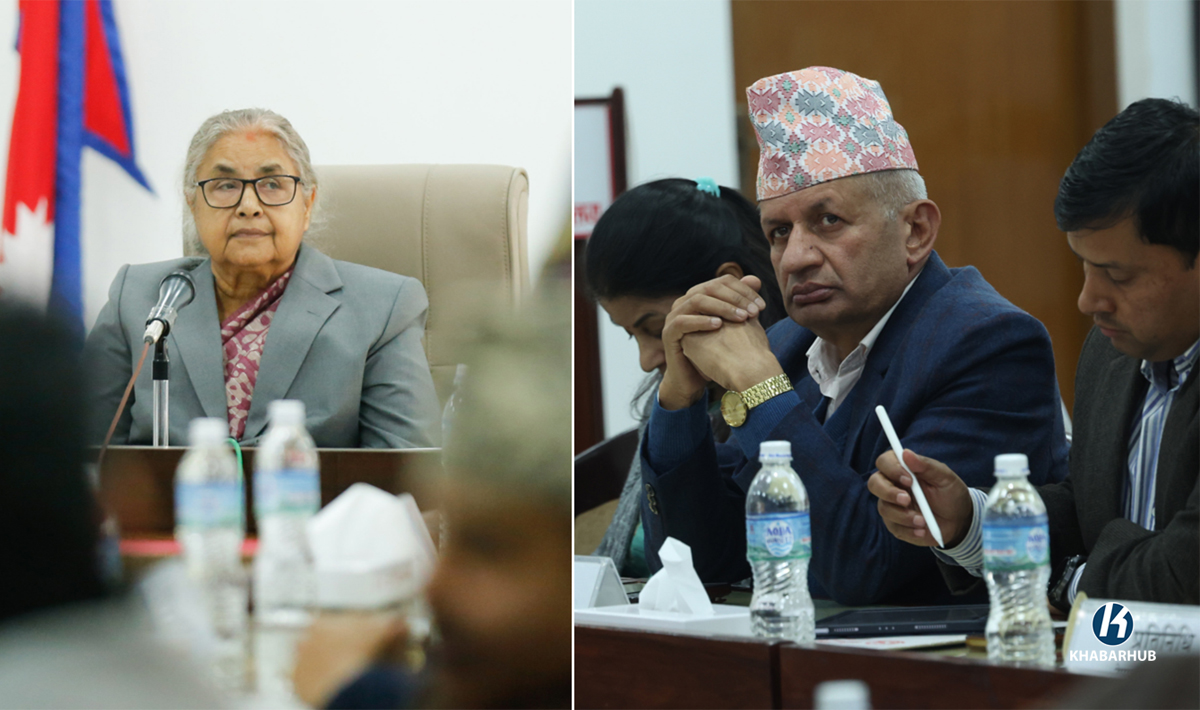
KATHMANDU: The interim government under the leadership of Prime Minister Sushila Karki appears determined to hold elections on March 5, 2026, as indicated by her recent steps.
She has been holding intensive consultations with the Election Commission, political parties, and donor agencies. On Wednesday, she met with 110 parties registered with the Election Commission to hear their views on election preparations. Most parties expressed readiness for elections and emphasized holding polls rather than restoring the dissolved House of Representatives.
However, the Nepali Congress and the CPN-UML remain skeptical. Their doubts have deepened following the incident in Simara, Bara, where UML leaders were obstructed during a demonstration on Wednesday. Nepali Congress leaders have also publicly stated that such incidents could hinder the elections scheduled for March 5, 2026.
The UML has already declared the dissolution of the House of Representatives (HoR) and the formation of the current government as unconstitutional. In its response to the Supreme Court on Wednesday, UML Chair KP Sharma Oli stated that all decisions taken by Prime Minister Karki should be annulled because she is an “illegitimate Prime Minister.”
While the UML has not accepted the legitimacy of the government, the Nepali Congress has also been unsettled by the Simara incident. By demanding elections while simultaneously facing obstructions to their leaders’ movement, both major parties have raised concerns about the fairness of the upcoming polls.
UML Chair Oli remains restricted “for investigation,” while Nepali Congress President Sher Bahadur Deuba has travelled to Singapore, distancing himself from the ongoing inquiry.
From the Nepali Communist Party, leaders Rajendra Pandey and Barshaman Pun stated that elections were the only solution. “There is no alternative to a fresh mandate,” Pandey said, adding that the government must create an environment conducive to participation.
The UML continues to cast doubt on the interim government and has said it will file a petition at the Supreme Court demanding the reinstatement of parliament. The Nepali Congress, on the other hand, has said it will not go to the court, even if it has sufficient signatures from MPs to do so.
Prime Minister Karki convened an all-party meeting for the third time on Wednesday. The UML again criticized the government and questioned the fairness of the proposed elections. UML was represented by Deputy General Secretary Pradeep Gyawali and Chief Whip Mahesh Bartaula.
While most parties insisted that elections proceed on time and did not advocate for restoring the House, the UML maintained its stance on reinstatement. Nepali Congress leader Dr. Prakash Sharan Mahat stated that the Simara incident cast doubt on the fairness of the March 5, 2026 elections.
Leaders Rajendra Pandey and Barshaman Pun represented the newly formed Nepali Communist Party (a merger of the Maoist Centre and Unified Socialist), while Treasurer Lima Adhikari spoke for the Rastriya Swatantra Party.
Nepali Congress shows flexibility while UML seeks delay
Both Nepali Congress and the UML have a key responsibility in ensuring elections take place. Without their cooperation, elections would lose meaning. Prime Minister Karki cautioned on Wednesday that UML’s insistence on reinstating the House could fuel instability.
If Nepali Congress and UML become supportive, pressure will mount on the government to conduct the March 5, 2026 elections. Although Nepali Congress appears willing to participate, internal challenges—such as its special and regular general conventions—remain unresolved. UML’s reluctance to go to elections immediately adds to the uncertainty.
Amid Nepali Congress’s confusion, UML appears to be maneuvering to push elections beyond March 5, 2026. Having suffered political setbacks during the Gen-Z movement, UML is keen to enter elections only after returning to a position of strength.
The UML’s immediate objective is the revival of the dissolved House and securing a political win. The Gen-Z movement of September 8 and 9 dealt a significant blow to UML, forcing then–prime minister KP Sharma Oli to flee Baluwatar and damaging his public standing.
UML has tasked former Chief Whip Mahesh Bartaula and Whip Sunita Baral with filing the petition for House restoration. The party is currently preparing for its 11th general convention.
“UML is preparing to prolong the election as it does not see a comfortable environment for itself. Nepali Congress has accepted that the interim setup is a product of special circumstances and says elections must move forward,” said Ganesh Parajuli, Rastriya Swatantra Party (RSP) leader present at the meeting.
“The UML is stuck on restoring the House when the major party should be supporting elections. UML is trying to avoid the polls because it fears being tested by the people.”
What did the leaders say?
During Wednesday’s meeting, UML Deputy General Secretary Pradeep Gyawali urged others not to question his party’s commitment to democracy. Stating that the UML had historically fought for democratic values, he argued that raising doubts about the party’s willingness to participate in elections was “ridiculous.”
Gyawali said it would be inappropriate to comment further on the matter as the case regarding the restoration of the House of Representatives is currently before the Supreme Court.
“Our activities should be understood as a warning,” Gyawali said. “The election must take place in a peaceful and fearless environment. What message was sent by preventing UML leaders from going to Simara and halting previously scheduled programs? Did that ensure peace and security or not?”
He added, “Our 500,000 cadres must be able to mobilize confidently during the election. Everyone has a responsibility to maintain peace. Party meetings should be held freely. When leaders are restricted from traveling, how can elections be conducted fearlessly?”
Gyawali also questioned how many weapons and prisoners had been recovered following the Gen-G movement. He expressed concern about declining morale among security personnel and cautioned the government against unnecessary interference, whether in the name of meeting Gen-G demands or conducting elections.
“Pandora’s box may open,” he said. While acknowledging the Prime Minister’s strong stance against corruption, he questioned whether “silence in practice” had become a pattern.
Karki accused parties that had ruled for decades of lowering police morale. “Police were being deployed to wash dishes in the homes of leaders and their relatives. We ended that practice,” she said. “Now tell me—who lowered morale? We are rebuilding confidence that was eroded over the past 35 years. We are mobilizing resources and working to create an institution that every police officer can take pride in.”
He further criticized Energy Minister Kulman Ghising, saying that opening a political party while serving in government was inconsistent with the principles of a neutral interim government.
Nepali Congress: Elections must move forward
Nepali Congress leader Dr. Prakash Sharan Mahat said the elections should proceed regardless of which parties were invited to the meeting. “There must be peaceful and fearless elections—that should be our focus,” he said. “We recognize that this government is a product of a special situation. Parliament comes through elections, and that path should not be blocked. We should go for elections.”
What did other parties say?
From the Nepali Communist Party, leaders Rajendra Pandey and Barshaman Pun stated that elections were the only solution. “There is no alternative to a fresh mandate,” Pandey said, adding that the government must create an environment conducive to participation.
Lima Adhikari of the Rastriya Swatantra Party (RSP) said the political system must be respected and elections held on time. She emphasized the need for all parties to help address the demands raised by Gen-G and warned the government to avoid actions that appear to be motivated by political revenge.
A representative of the Rastriya Prajatantra Party (RPP) claimed that the public was seeking alternatives because “the current system has failed.” Other smaller parties also stressed the importance of creating a favorable environment for elections.
Election preparations 60 percent complete: PM Karki
Prime Minister Sushila Karki said that 60 percent of election preparations had been completed. She stated that election work had begun within three days of her assuming office, ensuring the Commission had the necessary resources.
According to Karki, 821 weapons looted during the Gen-Z movement on September 8 and 9 have been recovered, and 7,000 prisoners have been brought under control. She expressed firm commitment to conducting the elections on March 5, 2026 “at any cost.”
“We came to hold elections. We want this country to move into the hands of a new generation—leaders with vision,” Karki said. “I am not saying the corrupt of yesterday should return. But through fair elections, candidates should win with minimal cost and without the influence of money.”
She added that an environment was being created for low-cost campaigning. Responding to reports suggesting she might contest from Jhapa, she said, “I will not contest. I have not come here to fight elections.”
Karki accused parties that had ruled for decades of lowering police morale. “Police were being deployed to wash dishes in the homes of leaders and their relatives. We ended that practice,” she said. “Now tell me—who lowered morale? We are rebuilding confidence that was eroded over the past 35 years. We are mobilizing resources and working to create an institution that every police officer can take pride in.”



Comment