




KAILALI: Just two months ago, Jugrani Chaudhary of Tikapur Municipality–5 was struggling. Despite being busy with household chores all day, her work went unrecognized and unappreciated by her family. She felt mentally stressed, unable to contribute financially through domestic work alone.
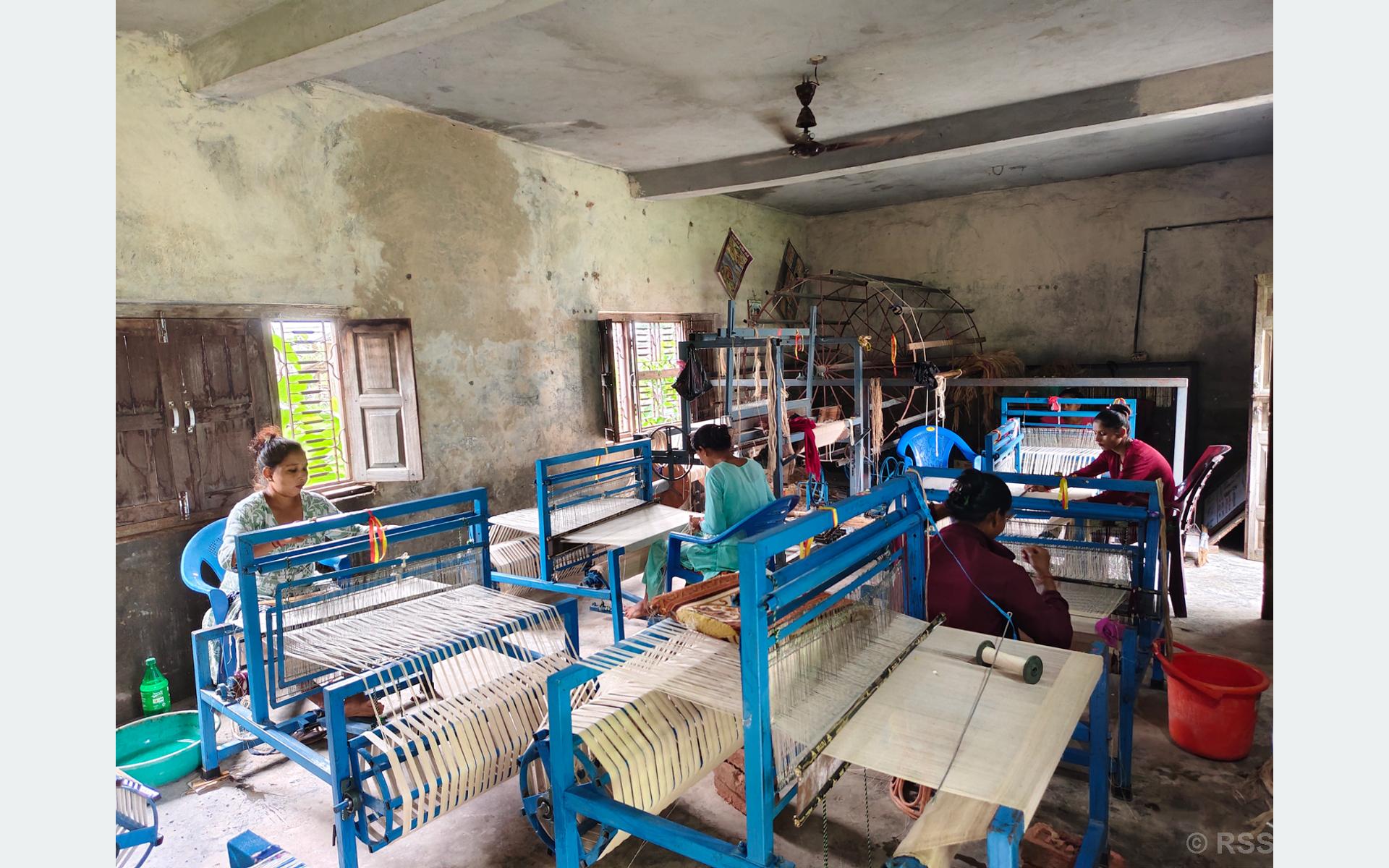
Today, her story has taken a remarkable turn. Jugrani’s life changed after she participated in a 25-day free training program organized by Dhansinghpur Ekata Samaj Saving and Credit Cooperative. The cooperative not only provided training but also supported her and other women with a power loom at a 50% grant, helping them connect with an income-generating enterprise.
Now, Jugrani weaves raw cloth from banana fiber—a sustainable and innovative practice that few in the region had imagined possible. “I didn’t even know cloth could be made from banana plants,” she shared. “Now, I weave every day. I feel independent for the first time.”
The cooperative trained eight women members in total, empowering them to transform banana plant waste into a source of income. The initiative has sparked excitement and a renewed sense of purpose among the participants.
“There’s no shortage of income if you have the right skills,” Jugrani said. “Even society’s perception of us has started to change.”
Kamala Saud, another trainee, echoed the sentiment: “Earlier, time passed slowly at home. Now, we’re so busy we barely have time for ourselves.”
The raw cloth produced by the women is being exported to Kathmandu, where it is purchased by the Allo Fiber market at Rs 300 per metre. However, demand is outpacing supply.
Sakuntala Chaudhary of Tikapur Municipality–7 said, “The demand for banana fiber cloth is very high. We haven’t been able to meet the demand from even a single company. With better equipment, we could produce much more.”
Currently, the cooperative facilitates the sale and transport of the fabric. For the past two years, it had been focused on producing and selling yarn from banana fiber. Now, with the introduction of weaving, their capacity is expanding—though not fast enough to meet market needs.
“We haven’t had to pay anything for raw materials,” said Ramkrishna Chaudhary, the cooperative’s manager. “But even so, the yarn we produce isn’t enough to meet demand. We can’t even produce enough for ourselves at this point.”
The women now hope for government support—particularly in the form of advanced training and modern equipment that would allow them to manufacture finished goods, not just raw fabric.
“We could earn more by producing goods like hats, bags, slippers, shoes, and quilts from this cloth,” said Kamala Kumari Chaudhary, another participant. “We’re willing to invest some of our own money, but we need help acquiring the necessary skills and machinery.”
She emphasized that while the local government spends millions every year on tailoring and sewing training programs, more attention should be given to utilizing local raw materials that often go to waste. “Tikapur is known for bananas,” she said. “If properly supported, every household here could become self-reliant just from the banana plant.”
Currently, over 1,000 hectares of land in Tikapur are used for banana cultivation. Once the bananas are harvested, the stems and other parts of the plant are usually discarded. The initiative by Dhansinghpur Cooperative proves that these by-products can be turned into valuable raw material for sustainable textiles.
The story of Jugrani Chaudhary and her peers is a testament to how targeted training, small investments, and local innovation can change lives—especially for women who are often excluded from economic opportunities.
Their message to the government is clear: Invest in skills, provide tools, and support local materials—and the women of Tikapur will do the rest.






Comment