




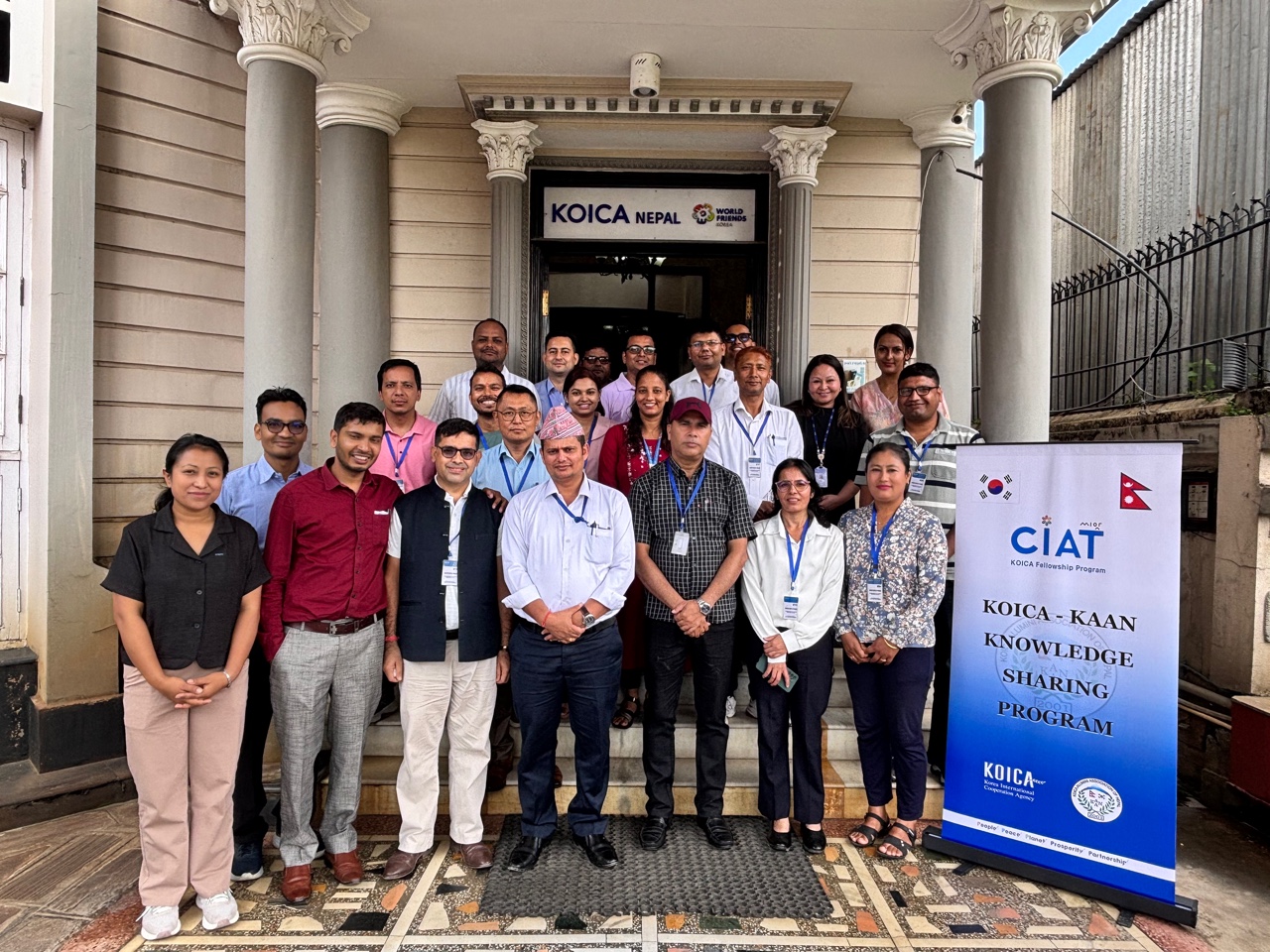
KATHMANDU: The KOICA Nepal Office organized a series of Pre-Departure Orientation Programs on August 20 and 21, 2025, for government officials traveling to Korea under the KOICA Capacity Improvement and Advancement for Tomorrow (CIAT) Fellowship Program.
On August 20, 15 officials from the Ministry of Education, Science and Technology, including representatives from CTEVT, participated in the orientation for the training program titled “Capacity Building of TVET Instructors on E-Learning in Nepal.”
Launched in 2023, this multi-year initiative is concluding in 2025. So far, 55 government officials from the Ministry have taken part in the program in Korea. During the session, KOICA Deputy Country Director Choong Hee Choi emphasized that the program would play a significant role in strengthening Nepal’s e-learning systems.
Similarly, on August 21, KOICA held a pre-departure orientation for 20 officials from the Ministry of Agriculture and Livestock Development, marking the launch of a new CIAT program: “Capacity Building for Agriculture Officers on Post-Harvest Management of Fruits and Vegetable Crops in Nepal.”
This multi-year project, running through 2027, aims to benefit 50 officials. The program draws on Korea’s experience to help improve Nepal’s agricultural policy and practices, particularly in post-harvest management.
The orientation was designed to ensure participants are well-prepared for their training. It covered program objectives, logistical details, and cultural aspects to help officials navigate their stay in Korea smoothly.
The session also featured a Knowledge Sharing Program, where Madan Marasini—an official from the Ministry of Agriculture and Livestock Development and a 2025 KOICA graduate from Kangwon National University—presented his thesis titled “Impact of Cooperative Participation of Wheat Seed Production Farmers on Technical Efficiency, Income, and Yield: The Case of the Terai Region in Lumbini Province, Nepal.”
Based on data from 121 farmers across four districts and using Stochastic Frontier Analysis and Propensity Score Matching, his research found that cooperative membership significantly reduced input costs and improved yields and gross margins.
However, the study noted that while cooperatives are efficient in input delivery, their role in enhancing overall production efficiency needs further development. The presentation underscored the potential of contract farming in supporting Nepal’s Seed Vision 2013–2025.
Since 1991, KOICA’s fellowship programs have supported over 2,200 Nepali government officials through Country-Specific, Multi-Country, and Scholarship programs.
This year, five additional officials have been awarded KOICA scholarships and are scheduled to depart in August 2025 to pursue Master’s degrees at prestigious universities in Korea.
KOICA remains committed to strengthening Nepal’s human resource development through continuous support in education, agriculture, and other key sectors.



Comment