




Imagine walking across the fallen and shattered remains of your home with uncertainty about the safety of your loved ones, where you lived happily just a moment ago, or wading through water as high as your waist, with trees and animal corpses floating in it. Many of us may have experienced similar events or witnessed them firsthand.
These events, which we usually term “natural disasters,” are inevitable and, at the same time, disquieting, as they cause widespread destruction, distressing scenes, undesirable and uncontrollable occurrences, and prolonged alterations in the social, environmental, economic, and psychological aspects of life.
On a different note, having grown up in an agricultural country and studied agricultural science and extension, I have personally witnessed the hardships farmers face due to irregular rainfall patterns. Since most parts of Nepal still rely on rain-fed agriculture, farmers eagerly wait for the monsoon for farming.
This signifies that the impacts of climate change and disasters range from simple changes in natural phenomena to massive catastrophes, leading to loss and damage at different levels.
Nepal is highly vulnerable to a wide range of natural disasters, including floods, landslides, heatwaves, hailstorms, droughts, fires, and public health epidemics. Youths are among the most affected groups, as they are directly exposed to these disasters and face the long-term consequences.
These disasters have wide-ranging impacts, not only causing loss of life and property but also creating long-term socio-economic and psychosocial challenges. We can still remember the devastating earthquake of 7.8 magnitude that struck the country on Saturday, 25th April 2015, which was followed by a 7.3 magnitude earthquake less than three weeks later and hundreds of aftershocks.
At the provincial level, each government has introduced its own laws and policies on disaster risk reduction and management, which include specific provisions for stakeholder involvement and youth mobilisation. More recently, local governments—municipalities and rural municipalities—have begun to formally acknowledge youth as a vital force in DRR.
The impact was immense, affecting around 2.8 million people, including 1.7 million children, across 14 districts. Nearly 9,000 people lost their lives, and over 100,000 people were injured. Many children and youth lost friends and family members, were injured, and faced the risk of lifelong disabilities, causing high levels of psychosocial distress among them and their families.
About one million children were unable to return to school due to the destruction of infrastructure and the deterioration of financial conditions. They were even deprived of necessities like nutritious food, clean water, shelter, and public health services, highlighting the vulnerability of communities to such catastrophic events.
Another major disaster that struck Nepal severely was the viral hazard that later escalated into the global COVID-19 pandemic. The outbreak, caused by the severe acute respiratory syndrome coronavirus 2 (SARS-CoV-2), originated in Wuhan, China, in December 2019.
This zoonotic viral disease, which initially spread from animals to humans, subsequently spread to other parts of Asia and then worldwide in early 2020. The World Health Organization (WHO) declared COVID-19 a public health emergency of international concern and subsequently announced it as a global pandemic.
Nepal reported its first confirmed case of COVID-19 in Kathmandu on 24 January 2020. As the cases spread rapidly across the country, the Nepal government imposed a nationwide lockdown on 24 March 2020, a measure that was unprecedented in its scale and impact.
Despite strict restrictions, the virus surged, and the highest daily surge in cases reached 10,258 on a single day in January 2022 during the second wave. By 20 June 2023, the global pandemic had claimed 12,031 lives in Nepal, according to the Ministry of Health and Population’s official COVID-19 dashboard.
The lockdowns, which were enforced multiple times during peak infection waves, were unlike anything any living generation of Nepalese had ever experienced. Their effects were far-reaching, particularly in a country heavily dependent on remittances from abroad. Economic activities came to a halt, and many people were left in challenging circumstances.
The global pandemic starkly revealed Nepal’s fragile public health system. Basic life-saving resources such as medical oxygen, intensive care beds, and diagnostic facilities were severely lacking. Recognising this, the Government of Nepal took prompt action to bolster healthcare capacity.
Public and private hospitals were supplied with additional beds, biosafety laboratories, ventilators, and oxygen production systems, enhancing the country’s ability to respond to the global pandemic.
During this national crisis, Nepal’s youth played a crucial role. Young public health professionals—including doctors, nurses, health assistants, and medical technicians—worked tirelessly on the frontlines.
Their commitment, even amid limited resources, saved many lives and demonstrated the resilience and dedication of Nepal’s youth in times of crisis. The pandemic disrupted lives and livelihoods across the nation, but it also emphasised the vital role of young people in disaster response.
At the same time, it is important to recognise that disasters affect youth in diverse ways—physically, socially, and psychologically. Many young people experienced internalised issues such as depression and anxiety, or externalised behaviours such as aggression and disruption.
For a disaster-prone and developing country like Nepal, fostering disaster resilience is essential to reducing long-term negative impacts. Building resilience involves educating children and youth about disaster risks and strengthening their coping capacities.
When young people recognise the severity of disasters and acquire adaptive skills, they are more willing and prepared to contribute to their communities’ preparedness, recovery, and resilience.
Why is it important to include youth in Disaster Risk Reduction (DRR) and Disaster Risk Management?
It is an undeniable fact that youth possess an inherent capacity to lead and contribute effectively to disaster management. Their communication skills, adaptability, flexibility, dedication, and willingness to unlearn and relearn make them valuable assets in DRR management and climate action.
In addition to speaking native languages, youth have a better ability to reach their peers and connect with their communities due to a shared perspective and intimate knowledge of the local context, allowing them to build quick rapport.
After the effective response of youth to major disasters in the country, such as the 2015 earthquake and the COVID-19 global pandemic, the Government of Nepal—more specifically, the Ministry of Youth and Sports—has become more proactive and open to the possibility of integrating youth into DRR policies.
However, much work is still needed to mainstream the inclusion and active participation of youth in disaster risk reduction, preparedness, response, and management.
The Government of Nepal has been gradually reshaping its approach to youth policy and engagement in DRR. This shift focuses on building youth capacity, encouraging their active role in governance, and integrating them into DRR strategies. These efforts are supported by both national initiatives and international organisations, including UNDP and UNDRR.
Nepal’s policy framework for DRR is guided by two key documents: the National Disaster Risk Reduction Policy, 2075 (NDRRP), and the National Disaster Risk Reduction Strategic Action Plan, 2018–2030 (NDRRSAP).
These align with the Sendai Framework for Disaster Risk Reduction, 2015–2030 (SFDRR) and emphasise inclusive, participatory approaches and cooperation among all stakeholders—government bodies, civil society, and especially youth.
Together, these policies highlight the importance of engaging youth in disaster management and recognise their active contribution as volunteers during and after disasters. The coordination of such stakeholder engagement is overseen by the National Disaster Risk Reduction and Management Authority (NDRRMA), the country’s DRR focal agency.
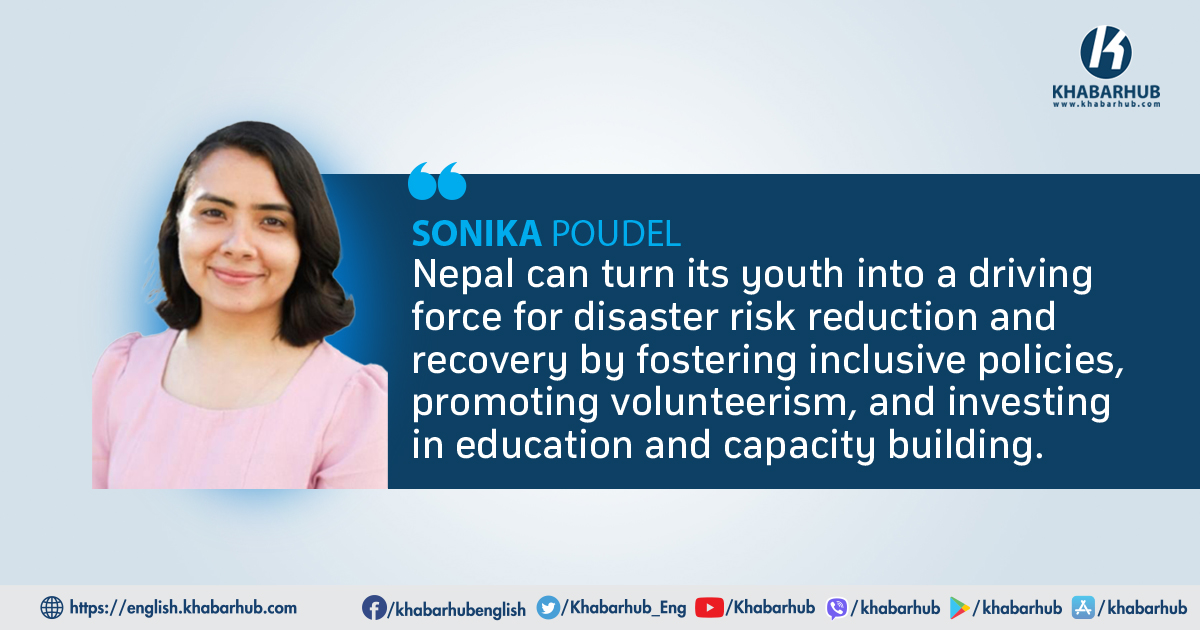
Youth engagement is not just helpful—it is essential for building strong, adaptive, and resilient communities. Nepal can turn its youth into a driving force for disaster risk reduction and recovery by fostering inclusive policies, promoting volunteerism, and investing in education and capacity building.
At the provincial level, each government has introduced its own laws and policies on disaster risk reduction and management, which include specific provisions for stakeholder involvement and youth mobilisation. More recently, local governments—municipalities and rural municipalities—have begun to formally acknowledge youth as a vital force in DRR.
They now incorporate youth in preparedness activities such as training and mock drills, community awareness programs, and disaster simulations, while also mobilising them during and after disasters. This marks a new foundation for youth participation in Nepal’s DRR landscape, but greater inclusion in governance and policy-making at all levels remains crucial to achieving the goals of the Sendai Framework in Nepal.
Youth possess great physical strength and strong determination, which can be utilised in rescue operations during emergencies, distributing relief packages, and helping to rebuild infrastructure post-disasters. Similarly, they have keen insight into the immediate needs of communities and can contribute meaningfully to decision-making processes.
They can educate local communities about disasters and teach coping mechanisms for use before, during, and after an event. This can, to some extent, reduce panic and chaos during disasters. Engaging in community volunteer activities helps to build capacity further, with the skills, leadership, experience, and confidence acquired benefiting youth in pursuing employment with humanitarian and development agencies.
Regardless of program objectives, the experience of working in the context of disaster response and management is valuable for future preparedness, leading to the empowerment and capacity-building of the youth involved.
Nepal’s vulnerability to disasters will continue to challenge its path toward achieving sustainable development. However, by strengthening disaster resilience and empowering youth, the country can reduce these risks and build a more secure future.
Youth engagement is not just helpful—it is essential for building strong, adaptive, and resilient communities. Nepal can turn its youth into a driving force for disaster risk reduction and recovery by fostering inclusive policies, promoting volunteerism, and investing in education and capacity building.
(Sonika Poudel is currently pursuing advanced graduate studies in Agricultural Extension Education in the USA)





Comment