



On Thursday, a group of self-proclaimed ‘civil society leaders’ held wide-ranging consultations with President Ram Chandra Paudel to discuss the latest political developments, particularly in the aftermath of the Gen-Z protests on September 8 and 9, 2025.
To be fair, the issues raised in the meeting were legitimate. Safeguarding the Constitution and protecting Nepal’s political system are essential. Many in the country agree that the Constitution needs to be defended against both internal and external threats.
But here’s where the real question emerges: who exactly are these so-called ‘civil society leaders’? Most of them are relatively unknown to the public, with little to no grassroots presence. Many appear to have strong political affiliations, making their presence in such high-level consultations questionable.
Why were these figures, largely seen as partisan or aligned with political interests, speaking on behalf of the public during such a crucial time? And more importantly, where were they when it mattered the most? When 19 Gen-Z protesters lost their lives on September 8, where were these voices? When government buildings were set on fire, and when public unrest surged across the country, did they come forward to condemn the violence or hold the government accountable? Did they challenge then-Prime Minister KP Oli or Home Minister Ramesh Lekhak? Did they (undergoing identity crisis) demand justice for the victims or answers from those in power?
It seems not. Aside from a few exceptions, these individuals remained silent. Perhaps their political affiliations or personal ambitions kept them from speaking out. Some are widely accused of being partisan actors dressed up as neutral civic voices — individuals more concerned with preserving their access to power than defending democratic values. And yet, they continue to present themselves as defenders of human rights and justice, insisting they stand above politics, when in fact, their actions betray a different truth.
Nepal’s political history has repeatedly shown that such claims often collapse under scrutiny. These individuals are frequently framed as elitist, disconnected from ordinary citizens, and far removed from the realities most Nepalis face daily. They appear to speak from air-conditioned meeting halls in Kathmandu, not from the streets or the communities they claim to represent. Their activism, if it can be called that, is selective and often self-serving. Most of them are absent when it comes to advocating for systemic change, be it justice reform, institutional accountability, or grassroots empowerment.
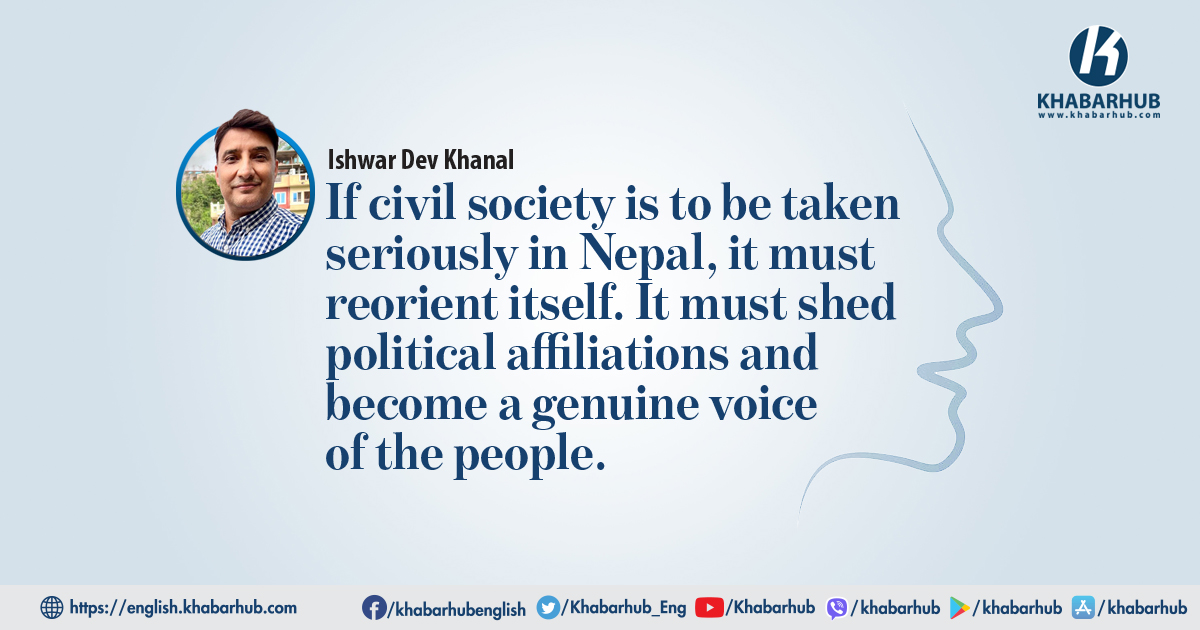
If civil society is to be taken seriously in Nepal, it must reorient itself. It must shed political affiliations and become a genuine voice of the people.
If we’re being honest, these so-called leaders have not led any serious campaign against corruption, have not consistently spoken out on issues of governance, and have not been seen mobilizing public opinion in any meaningful way. Where were their voices when inflation spiraled out of control? When student rights were trampled? When political appointments were blatantly made through nepotism and favoritism? Their silence has been louder than any of their statements.
With all due respect, civil society leadership is not about proximity to power or media visibility. It is about standing up when it is inconvenient, speaking out when it is risky, and placing public interest above personal gain. True civil society actors are watchdogs — not lapdogs of the political elite. Their focus should be on advancing good governance, transparency, social justice, and democratic reform — not on cozying up to power under the guise of neutrality.
Without meaningful participation from civil society, no anti-corruption law or democratic mechanism can function effectively. Civil society plays a vital role in educating citizens about their rights and responsibilities, encouraging participation in the democratic process, and holding power to account. It should create platforms for open public debate, promote respect for diverse viewpoints, and inspire democratic values among the youth — especially among the Gen-Z generation who are demanding change and accountability today.
Instead, what we witness in Nepal is a small circle of individuals who have turned civil society into a club of vested interests. They organize occasional protests, hold high-level meetings, and issue statements — but only when their own interests are threatened. Rarely do they take the time to engage with local communities, understand grassroots grievances, or stand beside the public in times of real need.
Until then, the credibility of Nepal’s civil society will remain in question. And its self-proclaimed leaders will continue to be seen not as defenders of democracy, but as opportunists exploiting its language for their own gain.
They claim to represent the people, but their actions prove otherwise. They have not spoken out about the appalling state of roads and infrastructure, the widespread sale of adulterated food, environmental pollution, or the mental and physical health crises that plague ordinary citizens. These issues, which affect millions every day, are not part of their agenda. Why? Allegations: Because they are too focused on preserving their influence and aligning themselves with power structures that benefit them personally.
This leads to an obvious conclusion: if you have not been chosen by the people, if you do not speak for the people, and if your actions do not reflect public interest, then you should stop calling yourselves civil society leaders. That title is not self-bestowed. It is earned — through public trust, consistent advocacy, and a demonstrated commitment to values over ambition.
If civil society is to be taken seriously in Nepal, it must reorient itself. It must shed political affiliations and become a genuine voice of the people. It must engage directly with communities, listen to their concerns, organize meaningful debates, raise critical issues such as corruption and injustice, and put pressure on political parties to act in the public interest — not serve private agendas.
Until then, the credibility of Nepal’s civil society will remain in question. And its self-proclaimed leaders will continue to be seen not as defenders of democracy, but as opportunists exploiting its language for their own gain.



Comment