



May 10th lessened the risk to global instability and deflected the nuclear war with two longtime adversaries India and Pakistan after the announcement of the ceasefire by the triads, India, Pakistan and the United States of America (US).
Prime Minister (PM) Narendra Modi claimed that India had “only paused” its military action as PM Shehbaz Sharif who expressed gratitude to President Trump. The 22nd deadly terrorist attack on innocent tourists witnessed 26 dead and at least 17 injured in a hail of gunfire in Pahalgam, Jammu and Kashmir.
The four-day hostility comes with condemnation to acts of terrorism as well as to de-escalate the fear of intimidations revolving into a full-scale war and the use of nuclear weapons. The communique of the ceasefire by the US, India and Pakistan will be held at a neutral location to reduce tension. The conflict subsided with a clear message “No Tolerance for Terrorism”.
President Donald Trump made the initial announcement of a break in fighting over his social media platform, Truth Social, on Saturday morning. “After a long night of talks mediated by the US, I am pleased to announce that India and Pakistan have agreed to a full and immediate cease-fire,” he said. “Congratulations to both countries on using common sense and great intelligence. Thank you for your attention to this matter!”
Terrorism has emerged as the most persistent and multifaceted threats to peace, stability, and development in South Asia. An unsettled Kashmir dispute as well as geopolitical anxiety is a setback. The Pahalgam attack trails the 14 February 2019 Pulwama attack as well as the 5th August 2019 revocation of Article 370 that stripped its semi-autonomous status.
Modi in his initial response shortly after the attack pledged that those responsible for the “heinous act” will be brought to justice. “Their evil agenda will never succeed”. “Our resolve to fight terrorism is unshakeable and it will get even stronger.”
A little-known group called The Resistance Front (TRF) also known as the “Army of the Pure” emerged in 2019 with the aim to fight for Kashmir’s secession from India claimed responsibility at the earlier stage for the attack.
TRF is proxy of the Pakistan-based militant group Lashkar-e-Taiba (LeT), which has been designated as a terrorist group by the Indian government under the Unlawful Activities (Prevention) Act, Russia, the US and the United Nations (UN). A known fact that LeT possesses support by Inter-Services Intelligence (ISI) an intelligence agency of Pakistan.
It is one of many terrorists’ attacks in India and other parts of South Asia. While India remains one of the most affected nations, it is increasingly evident that terrorism transcends national borders, making it a regional menace rather than a challenge faced by one country alone.
LeT has mounted attacks on civilians, economic and military targets but Pahalgam shooting on tourist destination comes since the November 2008 Mumbai shootings that killed 160. The Kashmir region has been the subject of trilateral dispute among China, India and Pakistan since 1947.
‘Operation Sindoor’ was launch by the Indian Armed Forces at nine terrorists camps both in Pakistan Occupied Kashmir (PoK) and Punjab inside mainland Pakistan from where attacks against India have been planned and carried out.
These sites were reportedly linked to Jaish-e-Mohammed (JeM) and LeT; two groups answerable for carrying out terror attacks in India. Indian Foreign Secretary Vikram Misri stated Pakistan a ‘haven for terrorists,’ emphasising the operation’s focus on preventing further attacks.
Without regional collaboration and international support, terrorism could further destabilize South Asia, undermining peace, development, and security in both nations.
The attack has shattered Modi’s Kashmir narrative and also comes with shifting geostrategic environment in South Asia in addition is being wedged by China and US rivalry. The geostrategic landscape of South Asia is undergoing significant transformation, largely driven by China’s expanding influence across the region.
Beijing’s strategic goals—such as securing trade routes, accessing natural resources, and counterbalancing US presence—are reshaping alliances and regional politics. China’s subtle yet persistent policy push for reducing US influence in South Asia aligns with its broader regional ambitions, particularly in shaping outcomes in the continental and the Indian Ocean Region (IOR).
At the same time, China’s policy toward India remains a key factor. Border tensions, rivalry for regional leadership, and India’s growing alignment with Western powers, including the US, have led to a complex and often adversarial relationship.
Thus, China’s approach to South Asia is not only about expanding its own influence but also about containing India’s rise and creating a favorable balance of power in the region.
The intergovernmental organisations South Asia Association of Regional Cooperation (SAARC) and Bay of Bengal Initiative for Multi-Sectoral Technical and Economic Cooperation (BIMSTEC) are serious about terrorism and acts of terrorists and also have fundamental values to fight against terrorism. BIMSTEC joint military exercises with an aim top foster joint planning and preparation, institutionalise regional cooperation, assess plans and procedures, and enhance understanding and sharing of best practices on common challenges.
This nurtures a fundamental question: for a paradigm modification on regional counter-terrorism mechanism-redeploying from reactive employment to proactive deterrence. Arguing “Is terrorism merely India’s confrontation, or is it a South Asian challenge requiring collective action?”
The Scope of the Terrorism Threat in South Asia: The Regional Problem
Terrorism is gestated in inequality, multiplied through ideology, and maintained by political fragility. It is not just political response and no longer confined to battlefields. Yet counter-terrorism determinations remain fragmented—treating it only bilaterally with missing multilateral approach though charter exist as confronts stay put as a geopolitical challenge.
South Asia, home to nearly two billion people, is one of the most densely populated and geopolitically sensitive regions in the world continues to grapple with a significant and evolving terrorism threat, driven by a complex interplay of local insurgencies, transnational jihadist movements, and geopolitical tensions.
The region’s vulnerability is heightened at various times, suffered from terrorist activities, insurgencies, or religious extremism and the resurgence of extremist groups.
The Kashmir region evolves a triangular geopolitical dispute between Indian-administered Jammu and Kashmir, Pakistan-administered Azad Kashmir and Gilgit-Baltistan, and China-administered Aksai Chin and the Trans-Karakoram Tract.
In the contemporary strategic environment, the region has witnessed Chittisinghpura massacre where 35 Indian Sikh villagers were mass murdered on 20 March 2000, Uri attack in September 2016 killing 19 Indian soldiers, 40 paramilitary personnel were killed in Puwana in 2019. India hit an alleged military camp in Balakot with airstrikes. Pakistan responded with air raids, leading to a dogfight and the brief capture of an Indian pilot.
Both sides showed strength but avoided full-scale war. Two years later, in 2021, they agreed to the Line of Control (LoC) ceasefire, which was largely held – despite recurring militant attacks in Indian-administered Kashmir.
India and the international community accuse the TRF, LeT and JeM and Hizb-ul-Mujahideen (HuM) also called Hizb as terrorists organisations.
The United Nations Security Council (UNSC) states that JeM has links with al-Qaeda, Osama bin Laden and the Taliban. HuM also designated and placed sanctions by the US in 2017 as a “foreign terrorist organisation” is the largest indigenous rebel group based in Jammu and Kashmir that stands for the whole of Kashmir to be allowed to accede to Pakistan.
TRF is an offshoot of LeT, which calls for the “liberation” of Jammu and Kashmir and Ladakh. Islamic State of Iraq and Syria (ISIS) is also now a reality for South Asia, with the region facing an increasing risk of ISIS-inspired violence.
The UN states that LeT, a proxy militant organisation used by Pakistan against India was involved in 2000 Red Fort attack, the 2001 attack on India’s parliament, 2005 Delhi bombings and 2006 attack on Mumbai commuter trains that killed 189 people. 166 people were killed at several sites in Mumbai also known as the 26/11 Mumbai attacks. Other attacks are 2014 Kashmir election attacks and Pampore Encounter.
Western South Asia Afghanistan and Pakistan struggle with weak governance, economic hardship, and displaced populations, creating fertile ground for radicalisation and face escalating terrorism.
In 2023, Pakistan experienced a record surge in terrorism-related violence. The country recorded 641 militant attacks, resulting in 974 deaths and 1,351 injuries. This marked an 81% increase in fatalities compared to 2022. The majority of these incidents occurred in Khyber Pakhtunkhwa and Balochistan provinces.
Over 82% of the deaths were attributed to three major groups: Tehrik-e-Taliban Pakistan (TTP), Islamic State Khorasan (IS-K), and the Balochistan Liberation Army (BLA).
Following the Taliban’s return to power in 2021, Afghanistan has become a hub for global jihadist groups, including IS-K. These groups have been linked to multiple international terrorist attacks, raising concerns about the country’s role as a sanctuary for extremist activities.
Bangladesh and Maldives in the past have grappled with rising extremism. The deadliest Islamic attack in Bangladesh history also termed as 7/16 occurred on 1 July 2016 in Dhaka killing 29 people. Islamic State of Iraq and the Levant (ISIL) claimed responsibility, which was denied by Home Minister Asaduzzaman Khan and stated that the perpetrators belonged to Jamaat-ul-Mujahideen.
Nepal witnessed a communist movement settled through negotiation with pluralism as an ideal. Nepal experienced no acts of international terrorism, while 2020 saw many small incidents of politically motivated violence like the May 2019 Kathmandu bombing.
Sri Lanka defeated one of the longest-running civil wars in Asia the Liberation Tigers of Tamil Eelam (LTTE), which lasted nearly three decades. Despite counterterrorism efforts, cooperation remains limited, and trust issues persist.
Hotels, churches and residential houses in Colombo were targeted by ISIS related terrorist suicide bombing that killed 270 people with 500 injured on 21 April 2019. In November 2016 justice minister Wjjeyadasa Rajapakshe told the parliament that 32 Sri Lankan Muslims from well-educated and elite families joined ISIL.
Terrorist related bombings and attacks ignites new modus operandi for ISIS in South Asia, consisting of three elements: South Asian citizens returning to the region after joining its ranks in Syria; regional militant groups inspired by the ideology of ISIS, carrying out attacks in its name; and ISIS operating on the ground in South Asia, through provinces such as Islamic State – Khorasan Province (ISIS-KP).
Moreover, the porous borders, political instability, ethnic tensions, and socio-economic disparities across South Asia create fertile ground for terrorist networks to thrive and operate transnationally. In this context, terrorism is not an isolated challenge for India but a regional security crisis.
Amid all this India and Pakistan cease-fire appears to hold despite accusations of violations. India’s new counterterrorism doctrine says ‘any act of terrorism on Indian soil will be considered as an “Act of War” at the same time India may be considering renouncing its long-standing no-first-use nuclear doctrine which was adopted in 1998.
The 16 August 2019 tweet by Indian Defence Minister Rajnath Singh “India has strictly adhered to this doctrine,” Singh wrote, but “what happens in the future depends on the circumstances.” India formally published its nuclear command structure and reaffirmed its no-first-use policy, but added that a chemical or biological attack could warrant a retaliatory nuclear response, further conditioning the scope of its 1998 pledge in 2003.
India and Pakistan’s Position and Response
Diplomacy has intervened escalation by reaching an understanding to stop all firings and military actions on land, air and sea with immediate effect after four days of intense cross-border drone and missile strikes that brought the two countries teetering on the edge of full-scale war.
The announcement of the cease-fire while both nations have cross-border skirmishes and heightened military readiness, raising concerns about the potential for further escalation. The negotiations pivots on whether diplomacy can arbitrate further acts of terrorism and intensification.
When political and diplomatic manoeuvring for de-escalation and prevention of an all-out war was ongoing Indian armed forces launched high-precision military offensive targeting nine militant camps used for facilitating terrorists’ groups in mainland Pakistan and Pakistan occupied Kashmir (PoK).
India conducted with precise targets or the known terrorists bases like JeM in Bahawalpur and Jamat-ud-Dawa a front of LeT in Mureke in Punjab. At the same time Dabalpur and Muridke in Punjab also were hit, a province that has been prescribed by the UN sanctions committee. Indian officials confirmed the strikes were precise and avoided Pakistani military facilities.
While small-arms fire along the militarised LoC were exchanging a surface-to-surface tactical missile, named the Abdali Weapon System, with a range of 450km (280 miles), which can carry conventional and nuclear warheads was successfully tested.
The test firing came three days on 3rd May after Pakistan’s Information Minister Attaullah Tarar said of “credible intelligence” that India intends to launch a military strike within 24 to 36 hours. India has condemned and termed the test launch as a “blatant act of provocation.”
A tit-for-tat drone attacks with unmanned weapon across a volatile border mark the new phase in operations. India retaliated after Pakistan launched drones and missiles attack at three military bases in the Indian Administered Kashmir.
As Washington and other global powers urge restraint, the region is teetering on the edge of escalation, moving into a new drone era – one where ‘invisible eyes’ and unmanned precision may determine escalation or restraint.
Pakistan’s Defence Minister Khawaja Muhammad Asif has warned “not to underestimate Pakistan’s response” and that India’s attack “will not go unanswered”. He added during an interview with CNN after the strike that Pakistan had “already retaliated” by downing five Indian jets and a combat drone. He claimed “It’s all over social media, on Indian social media, not just our social media. The debris of these jets fell into Kashmir” when asked for evidences.
However the statement was seen as “inadequate” and disappointing by New Delhi even after Jaishankar engaged eight non-permanent member nations of the UNSC as part of its diplomatic offensive in addition it also comes as India mulls options to respond to the terror attack.
Indian Air Force claimed that Pakistan had used Turkish-made drones to target 36 locations in India’s western and northwestern regions, India-controlled Kashmir, and along the edge of the Arabian Sea. Islamabad denied these allegations and instead pointed to Indian drone strikes in Pakistan-controlled Kashmir. Each side has accused the other of being responsible for civilian deaths.
Both sides claim victory and accuses each other, bringing the total number of people said to have been killed since the fighting began on to around 48; while hostilities continues.
Reactions by both nuclear-armed India and Pakistan comes with diplomatic notes, denial and security measures.
Modi returned shortening his visit to Saudi Arabia, by which time Saudi Arabia had publicly decried the killings. He also will not visit Moscow’s invitation to attend Russia’s Victory Day Parade on May 9th that marks 80 years since the Soviet victory over Nazi Germany in World War II Day celebrations.
Modi in his initial response shortly after the attack pledged that those responsible for the “heinous act” will be brought to justice. “Their evil agenda will never succeed”. “Our resolve to fight terrorism is unshakeable and it will get even stronger.”
Indian Defense Minister Rajnath Singh condemned the attack and vowed a swift response as “extremely inhuman” and reaffirmed India’s zero-tolerance policy towards terrorism, vowing to bring the perpetrators and their supporters to justice.
“Those responsible and behind such an act will very soon hear our response, loud and clear”. He also stressed that “We won’t just reach those people who carried out the attack. We will also reach out to those who planned this from behind the scenes on our land.”
Khawaja Asif, first reacted that ‘Islamabad has nothing to do with it’ distanced from the bloodshed, as he called the violence as “home-grown” and part of a “wider rebellion” against New Delhi. “Pakistan has no link with the Pahalgam terror attack. These are not acts of foreign interference but local uprisings.”
Retaliatory moves as tensions rise with trade diplomatic economic and security measures follows.
Indian Cabinet Committee on Security (CCS) recognising the seriousness of the terrorist attack and Pakistan’s alleged support for cross-border terrorism took series of diplomatic measures-one of suspended the 1960 Indus Waters Treaty (IWT) invoking Article XII (3) for modification, which allocates 80% of the Indus River System’s water to Pakistan; citing The Wagah-Attari border crossing was closed; and Pakistani nationals with SAARC Visa Exemption Scheme (SVES) visas were cancelled. Diplomatic staff were also reduced from the present 55 to 30. Several security actions were undertaken: The Defence, Military, Naval, and Air Advisors in the Pakistani High Commission in New Delhi are declared persona non grata. India also withdrew its own Defence, Navy and Air advisors from the Indian High Commission in Islamabad.
Modi’s pledge to “identify, track, and punish” those responsible underscores “national resolve to deal a crushing blow to terrorism” with full confidence with the armed forces. Affirming “complete operational freedom to decide on the mode, targets and timing” to crush terrorism while widespread military exercises is being launched to track down the perpetrators.
Diplomatic measures and security concerns were expressed after the National Security Committee meeting chaired by Sharif-Pakistan rejected India’s decision to suspend the Indus Waters Treaty of 1960 on the grounds that the pact has no provision for unilateral suspension, usurpation of the rights of lower riparian will be considered and said any stopping or diversion of the flow of water belonging to Pakistan under the pact will be seen as an “act of war” and responded to with “full force” across the complete spectrum of National Power describing water as a “vital national interest”.
Downgrading diplomatic relation, a statement said that “airspace will be closed with immediate effect for all Indian owned or Indian operated airlines” and that trade with India, including to and from any third country through Pakistan, will be suspended forthwith”.
Pakistan declared the Indian defence, naval and air advisors in Islamabad persona non grata and that the Wagah border post will be closed. All cross-border transit from India through this route will be suspended and Indians who crossed via this post should return by April 30.
The statement says that it will “exercise the right to hold all bilateral agreements with India including but not limited to Simla Agreement in abeyance”, till India desists from “fomenting terrorism inside Pakistan; trans-national killings; and non-adherence to international law and UN Resolutions on Kashmir”.
The TRF, initially claiming responsibility, later retracted their statement, attributing it to a cyber intrusion. As New Delhi accuses; Islamabad denies involvement in the attack and called for a neutral investigation.
As Pakistan has condemned and denied claims of harbouring terror outfits, Pakistan’s Foreign Minister and Deputy Prime Minister Ishaq Dar referred to the perpetrators as “freedom fighters.” Speaking to reporters in Islamabad in Urdu said, “Ye toh hamein shukar guzar hona chahiyeh, wo freedom fighters bhi ho sakte hain… hamein nahi pta.. we don’t know… hamne honesty ke saath statement diya tha lekin mein smhja hu unhone (India) apne failure ko jo internal hai… ek baar phir indirectly Pakistan ko jo hai hawala karne ki koshish ki…” (We should be thankful; they [the terrorists] could also be freedom fighters. We don’t know. We made the statement honestly. However, I believe India is again trying to blame Pakistan for its internal failures indirectly.) “Those who carried out attacks in Jammu and Kashmir’s Pahalgam district on April 22 might be freedom fighters.”
Asif’s admission of backing and funding terrorist groups and has suffered from extremism and reforming past mistakes, which has been echoed by former Foreign Minister Bilawal Bhutto.
Asif in conversation with Sky News’s Yalda Hakim warned of an “all-out war” possible with India. when she asks him, “But you do admit, you do admit, sir, that Pakistan has had a long history of backing and supporting and training and funding these terrorist organisations?
Asif says, “We have been doing this ‘dirty work’ for the United States for about three decades… and the west, including Britain…That was a mistake, and we suffered for that, and that is why you are saying this to me. If we had not joined the war against the Soviet Union and later on the war after 9/11, Pakistan’s track record was unimpeachable.”
He also said “We are neighbours, we have problems we have some serious problems in Kashmir but we should be solving our problems through negotiations. We have had negotiations in the past but we do not have that mechanism anymore between our two countries.” Hinting it will escalate the situation; when asked What message do you have for Delhi.
The Indian military, when asked about Indian jets downed, said “losses are a part of combat” adding that all of India’s pilots were back home and had downed a few Pakistani planes. It furthered stated that 11 Pakistan Air Forces bases were strike including one in Rawalpindi, has lost 35 to 40 military personnel and 100 terrorists that included individuals such as Yusuf Azhar, Abdul Malik Rauf and Mudasir Ahmed, that were reportedly “involved in the hijack of IC814 and the Pulwama blast”.
The likelihood of terrorist in India and anywhere in South Asia cannot be ruled out.
Global Condemnation and Calls for De-escalation
The UN and the major powers have elicited widespread international condemnation, disapproval of the terrorist attack and concern and have called for restraint and dialogue.
UN Secretary General Guterres welcomed the ceasefire on 10 May to “contribute to lasting peace and foster an environment conducive to addressing broder, longstanding issues between the two countries” when he was reiterating condemnation “Targeting civilians is unacceptable – and those responsible must be brought to justice through credible and lawful means,”; on 5th May expressed deep concern over deteriorating relations between the two South Asian neighbours, saying they had reached “their highest in years.”
Chinese Foreign Ministry statement said “As Pakistan’s ironclad friend and all-weather strategic cooperative partner, China fully understands Pakistan’s legitimate security concerns and supports Pakistan in safeguarding its sovereignty and security interests.”
While he has offered to help de-escalate to help defuse tensions, promote diplomacy with a renewed commitment to peace as well as prevent from further escalation stressing that “a military solution is no solution.”. The UN Security Council commenced closed-door consultations on Pakistan’s request, currently a non-permanent member of the 15-nation Security Council.
In its April 25 statement on the attack, the United Nations Security Council (UNSC) condemned the terror attack in the “strongest terms” and reaffirmed that terrorism in all its forms and manifestations constitutes one of the “most serious” threats to international peace and security.
However the statement was seen as “inadequate” and disappointing by New Delhi even after Jaishankar engaged eight non-permanent member nations of the UNSC as part of its diplomatic offensive in addition it also comes as India mulls options to respond to the terror attack.
UN Politics occurs as Pakistan is also a member of the UN body for the 2025-26 period. China and Pakistan’s coordination is also seen as diluting the UNSC statement as China and India have been discussing the restoration in ties unlike the strong Pulwama statement in 2019, the UNSC statement after Pahalgam conspicuously avoided direct support for India’s investigation.
The killings unfolded as India was hosting US Vice President JD Vance as well as a day after Modi met Vance in New Delhi. Similar previous attack on civilians was in March 2000 also known as the Chittisinghpura massacre were killed on the eve of a visit by then-US president Bill Clinton. Indian government asserts that LeT was behind the attack.
When the situation remains volatile, with both nations taking steps that could further strain bilateral relations and impact regional stability, Vance expressed that the US is ready to provide all assistance in the joint fight against terrorism. US President Donald Trump called Modi to offer “full support to India to bring to justice the perpetrators of this heinous attack”.
In public, the US government has expressed support for India but has not criticised Pakistan and is in touch with both the governments of India and Pakistan at multiple levels in a bid to de-escalate tensions.
The State Department spokesperson also said Washington “stands with India and strongly condemns the terrorist attack in Pahalgam,” reiterating comments similar to recent ones made by Trump and Vance while the state department urged both sides to work towards what it called a “responsible solution.”
Washington views New Delhi as central to containing China across South Asia and the Indian Ocean.
President Vladimir Putin condemned the attack as a “brutal crime” and reaffirmed Russia’s commitment to combating terrorism in all its forms. Russia also issued a travel advisory for its citizens, citing increased security risks in the region.
South Asia: Nepal, Sri Lanka, and Bangladesh condemned the attack and reaffirmed their stance against terrorism. Afghanistan’s Taliban government also condemned the attack, stating that such incidents undermine efforts to ensure regional security and stability
The European Union (EU) who into India as a “new Strategic Partner” called on New Delhi and Islamabad to show “restraint” and pursue dialogue to defuse tensions amid speculation about India’s possible retaliation against Pakistan. Leaders from France, Germany, and the United Kingdom condemned the attack. Former UK Prime Minister Rishi Sunak described the attack as “barbaric” and expressed solidarity with India.
China’s urges both India and Pakistan to exercise restraint and reduce tensions, highlighting the potential for regional instability. China backed Pakistan, its all-weather ally in safeguarding its sovereignty and security interests, with foreign minister Wang Yi calling on New Delhi and Islamabad to “exercise restraint” and that “Conflict is not in the fundamental interests of either India or Pakistan”.
Chinese Foreign Ministry statement said “As Pakistan’s ironclad friend and all-weather strategic cooperative partner, China fully understands Pakistan’s legitimate security concerns and supports Pakistan in safeguarding its sovereignty and security interests.”
Beijing reveals cautions posture and that it “welcomed” any measures to “cool down” the situation between India and Pakistan, calling for a “fair and just investigation”. Wang expressed support for Pakistan’s “resolute” action on terrorism and backs an “impartial investigation” into the incident.
In the Middle East (ME), countries like Kuwait, Qatar, Saudi Arabia and the United Arab Emirates (UAE) condemned the attack and expressed solidarity with India. Pakistan has sought support from Gulf allies to ease tensions with India.
The firm criticism by Saudi Arabia of the attack and the willingness of the Gulf Cooperation Council (GCC) countries to publicly stand by India is a triumph of New Delhi’s diplomacy over the past two decades contradicting the Pakistan, Saudi and the US relationship during the Cold War. Iran, Kuwait, Saudi Arabia and the UAE have dispatched their diplomats to the region to try to de-escalate the conflict.
Turkey who has supported the Islamabad and Rawalpindi narrative of Kashmir reveals its strategic alignment with in the language of brotherhood and solidarity has neither condemned nor has called for de-escalation.
Hours after the Pahalgam terror attack, when the world stood with India to counter terrorism, Turkish President Recep Tayyip Erdogan met Shehbaz Sharif – the only global leader to meet the Pakistani prime minister. Sharif expressed gratitude for Turkey’s “unwavering support” over Kashmir.
In search for a neutral location and the solutions to the root cause of the Kashmir issue, the fragile cease-fire brokered by the US is persuasive with both the armies in communication. Both nations have ceased hostilities since then but say they remain vigilant, warning each other of the consequences of violating the ceasefire in addition declared military victory.
South Asia: Nepal, Sri Lanka, and Bangladesh condemned the attack and reaffirmed their stance against terrorism. Afghanistan’s Taliban government also condemned the attack, stating that such incidents undermine efforts to ensure regional security and stability
Ishaq Dar acknowledges support for TRF, a proxy group, while trying to get its name removed from a UNSC statement.
The long standing United Nations Military Observer Group in India and Pakistan (UNMOGIP) with 43 military observers was established by the UNSC in 1949 to observing the cease-fire lines in the Kashmir region highlights the enduring tensions between despite decades of monitoring and multiple wars.
Recent escalations, especially after terror attacks, show that unresolved issues can persist and risk long-term instability as secession doesn’t guarantee peace unless inclusive governance addresses root causes of alienation. Two, militarisation worsens tensions as nuclear arms haven’t resolved South Asia’s hostilities and threatens peace. Diplomacy and cooperation are needed instead.
Three, resources can fuel conflict as disputes over the Indus River. Four, geopolitical mismanagement could spiral out of control. Lastly, Terrorism thrives in division – Extremist groups may exploit state rivalries and become a terrorism epicenter as seen in South Asia. Cooperation between states is crucial.
While condemning the terrorist act in Pahalgam, de-escalation was in the interest of important powers likely because it got an indication that Pakistan may have been eyeing the nuclear course in the midst of an Indian missile salvo that encompassed strikes on a military facility thought to be near the Pakistani capital’s nuclear command centre.
A fragile ceasefire is in place with President Donald Trump and Secretary of State Rubio exemplary role. ME powers Iran, Kuwait, Saudi Arabia and UAE extended commendable capacity. At the same time India’s global aspirations and Pakistan’s national strategic situation has contributed with geopolitical risks.
Washington’s unyielding stance, GCC and the ME powers smart diplomacy, China coercive diplomacy, Russia’s clear posture for peace, Association of Southeast Asian Nations (ASEAN) posture in addition South Asians SAARC / BIMSTEC appeal will play a significant role for sustainable peace. Peace and progress in South Asia will contribute immensely for global stability.
South Asia’s Strategic Response
A swift four weeks has conveyed a shift in India’s doctrinal approach for a “new normal” while placing traditional positions intact after Modi’s comments. One is on the armed forces operational approach signaling that “no home for terrorists” and the other is an opening for diplomacy if Pakistan ensures “no safe heaven” to terrorists’ groups it nurtures.
Pakistan denies supporting any terrorists’ organisations. Modi also refers to the traditional stance that “terror and talks cannot happen together”. The suspension of the 1962 Indus Water Treaty by New Delhi for sharing water and Modi’s expression that “water and blood cannot flow together” has brought about new avenues and added complexities.
The Charter that entered into force on 20 May 2024 includes efforts to coordinate intelligence sharing, law enforcement, and joint operations to combat these threats.
In search for a neutral location and the solutions to the root cause of the Kashmir issue, the fragile cease-fire brokered by the US is persuasive with both the armies in communication. Both nations have ceased hostilities since then but say they remain vigilant, warning each other of the consequences of violating the ceasefire in addition declared military victory.
To effectively counter terrorism, South Asian countries need to move beyond political rivalries and adopt a comprehensive and coordinated regional strategy. China, Iran, Russia, Saudi Arabia, Turkey and the US interests will carry the negotiation though United States, Russia, and the United Kingdom—have refrained from seeking a direct mediation role but not unfavorably effect as Europeans and the Americans have other goals with India.
India’s security interest prevails and military actions echoes imminent but strategic interests will further prevent for strategic stability. Stopping further terrorists’ attacks is more vital than a retorting to unresolved options where both India and Pakistan could further be strategically trapped.
The reasons for this failure of regional response are both political and structural. SAARC summit has not been held since 2014, with the 2016 summit in Islamabad indefinitely postponed following India’s boycott after the Uri attack.
Moreover, China’s increasing influence in South Asia has led to geopolitical recalibrations. Countries like Bangladesh, Maldives, Nepal, Pakistan and Sri Lanka are forging closer economic ties with Beijing, making SAARC less relevant to India’s immediate priorities.
BIMSTEC and SAARC: A Regional Dream Deferred to Counter Terrorism
BIMSTEC a more promising platform recognised counter-terrorism during the establishment in 1997 and also expressed during the first summit held on 31 July 2004 in Bangkok has now emerged as a more action-oriented strategic alternative platform for cooperation and mutual assistance against terrorism of all forms. BIMSTEC has shown greater willingness to address security-related issues.
The BIMSTEC Joint Working Group on Counter-Terrorism and Transnational Crime (JWG-CTTC) is a vital initiative initiated at the 8th Ministerial meeting in Dhaka on December 2005 that fosters intelligence sharing, capacity building, and joint training among member states.
JWG-CTTC supervises and guides its constituent six sub-groups mandated by its own Terms of Reference (ToR) created four in 2004 and added another two in 2017. (i) Sub-Group on Intelligence Sharing (ii) Sub-Group on Legal and Law Enforcement Issues (iii) Sub-Group on Prevention of Illicit Trafficking in Narcotic Drugs, Psychotropic Substances and Precursor Chemicals and (iv) Sub-Group on Anti- Money Laundering and Combating the Financing of Terrorism, (v) Sub-Group on Cooperation on Countering Radicalization and Terrorism; and (vi) Sub-Group on Human Trafficking.
To effectively counter-terrorism, South Asian countries need to move beyond political rivalries and operationalize a comprehensive and coordinated regional strategy and goals.
The 30 March 2022 BIMSTEC Charter adopted at the fifth summit in Colombo, further reiterates the need to enhance cooperation at both policy and operational levels to counter all forms of terrorism and transnational crime by strengthening security cooperation in combating terrorism, transnational organized crimes, illicit drug trafficking and violent extremism in all forms to ensure regional peace and stability in the Bay of Bengal region.
The Charter that entered into force on 20 May 2024 includes efforts to coordinate intelligence sharing, law enforcement, and joint operations to combat these threats.
This convention on cooperation, signed in 2009 provides a legal framework for cooperation entered into force in 2021 after ratification by all member states.
BIMSTEC also holds annual meetings of National Security Chiefs to discuss information and intelligence sharing related to terrorism and security concerns.
BIMSTEC member states have conducted joint military exercises, including the First BIMSTEC Multinational Military Field Training Exercise (BIMSTEC MILEX-18), which focused on counter-terrorism in semi-urban terrain. Additionally, a Humanitarian Assistance and Disaster Relief (HADR) Exercise called PANEX-21 was held in Pune, India. These exercises aim to enhance cooperation, improve interoperability, and share best practices.
SAARC is a missed opportunity as it holds a The SAARC Regional Convention on Suppression of Terrorism, signed in 1987 at the 3rd SAARC Summit in Kathmandu, is a key agreement aimed at preventing and eliminating terrorism in the SAARC region.
This convention entered into force on August 22, 1988. It’s a cornerstone of SAARC’s efforts to address terrorism, emphasizing mutual assistance and cooperation among member states. The failure of SAARC to act decisively stems from its structural limitations and political inertia.
The absence of trust among member states, political tensions between India and Pakistan, inability to hold regular summits, acting decisively, polarisation of ideologies and the politicisation of counter-terrorism mechanism have severely limited its scope and have rendered SAARC largely ineffective in addressing the threat of terrorism.
In the absence of any realistic future regional cooperation, or any specific, official SAARC-wide joint military exercise, there is a strong history of bilateral military exercises, particularly between Nepal and India, under the “Surya Kiran” series.
These exercises, which alternate annually between the two countries, aim to enhance interoperability and deepen understanding between the armies to improve military skills in areas like jungle warfare, counter-terrorism, UN peacekeeping, disaster management, and humanitarian assistance.
Two, internationalisation of the Kashmir dilemma by Pakistan; a diplomatic behaviour that small nations prefer. China, readiness also beholds meaningful component for either a success or resumption of a new normal.
A focus on counter-terrorism in a reconstituted India–Sri Lanka–Maldives trilateral meeting at the level of the country’s national security advisers, as well as the BIMSTEC meeting, which includes Bangladesh, India, Nepal and Sri Lanka could assist ways to enhance regional counter-terrorism cooperation.
To effectively counter-terrorism, South Asian countries need to move beyond political rivalries and operationalize a comprehensive and coordinated regional strategy and goals.
Beyond these forums, national security operations or bilateral cooperation with strategic extra-regional powers, such as the EU, ME powers, Russia and the remain the only viable alternative option in the policy apparatus.
Key recommendations for immediate effect include:
- Enhancing Intelligence Sharing: Through both SAARC (if revitalized) and BIMSTEC, countries must share real-time intelligence and best practices.
- Unified Legal Frameworks: Harmonising counter-terrorism laws and extradition treaties will strengthen prosecution and deterrence.
- De-radicalization Programs: Joint efforts in education, community engagement, and cyber monitoring are crucial to prevent radicalisation.
- Countering Terror Financing: Strengthening cooperation to track and block financial networks that support terrorism is essential.
- Identifying Terrorists Groups: Discourage terror activities and encourage political dialogues.
Conclusion
Four weeks has witnessed instantaneous strategic events and a strategic transferal on approaches to eradicate terrorism in South Asia. India and Pakistan have entered another chapter of militarisation with less room for diplomacy and more interval for a full-scale war.
A coincidence for New Delhi could be falling into a strategic trap. Even if India and the international community allege the TRF, LeT, JeM and HuM as terrorists’ organisations. Although the full extent of the threat is not yet understood, it is clear that regional counter-terrorism cooperation needs to be strengthened.
The terrorism threat in South Asia remains acute and multifaceted, with significant implications for regional and global security but India and Pakistan are the only main victims with a spiral implication to South Asia and global politics. Addressing this challenge requires coordinated efforts among South Asian nations, supported by international partners, to combat extremist ideologies, enhance border security, and promote political stability.
Wars, in the 21st century is filled with risks to human existence particularly with two nuclear armed nations India and Pakistan. It is a long-term resolute with nation’s ability to sustain the war economically, by the nature of soldier’s morale, military capabilities and national spirit. Wars end either with either a victory, a compromise or a mutual exhaustion.
Neither side will achieve victory nor will be exhausted- an example is Russia and Ukraine war where the military reality is that neither the invader, Russia, nor the defender, Ukraine, has achieved its stated goals in addition neither side is motivated to continue fighting or to capitulate. So ‘compromise’ is the only outcome but with regional resolute to counter terrorism.
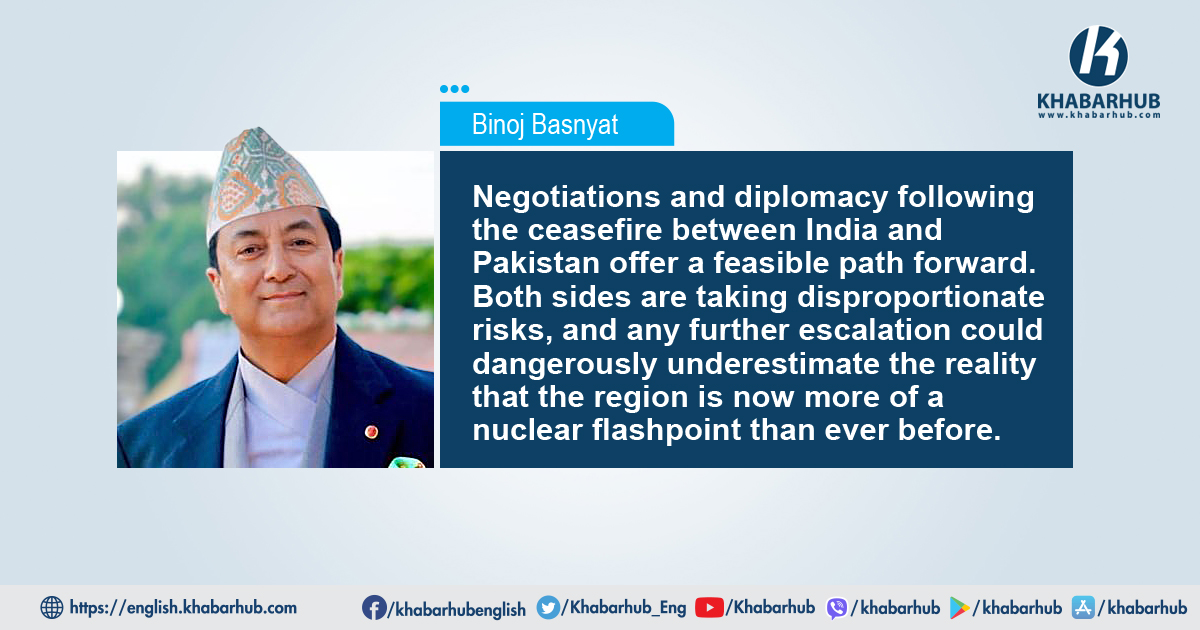
Nationalism and media also play an important part in shaping the outcome of the negotiation. But negotiation and diplomacy post cease-fire for India and Pakistan is a doable opening. Both sides stimulating an inordinate risk with probable escalation will have very little interplanetary composing the underestimation of the region being a nuclear flashpoint truer than ever.
The Washington brokered fragile cease-fire with Delhi and Islamabad – just as it did in 1999, 2001 and 2019 will either succeed or fail for another catastrophe. Two issues point out for a long-awaited peace in the region. One, the root cause that India spells out is Islamabad’s support to terrorism, which international community agrees.
Two, internationalisation of the Kashmir dilemma by Pakistan; a diplomatic behaviour that small nations prefer. China, readiness also beholds meaningful component for either a success or resumption of a new normal.
While India bears a significant brunt of terrorism in the region, the threat is neither confined nor unique to it. The interconnectivity of terrorist networks and the shared vulnerabilities across South Asia demand a regional response.
SAARC, though underutilised, holds a symbolic key agreement aimed at preventing and eliminating terrorism, while BIMSTEC Joint Working Group on Counter-Terrorism and Transnational Crime (JWG-CTTC) is a vital initiative and offers a more practical and functioning avenue for cooperation. Only through collective political will, mutual trust, and strategic alignment can South Asia hope to overcome the scourge of terrorism and ensure lasting peace and prosperity.
Secondly, public diplomacy practiced in front of global audiences with more candidness encompassing public messages, social media, corresponding disclosures, strategic press engagement and public bordering of diplomatic goals. Contrary to the past of diplomacy remaining an art of closed doors. Negotiations transpired secluded; announcements were sporadic and measured.
Finally, all-out war nor recruiting, training financing, equipping and dispatching terrorists is the answer. Acts of terrorism must stop.
Nationalism and media also play an important part in shaping the outcome of the negotiation. But negotiation and diplomacy post cease-fire for India and Pakistan is a doable opening. Both sides stimulating an inordinate risk with probable escalation will have very little interplanetary composing the underestimation of the region being a nuclear flashpoint truer than ever.
(The author is a Strategic Analyst, Major General (Retd) of the Nepali Army, and is associated with Rangsit University, Thailand)



Comment