




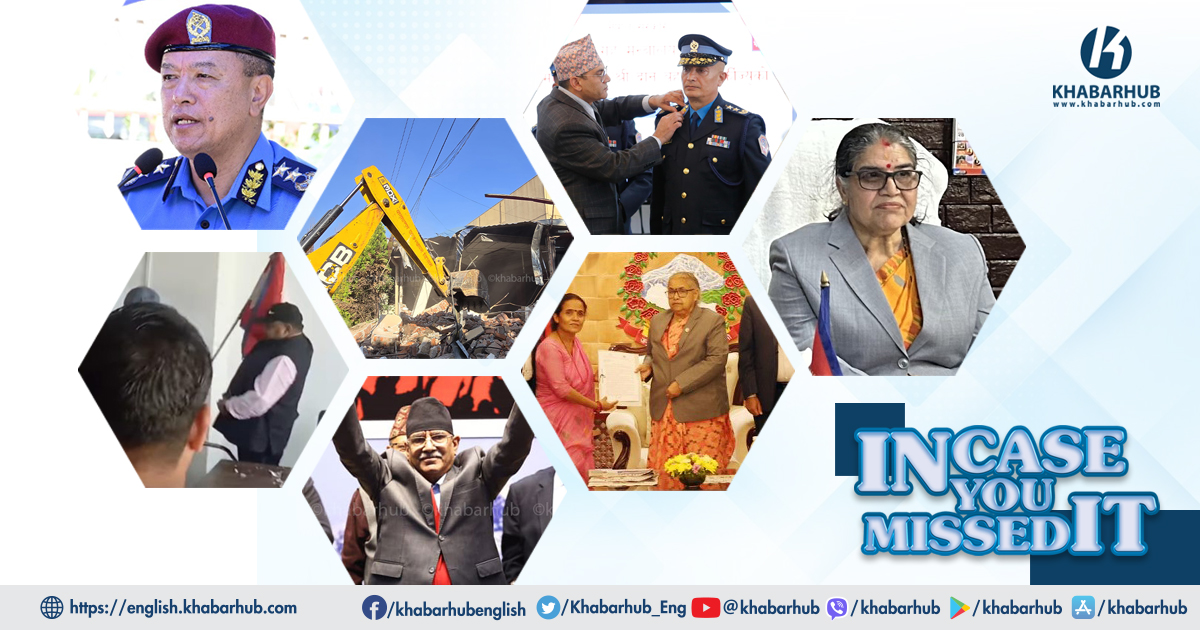
KATHMANDU: The past week in Nepal was marked by a series of dramatic political developments, institutional disruptions, and rising anxieties within the security and governance apparatus. Examined together, these events paint a picture of a state grappling with constitutional ambiguity, political mistrust, and administrative fragility at multiple levels.
From the dismissal of a province chief to the unsteady reconfiguration of political parties and the resurgence of transnational criminal concerns, Nepal’s political system appears to be entering a period of heightened uncertainty—one that could shape the trajectory of the 2026 electoral cycle.
Constitutional storm in Madhesh Province
The most prominent development was the dismissal of Madhesh Province Chief Sumitra Subedi Bhandari by President Ram Chandra Paudel. Acting on the Cabinet’s recommendation under Article 165(1b) of the Constitution, the President removed Bhandari after she administered the oath of office to UML leader Saroj Kumar Yadav as Chief Minister under controversial circumstances. The pre-dawn swearing-in ceremony, conducted at a hotel in Bardibas before Bhandari’s sudden departure to Kathmandu citing health reasons, immediately sparked public and political backlash.
This episode reignited debates over the conduct and neutrality of province chiefs—a recurring theme since the federal system’s inception. Critics argue that the event exposed structural vulnerabilities within Nepal’s provincial framework: unclear constitutional procedures, inconsistent interpretations of Articles 165 and 168, and a tendency for central-level political actors to exert influence over provincial affairs. The swearing-in’s secrecy and haste intensified suspicions that partisan motivations outweighed constitutional propriety.
The Kathmandu Metropolitan City’s demolition of an illegal structure built by a company owned by former minister Deepak Khadka highlighted persistent issues in urban governance: long-delayed enforcement, political patronage, and contested land leases.
The aftermath was equally troubling: vandalism erupted inside the Chief Minister’s Office as provincial assembly members and others stormed the premises, damaging furniture and even discarding the national flag. Such symbolism—a damaged office of executive authority and a discarded flag—reflects deeper tensions about legitimacy, procedural fairness, and political ethics within the province. It also underscores how quickly constitutional disputes can escalate into confrontations that undermine public trust in state institutions.
Centre moves to reinforce control
Amid these tensions, Prime Minister Sushila Karki convened a meeting with representatives from local governments. While framed as a routine discussion, the timing suggests a strategic effort to consolidate central authority and reassure local bodies ahead of looming elections.
Issues raised during the meeting highlighted persistent governance bottlenecks: shortages of staff due to austerity measures, lack of clarity regarding inter-tier cooperation, and security concerns—including a large number of escaped prisoners still unaccounted for.
Home Minister Om Prakash Aryal’s remarks about missing weapons and fugitives were particularly striking, revealing cracks in Nepal’s security architecture. The prime minister’s emphasis on maintaining peace and “building hope and stability” suggests that the federal government is increasingly aware of public dissatisfaction.
Her comments on the importance of political culture and discipline further indicate a desire to stabilize the political environment, even as local representatives expressed frustration with budget limitations and unclear administrative directives.
The meeting also revealed an emerging dynamic: as the federal government calls for cooperation and unity, local governments are demanding clarity, autonomy, and functional support. This tension has implications for the upcoming elections, which will depend heavily on the efficiency and coordination of the three tiers of government.
Security sector under scrutiny
Adding to the complexity was the appointment of Dan Bahadur Karki as the new Inspector General of Police, replacing Chandrakuber Khapung, who retired after 30 years of service. Ordinarily, such an appointment would be routine, but the broader context made it significant. Only days earlier, the Commission for the Investigation and Inquiry into the Gen-Z movement issued a travel ban on outgoing IGP Khapung, limiting both foreign and out-of-valley travel.
This decision—mirroring earlier restrictions imposed on former Prime Minister KP Sharma Oli and former Home Minister Ramesh Lekhak—signals a growing trend in Nepal’s oversight mechanisms: senior political and security officials are being placed under investigation and movement restrictions with increasing frequency.
Whether this trend represents improved accountability or politically motivated targeting remains a matter of debate. What is clear, however, is that the security sector is becoming a focal point of political contestation, potentially complicating future law-enforcement operations.
Political reconfigurations: Unity and fragmentation
At the party level, the week displayed a mix of attempted consolidation on the left and fragmentation among emerging political forces.
The newly announced Nepali Communist Party (NCP), formed by 10 left groups including the Maoist Centre and the Unified Socialist, unveiled a 138-member central committee. The committee’s formation ahead of Election Commission deadlines reflects strategic urgency: the new party must secure registration to contest the 2026 general election.
With Pushpa Kamal Dahal “Prachanda” as Coordinator and Madhav Kumar Nepal as Co-coordinator, the NCP seeks to project unity, yet internal dynamics suggest otherwise. Senior leader Jhalanath Khanal being listed only as an ordinary member indicates persistent factional sensitivities.
Moreover, the inclusion of Prachanda’s family members—Bina Magar, Renu Dahal, and the absence of Ganga Dahal—has already drawn scrutiny, raising familiar questions about nepotism within Nepali left politics. The party has emphasized that this list is temporary, composed only of pre-unification standing committee members, with full structures to be formed later. Yet public perception may already be cemented: the new alliance, while promoting unity, appears to rely on old hierarchies and patronage networks.
The ability of political leaders and institutions to restore trust, ensure constitutional clarity, and maintain stability will be critical in determining whether the country can navigate this turbulence or whether the fault lines will deepen further.
In contrast, the Rastriya Swatantra Party (RSP) continues to fracture, with senior leader Santosh Pariyar resigning amid what he called “deepening internal rifts.” With RSP branding itself as an anti-establishment, reform-oriented force, the steady exit of influential figures raises doubts about its internal coherence and ideological direction. Pariyar’s departure comes at a critical time when the party should be expanding its organizational capacity ahead of elections. Instead, it appears to be struggling with leadership disputes and strategic confusion.
Governance and law enforcement
The Kathmandu Metropolitan City’s demolition of an illegal structure built by a company owned by former minister Deepak Khadka highlighted persistent issues in urban governance: long-delayed enforcement, political patronage, and contested land leases.
While KMC’s action appears decisive, it also reflects the institutional delays and political shielding that allowed the dispute to linger for more than a decade. Even court rulings in favor of Nepal Scouts, the rightful landowner, did not result in timely action—revealing systemic weaknesses in enforcing legal decisions against politically connected groups.
Meanwhile, the arrest of four Chinese nationals for running an illegal cross-border marriage bureau exposed vulnerabilities in Nepal’s immigration and security monitoring. The group reportedly targeted women from impoverished and marginalized communities, raising concerns about trafficking and exploitation.
The fact that the suspects had been entering and leaving Nepal for years on various visas—and were found without proper documentation during inspection—underscores lapses in visa oversight and enforcement. This case adds to a growing list of transnational crimes involving foreign nationals exploiting regulatory loopholes, with Nepal increasingly being used as a transit or recruitment hub.
Conclusion: A week reflecting systemic strain
Taken together, the week’s events reveal a political system under stress. Constitutional crises at the provincial level, uneasy coordination among government tiers, security-sector investigations, and party realignments all point to an environment of deepening uncertainty. As Nepal approaches the 2026 elections, these dynamics are likely to intensify. The ability of political leaders and institutions to restore trust, ensure constitutional clarity, and maintain stability will be critical in determining whether the country can navigate this turbulence or whether the fault lines will deepen further.



Comment