




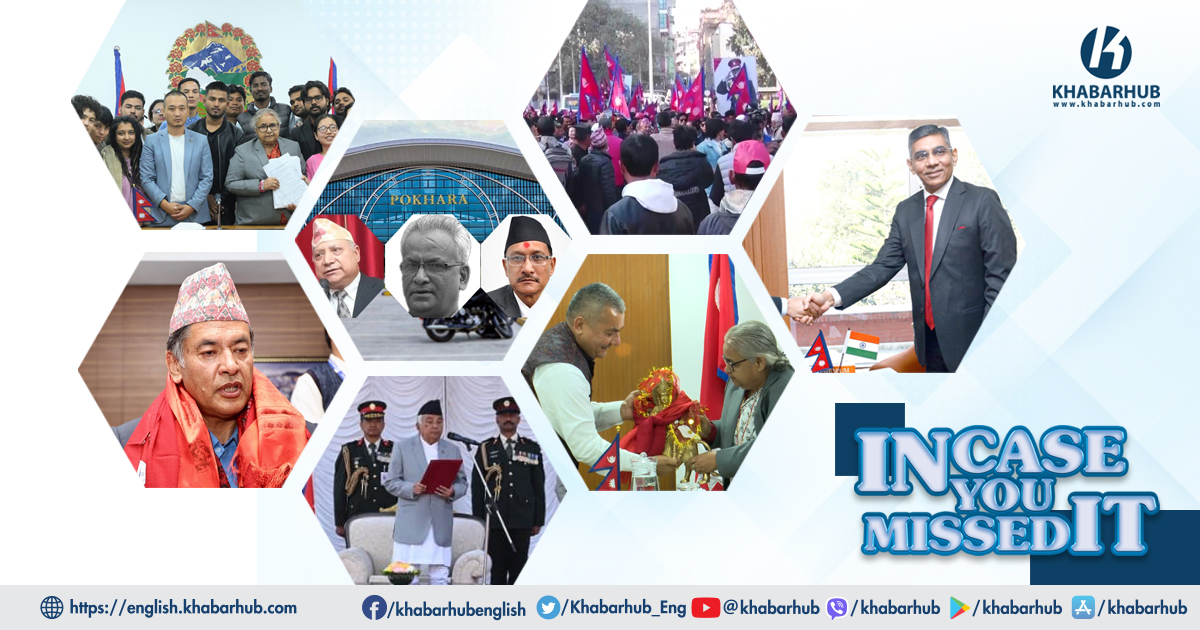
KATHMANDU: Last week offered a rare convergence of street power, institutional response, elite recalibration, and popular sentiment in Nepal’s political landscape. From the signing of a landmark agreement between the Gen-Z People’s Movement and the government to internal power consolidation within major parties, judicial interventions, high-profile corruption cases, ideological counter-mobilizations, and even a national cricket triumph, the developments collectively exposed a system under strain, yet not without possibilities for renewal.
At the heart of these events lies a deeper question: is Nepal witnessing the beginning of structural political change driven by civic pressure and accountability demands, or merely another cycle in which public anger is absorbed, redirected, and neutralized by entrenched power?
Gen-Z agreement: From protest to the table
The most significant political development of the week was the 10-point agreement between the Gen-Z People’s Movement and the Government of Nepal. Emerging from protests against corruption, impunity, and systemic exclusion, the agreement marked an uncommon moment when a non-party, youth-driven movement compelled the state to negotiate.
Key provisions include the declaration of those killed during the September protests as martyrs, relief and long-term support for injured protesters, free healthcare and education, and the establishment of a Martyrs’ Memorial Foundation. Symbolically, these measures recognize the legitimacy of youth-led dissent and the cost paid by protesters.
More consequential, however, are the agreement’s reform-oriented commitments. These include the formation of a high-level commission to propose constitutional amendments, reforms to proportional representation, enhanced youth participation in governance, the introduction of a “None of the Above” (NOTA) voting option, primary elections, and lowering the candidacy age to 21. The proposal to establish a Gen-Z Council as an advisory body further signals an attempt, at least on paper, to institutionalize youth voices within governance structures.
At the same time, entrenched actors continue to manipulate structures to retain power. The struggle ahead is not merely between parties, but between two visions of politics: one rooted in accountability, participation, and reform; the other in control, calculation, and continuity.
Yet, history urges caution. Nepal has formed many commissions whose reports never translated into policy. Whether this agreement becomes a catalyst for reform or a mechanism to diffuse pressure depends entirely on implementation, timelines, and sustained public scrutiny.
Institutional response or strategic containment?
While the agreement has been celebrated by Gen-Z leaders as a “new chapter,” it also reflects the state’s instinct to manage unrest through accommodation rather than transformation. Relief packages and memorials, while important, do not dismantle patronage networks, reform campaign financing, or depoliticize state institutions.
The true test will lie in whether the government allows proposed reforms, particularly those that threaten established party dominance, such as primary elections and NOTA, to advance beyond rhetoric. Without legal anchoring and enforcement mechanisms, the agreement risks becoming another example of symbolic governance designed to buy time rather than redistribute power.
UML closed session: Old politics consolidates
Even as youth movements pushed for inclusion and reform, traditional party politics moved in the opposite direction. The CPN–UML’s closed session began only after the rapid amendment of the party statute, expanding both the number of office bearers and Central Committee members.
By increasing office bearers to 19 and the Central Committee to 301 members, party Chair KP Sharma Oli effectively reinforced organizational control. The speed with which the statute was amended, within three months of its adoption, underscored how procedural tools are routinely used to secure power rather than deepen internal democracy.
Senior Vice Chair Ishwor Pokharel’s challenge highlighted internal dissent, but the process ultimately demonstrated the limits of intra-party competition in Nepal’s major parties. While Gen-Z activists demand transparency and participation, party structures remain centralized and leader-centric, reinforcing the widening disconnect between political institutions and a reform-hungry public.
Judiciary and anti-graft push: Institutions strike back
Last week also saw assertive institutional interventions, particularly from the judiciary and the anti-corruption watchdog. The Supreme Court’s mandamus order reinstating Hitendra Dev Shakya as Managing Director of the Nepal Electricity Authority reasserted judicial oversight over executive decisions. It reinforced the principle that political authority cannot override due process—an important signal amid growing executive assertiveness.
More dramatically, the CIAA’s filing of a massive corruption case over the Pokhara International Airport shook the political establishment. With 55 defendants—including former ministers, senior bureaucrats, and a foreign contractor—and claims of losses exceeding Rs 8.36 billion, the case stands as one of the largest corruption prosecutions in a decade.
Similarly, the visit-visa extortion scandal exposed how state institutions were allegedly weaponized to exploit vulnerable citizens seeking foreign employment. These cases validate a core public grievance echoed by Gen-Z protesters: corruption in Nepal is not episodic but systemic.
Parliament dissolution and elite maneuvering
The Nepali Congress’s decision to file a petition at the Supreme Court demanding the restoration of the dissolved House of Representatives added another layer of complexity. Coming shortly after a meeting between party President Sher Bahadur Deuba and UML Chair Oli, the timing fueled perceptions of strategic maneuvering rather than principled constitutional defense.
While judicial scrutiny of parliamentary dissolution is essential, public trust remains fragile when such moves appear reactive and elite-driven. For many citizens, courtroom battles among political leaders feel detached from daily struggles over inflation, unemployment, and failing public services.
Competing narratives
The week also witnessed a surge in ideological counter-mobilization. Durga Prasai’s call for a referendum on monarchy and the Rastriya Prajatantra Party’s protests demanding a new national consensus, including the King, political parties, and Gen-Z activists,revealed unresolved tensions within Nepal’s republican framework.
These narratives gain traction not necessarily because monarchy enjoys majority support, but because democratic institutions have repeatedly failed to deliver stability, accountability, and dignity. In periods of governance failure, alternative political imaginaries, however regressive, find renewed space.
The convergence of youth reformists, conservative monarchists, and establishment parties underscores a fragmented political terrain where dissatisfaction is widespread, but consensus remains elusive.
Elections, symbols, and external signals
As the Election Commission distributed symbols for the upcoming House of Representatives election, the procedural machinery of democracy continued to move forward. India’s pledge to support Nepal’s election process and post-earthquake reconstruction further highlighted the regional and international stakes tied to Nepal’s political stability.
Yet elections alone cannot restore public faith. Without credible reform in party democracy, governance accountability, and anti-corruption enforcement, electoral exercises risk becoming ritualistic rather than transformative.
Cricket as counterpoint: NPL and national morale
Amid political turbulence, sport provided a rare moment of collective relief. Lumbini Lions’ victory in Nepal Premier League (NPL) Season 2, after a dramatic turnaround from early setbacks, captured public imagination.
Cricket’s growing cultural and political significance should not be underestimated. In a week dominated by protests, corruption cases, and institutional conflict, the NPL final offered a unifying narrative of resilience, merit, and fair competition, values conspicuously absent from much of Nepal’s political life.
That contrast itself is instructive: while politics remains mired in control and calculation, sport continues to demonstrate the power of performance, transparency, and opportunity.
Conclusion
Last week revealed a Nepal at a critical juncture. Civic movements have demonstrated their ability to force dialogue. Institutions have shown flashes of independence. Corruption has re-entered the legal spotlight. Political alternatives—both progressive and regressive—are competing for space.
At the same time, entrenched actors continue to manipulate structures to retain power. The struggle ahead is not merely between parties, but between two visions of politics: one rooted in accountability, participation, and reform; the other in control, calculation, and continuity.
Whether the energy of civic movements translates into lasting institutional change, or is absorbed and neutralized by the system, will define Nepal’s political trajectory in the months ahead.



Comment