




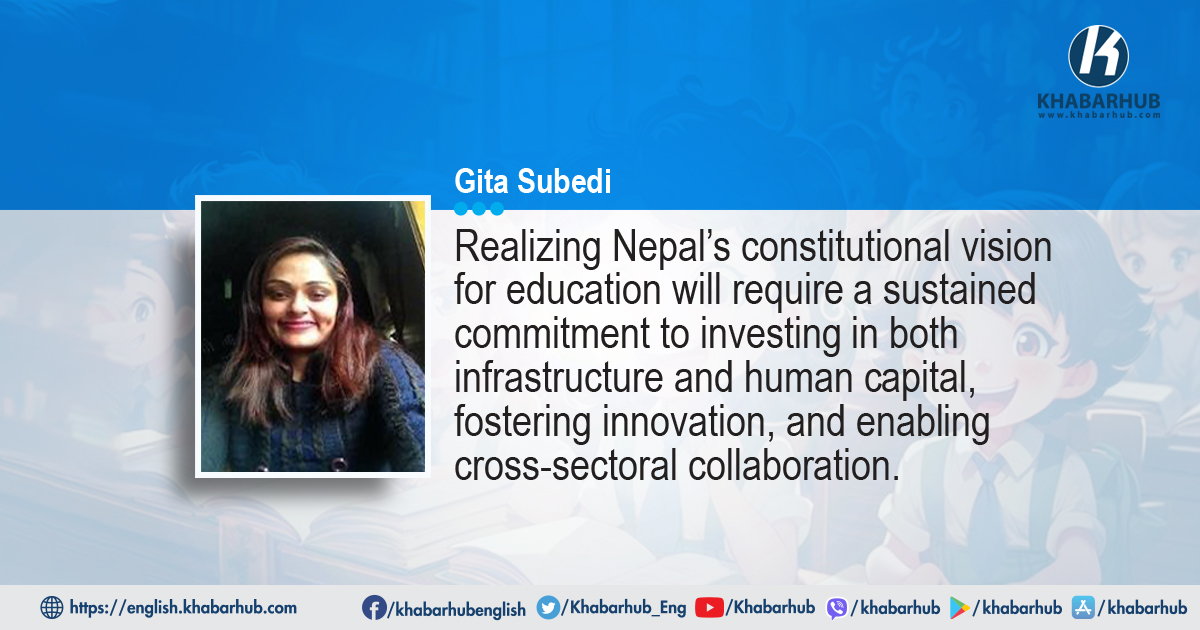
Nepal’s constitutional guarantee of free and compulsory education is more than a legal provision; it is a commitment to building an equitable and transformative education system.
This aligns with Nepal’s broader aspiration of a “Happy Nepali, Prosperous Nepal” by positioning education as a foundation for social justice, equity, human rights, economic growth, and a harmonious society.
The key education agenda seeks to ensure inclusive access to quality learning for every child, regardless of gender, socio-economic background, language, caste, vulnerability, ethnicity, geography, or ability. Despite progress in enrollment and policy development, persistent systemic challenges continue to hinder the realization of these goals.
While constitutional and legal frameworks are in place, the education system still faces significant financial and operational issues. Large numbers of out-of-school children (OOSC) and children with disabilities, particularly from marginalized communities, do not have equitable access, meaningful participation, and equitable learning outcomes as envisioned.
Only around half of the children who start Grade 1 eventually reach the Grade 12 examination, revealing high dropout and repetition rates in between.
Even at the secondary level, many students lack foundational, digital, and life skills, reflecting weaknesses in basic-level teaching and learning.
Civil Society Organizations can collaborate strategically, not as external implementers but as partners working with government, communities, and schools in co-designing and implementing reforms.
Some schools’ overcrowded classrooms, insufficient inclusive infrastructure, and limited access to modern teaching-learning resources hinder inclusive, resilient, and quality education delivery. In some contexts, overstaffing compared to the number of students can also be observed.
It is evident that a shortage of subject-specific teachers and insufficient training aligned with the ‘Teachers’ Competency Framework,’ including inclusive teaching, differentiated instruction, and ICT integration, is still lacking in many community schools, particularly in remote areas.
Many local governments lack sufficient skilled technical personnel to plan, budget, and monitor effectively in line with the School Education Sector Plan (SESP), education-related SDG 4 targets, and other national priorities.
School leaders, particularly head teachers and School Management Committees (SMCs/PTAs) in rural areas, often lack adequate training and professional support to fulfill their responsibilities as envisioned in policy and plans.
Most community schools have yet to develop ‘School Disaster Risk Reduction and Management (DRRM) Plans’ or contingency strategies for pandemics, earthquakes, floods, or other types of disruptions.
These gaps create systemic inequities in access, participation, and learning outcomes, underscoring the urgent need for targeted, evidence-based, and collaborative interventions.
In this context, Civil Society Organizations (CSOs)—ranging from international and national NGOs to CBOs—are well-placed to partner with different tiers of government in addressing these challenges.
Their reach, technical expertise, and grassroots connections position them as catalysts for educational reform in different areas. CSOs can collaborate with provincial and local governments in developing GESI-responsive Local Education Plans (LEPs). By aligning these plans with the SESP, the Consolidated Equity Strategy, Universal Design for Learning (UDL) principles, and other sectoral priorities of the Government of Nepal, CSOs can help ensure that policies are both inclusive and implementable.
There are opportunities to contribute to the formulation of school zoning policies and procedures, the implementation of need-based/pro-poor scholarship schemes, and targeted interventions for marginalized learners as envisioned.
Through localized research and diagnostic studies, CSOs can support the identification of root causes of exclusion, such as socio-cultural barriers, disability-related accessibility gaps, and economic constraints.
This evidence base can guide resource allocation, program design, and monitoring frameworks, ensuring interventions respond to actual needs rather than assumptions.
Many local government units and school leaders lack the capacity to translate policies into action. CSOs can provide technical training, mentorship, and model templates for planning, budgeting, and reporting.
By supporting participatory governance mechanisms such as social audits or results-based school funding, CSOs can also help strengthen accountability systems.
Additionally, CSOs can complement government efforts in areas like improving WASH facilities, constructing inclusive infrastructure, promoting mother-tongue-based instruction at the basic level, developing learning materials for multi-grade/multi-level (MGML) classrooms, and exploring innovative ICT/EdTech solutions that enable blended learning in both connected and remote settings in Nepal.
Equity is the cornerstone of the SESP and Nepal’s broader education policy commitments. Achieving this requires targeted support for all learners, including the most marginalized.
Expanding need-based scholarships, providing assistive devices for children with disabilities, and upgrading inclusive infrastructure in community schools are necessary steps. Accessible and safe school environments are essential to translate policies into actions.
WASH facilities designed for all users, child protection mechanisms to ensure learning spaces are free from violence, and gender-responsive spaces encourage attendance and retention, which are necessary in many community schools in Nepal.
As per legal mandates, mother-tongue-based or contextual learning has been envisioned. This can be achieved through the implementation of mother-tongue-based education in early grades along with MGML strategies for sparsely populated areas.
In this regard, CSOs can support these measures by mobilizing communities, advocating for pro-poor budgeting at the local level, and providing technical guidance for inclusive infrastructure design.
Another priority is enhancing learning quality and relevance. Inclusive quality education requires a shift from rote memorization to competency-based and student-centered learning.
This involves aligning facilitation methods with the National Curriculum Framework and UDL principles. Strengthening continuous professional development for teachers through training, mentoring, peer learning, and ICT-supported coaching is essential.
Integrating soft skills—such as communication, teamwork, critical thinking, and adaptability—into both pedagogy and assessment frameworks is necessary. Expanding Technical and Vocational Education and Training (TVET) opportunities that link with labor market demands ensures students gain employable skills.
In this regard, CSOs can collaborate on establishing communities of practice for teachers and other stakeholders, developing locally relevant teaching-learning materials, and facilitating industry linkages for vocational training programs.
Most importantly, education governance is central to education system reforms. CSOs can contribute by strengthening the ‘Integrated Education Management Information System (IEMIS)’ for real-time, data-driven decision-making.
They can facilitate inter-departmental coordination across all levels of government and community participation through school-based management, social audits, and transparent budgeting processes.
Encouraging leadership development programs for both male and female teachers and ensuring inclusive representation in decision-making roles, including head teacher positions, can support the development of a leadership pipeline policy.
Such governance reforms improve trust in the system and ensure that resources are used efficiently.
The increasing frequency of natural disasters and emergencies demands that education systems be prepared for disruptions. CSOs can assist schools in developing DRRM plans and conducting regular safety drills, support local governments in creating contingency plans for crises such as pandemics or floods, advocate for and help implement minimum safety standards in all schools—including safe buildings, adequate classroom space, and accessible facilities—and incorporate health and psychosocial support services, such as periodic check-ups, deworming, first aid, and counseling, into school programs.
Learning should not end with formal schooling. CSOs can help strengthen ‘Community Learning Centers (CLCs)’ to function as hubs for lifelong education, skills training, and community engagement.
By linking informal and alternative education programs to the ‘National Qualifications Framework,’ learners can gain accredited skills and re-enter formal education or employment pathways. ICT-based platforms can also extend learning opportunities to remote and marginalized populations.
A notable feature of Nepal’s education reform agenda is the integration of soft skills alongside academic knowledge. This requires embedding skills such as empathy, conflict resolution, collaboration, and adaptability into teacher training programs; promoting project-based learning and reflective classroom practices; linking student evaluations to teamwork, communication, and problem-solving performance; and encouraging student participation in school governance, clubs, or peer mentoring programs.
In this connection, CSOs can support by co-developing training modules, piloting innovative pedagogical approaches, and documenting best practices for scaling.
To sustain inclusive, resilient, and quality educational reforms, local governments should allocate at least 20% of their budgets to education. Priority investments can include safe, gender-responsive, and disability-inclusive infrastructure; ICT infrastructure and digital connectivity for teaching and learning; teaching and learning materials, including assistive technologies; scholarship programs; and school zoning initiatives to ensure equitable access. Strengthening monitoring and reporting systems through IEMIS is also essential.
In this regard, CSOs can advocate for and provide technical support for these allocations and monitor budget utilization to ensure funds reach the most disadvantaged learners.
If pursued with dedication and coordination, this vision can deliver on the promise of a just, prosperous, and inclusive society where every child, regardless of background or ability, can access, participate in, and benefit from inclusive, resilient, and quality education.
To sum up, Nepal’s education system stands at a pivotal moment, facing persistent inequalities but also holding immense potential for transformation.
Civil Society Organizations can collaborate strategically, not as external implementers but as partners working with government, communities, and schools in co-designing and implementing reforms.
By aligning efforts in policy, advocacy, evidence-based planning, capacity building, service delivery, and governance, CSOs can help create an education system that is equitable, high-quality, and resilient.
Together, these measures will improve school completion rates, narrow disparities across regions and socio-economic groups, and equip students with both foundational and soft skills to thrive in the modern world.
Realizing Nepal’s constitutional vision for education will require a sustained commitment to investing in both infrastructure and human capital, fostering innovation, and enabling cross-sectoral collaboration.
If pursued with dedication and coordination, this vision can deliver on the promise of a just, prosperous, and inclusive society where every child, regardless of background or ability, can access, participate in, and benefit from inclusive, resilient, and quality education.





Comment