




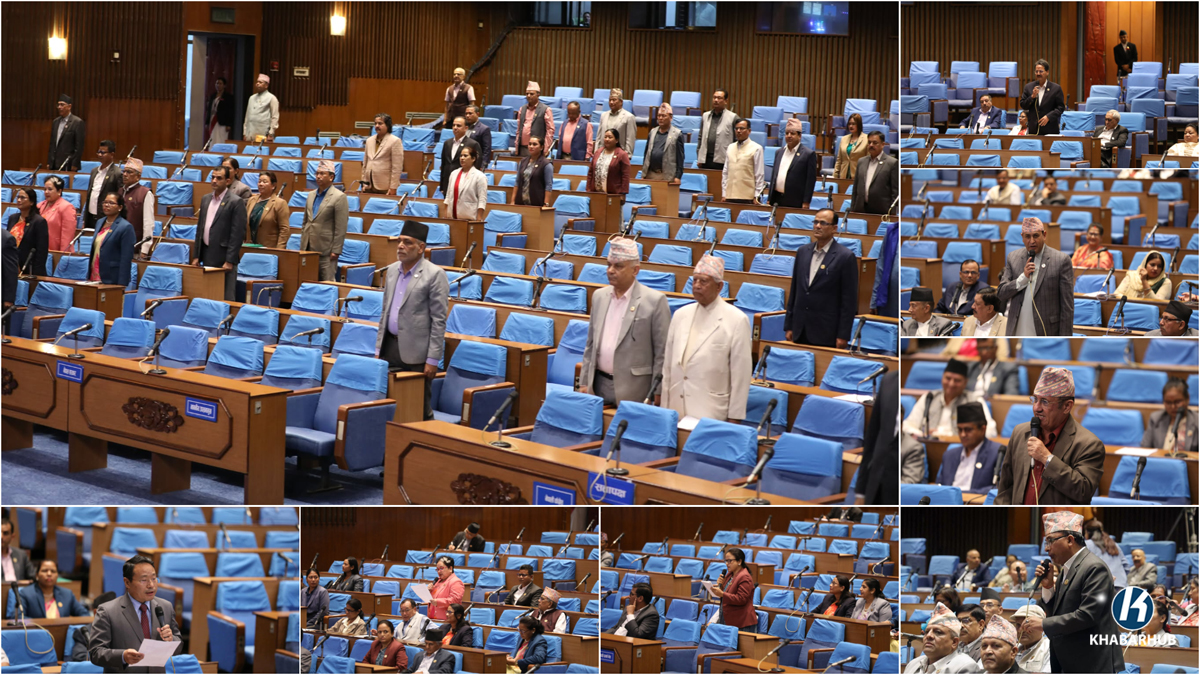
KATHMANDU: Thursday’s House of Representatives meeting witnessed lively and often pointed debate, with topics ranging from alleged political interference in medical appointments, to regional restructuring proposals, fertilizer shortages, and Prime Minister KP Sharma Oli’s controversial remarks about Rastriya Swatantra Party (RSP) Chair Rabi Lamichhane.
The session opened in the aftermath of Prime Minister Oli’s August 12 decision to appoint vice-chancellors to four health science academies. The following day, Dr. Ramesh Koirala—Chief of the Cardiovascular Department at Shahid Gangalal National Heart Centre—submitted his resignation from abroad. Koirala had been recommended for the post of Vice-Chancellor of BP Koirala Institute of Health Sciences by the Nepali Congress, but the appointment instead went to Professor Dr. Bikram Prasad Shrestha, reportedly at the discretion of PM Oli.
The decision sparked speculation that Congress President Sher Bahadur Deuba and Foreign Minister Dr. Arzu Rana Deuba had intervened to block Koirala’s appointment. A Setopati report further fueled the narrative, leading to a flurry of social media commentary—much of it employing the colloquial terms “Bhauju” (sister-in-law) for Minister Rana and “Devar” (younger brother-in-law) for Congress General Secretaries Gagan Thapa and Bishwo Prakash Sharma.
Independent MP Dr. Amaresh Kumar Singh brought the matter into Parliament, using the same familial metaphors to criticize political favoritism and alleging that financial considerations influenced appointments in the health sector, ultimately driving Dr. Koirala abroad. Singh also accused the political and bureaucratic establishment of looting the country.
The session then turned to the resignation of Congress MP Ramhari Khatiwada as Chair of the State Affairs and Good Governance Committee—a move praised by some for its display of political morality. RSP MP Dr. Chanda Karki contrasted Khatiwada’s action with what she described as Home Minister Ramesh Lekhak’s failure to uphold the same standards.
Rastriya Prajatantra Party (RPP) MP Dhruva Bahadur Pradhan called for legal action against those who tamper with “cooling-off” period regulations, stating that resignation alone should not be considered sufficient accountability.
Debate then shifted to Prime Minister Oli’s earlier parliamentary remarks implying that Rabi Lamichhane—currently in pretrial detention in Bhairahawa on cooperative fraud charges—had no moral authority to criticize others, citing his past dual citizenship issues. Maoist Centre MP Barsha Man Pun challenged Oli to justify such statements, noting that it was the government itself that had once appointed Lamichhane as Home Minister. Maoist MP Rekha Sharma cautioned Oli against making light of parliamentary proceedings by reducing them to “social media content.”
MPs from both ruling and opposition benches then raised concerns over an acute shortage and black-market sale of chemical fertilizers, accusing the government of failing to ensure timely distribution to farmers. Agriculture Minister Ramnath Adhikari admitted budget constraints were limiting imports, despite high subsidies of up to 84% on some fertilizers, and outlined plans to supply six lakh tonnes against an annual demand of thirteen lakh tonnes.
In regional issues, UML MP Surya Prasad Dhakal proposed amending the constitution to incorporate Banke and Bardiya districts into Karnali Province. Congress MP NP Saud called for a parliamentary study committee to address longstanding problems in Nepal’s prisons, citing poor infrastructure, inadequate healthcare, and lack of rehabilitation programs.



Comment