




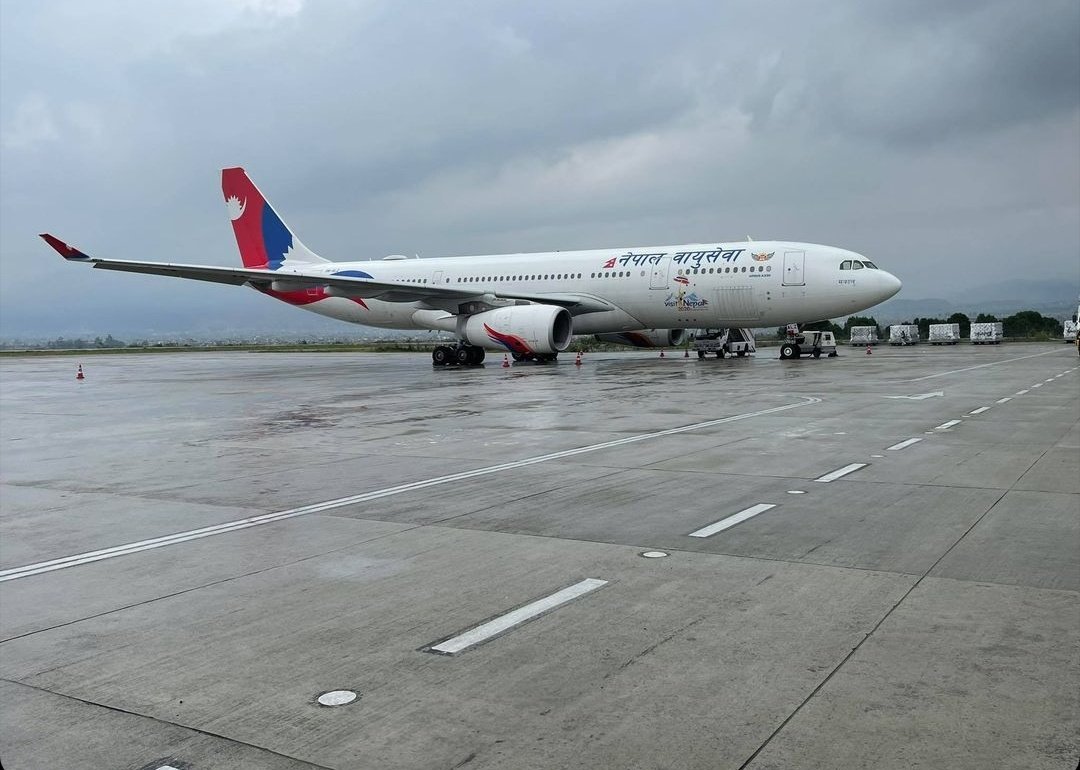
KATHMANDU: Nepal Airlines Corporation (NAC), the government-owned airline, has long struggled to achieve profitability, even as other state-owned enterprises report gains.
Established in 1958, NAC has recently faced criticism over operational inefficiencies and rising losses, despite operating six aircraft, including two wide-body, two narrow-body, and two twin-otters.
According to audit data, NAC’s losses, though still significant, have decreased over the past two fiscal years. In FY 2021/22, the airline recorded a loss of Rs 1.71 billion. By FY 2022/23, it had reduced its deficit to Rs 665 million.
For FY 2023/24, NAC projected total revenue of Rs 20.5 billion, largely driven by international flights, which generated Rs 14.2 billion, and ground handling services, which contributed Rs 5.49 billion.
Ticket sales, cargo, and excess baggage accounted for 73 percent of total revenue, while ground handling services made up the remaining 27 percent.
Despite these improvements, NAC’s cumulative losses as of July 2023 stood at Rs 15.62 billion, with long-term debt reaching Rs 52 billion.
The airline employs 1,466 staff members, though 910 positions remain vacant from the sanctioned 2,369 posts. Among the employees, 855 are permanent, 336 on contract, and 275 on monthly wages. NAC has 79 pilots, most of them permanent, and 168 cabin crew, largely on contract. Last fiscal year, 30 employees resigned, and 56 retired.
Over the past four years, NAC has spent nearly Rs 7.92 billion repaying loans from the Employees Provident Fund and the Citizen Investment Trust used to purchase Airbus A330 and A320 aircraft. After these repayments, around Rs 47.05 billion remains, carrying interest rates averaging over 10 percent.
To ease this financial burden, NAC initiated a debt swap process and has received applications from two international lenders. Securing loans at lower interest rates could significantly reduce expenses. For instance, borrowing at 5 percent interest could save Rs 160 million annually, while 2 percent could save up to Rs 1.5 billion per year.
Analysts say that while NAC’s recent efforts to reduce losses and restructure debt are steps in the right direction, long-term sustainability will require stronger management, efficient operations, and careful financial planning. For Nepal’s flagship airline, the challenge remains not only to cover costs but to establish a path toward consistent profitability.






Comment