




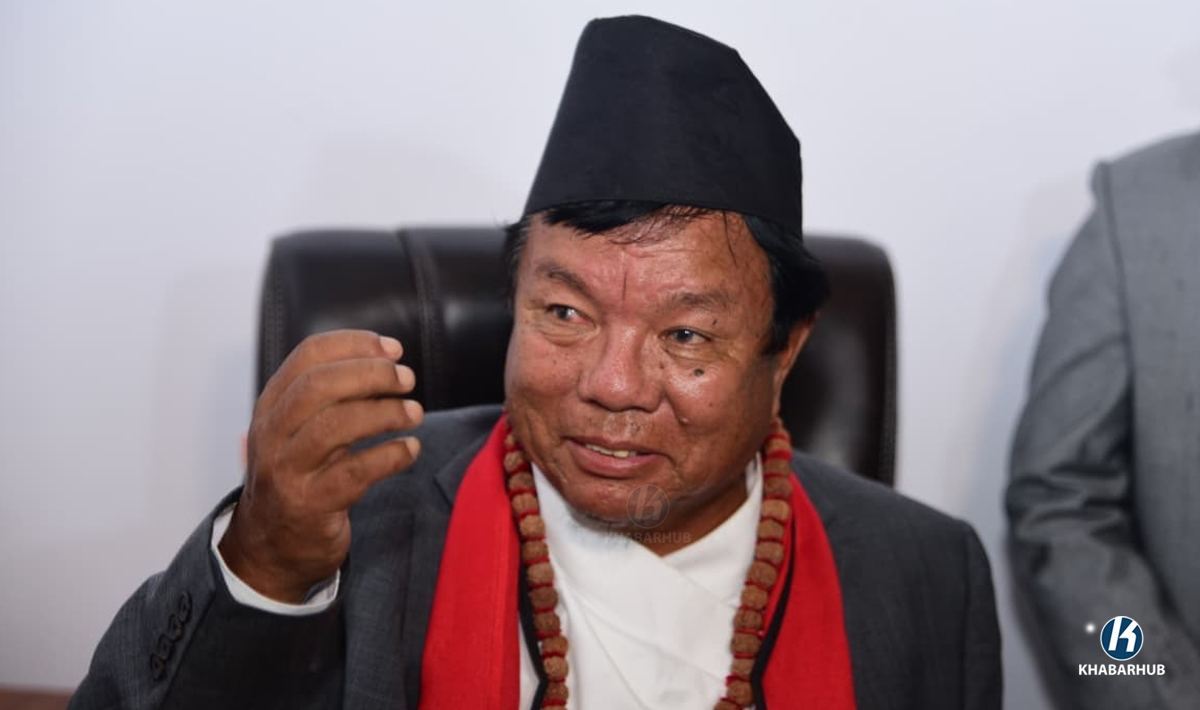
KATHMANDU: Minister for Education, Science, and Technology Mahabir Pun has stressed the importance of doing away with political interference and appointing non-political, qualified individuals to leadership roles to enhance the quality of universities in the nation.
During a discussion programme on the ‘Policy Framework for Higher Education in Nepal’ held today by the Nepal Higher Education Foundation (NHF) at VS Niketan in Tinkune, Minister Pun articulated that the selection of university leadership should be strictly based on merit, integrity, and the capacity for independent decision-making, rather than political connections.
He remarked that political maneuvering has emerged as the primary barrier to transforming universities into hubs of knowledge, research, and innovation.
He said, ‘There have always been complaints that universities are politicized as long as the Prime Minister serves as the chancellor. For university reform, now non-political and capable individuals should be given responsibility.’
Minister Pun highlighted that, at present, the Prime Minister holds the chancellorship in 18 universities in Nepal, and since the appointments of vice-chancellors, rectors, registrars, and deans are appointed through the Prime Minister, the trend of political maneuvering and favoritism has been prevalent. “To end such a situation, a competent person must take leadership.
The university’s academic quality, research, and autonomy must be made qualitative and independent,” he stated.
Minister Pun announced that the process of amending the necessary legislation to eliminate the provision of the Prime Minister serving as the Chancellor of the university has commenced.
He added, “The Prime Minister should not serve as the Chancellor, and there should be a provision to appoint a competent, impartial, and non-political person as the Chancellor through the Board of Trustees or Council.
The participants underscored the necessity of eliminating political interference to enhance universities. Professors Dr Min Bahadur Bista, Assistant Professor Dr Dipendra Parajuli, and Assistant Professor Manoj Kumar Karna, among others, articulated the perspective that for universities to evolve into hubs of knowledge generation, the selection of leadership must be entirely non-political, transparent, and merit-based.
Professor Dr Teerth Raj Khaniya, Chairman of the Nepal Higher Education Council, emphasized the significance and relevance of the programme, asserting that clarity in policy, institutional autonomy, and accountable leadership are crucial for timely reforms within Nepal’s higher education framework.
The programme featured comprehensive discussions regarding the current landscape, challenges, opportunities, and potential policy initiatives aimed at enhancing higher education.






Comment