




KATHMANDU: Political parties typically hold general conventions to evaluate their policies, debate ideological directions, and elect leaders. Such events are considered essential democratic exercises that allow parties to adapt to changing political contexts while engaging their members in decision-making.
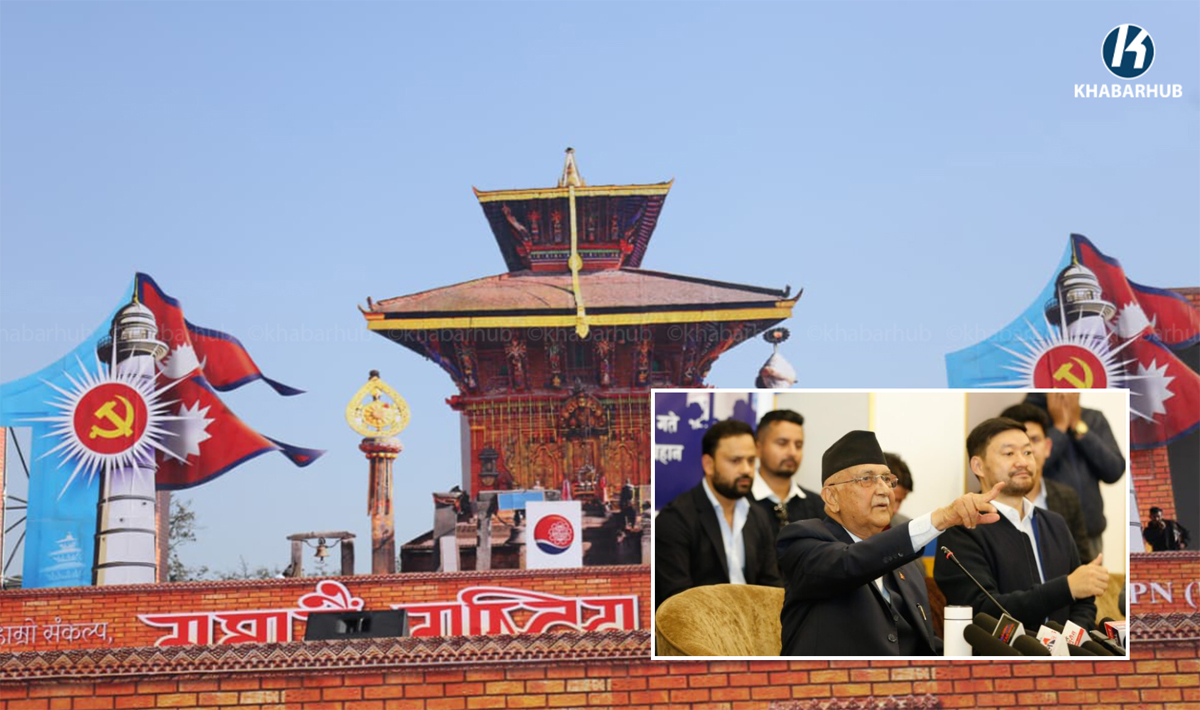
The CPN-UML is holding its 11th General Convention in Bhaktapur from today (Saturday). Preparations, including large-scale decorations and logistical arrangements, are almost complete, and more than 2,000 delegates have already arrived in the capital.
However, despite being convened after four years, the UML’s 11th General Convention will reportedly not include discussions on ideological or policy matters. Due to Chairman KP Sharma Oli’s firm organizational control, the convention appears set to focus solely on selecting leadership rather than debating ideas.
Oli faction: Ideological discussions already completed
Leaders close to Chairman Oli have argued that there is no need for further ideological debate at the general convention, claiming that political, ideological, and policy matters were thoroughly discussed during the party’s Legislative General Convention held from September 5-7, 2025.
They also frame the upcoming event as a “unity general convention,” implying that the leadership selection process should proceed without contestation.
“Politically, we have already analyzed the country’s situation and our own history. Only three months ago, we reviewed our entire past, our work, successes, and shortcomings. We have already passed the political report and resolution,” Oli said.
He added that the organization’s status had already been assessed, and therefore, “there is no need to change the organizational policy or political report.” Only minor amendments to the statute, if necessary, would be made briefly, with “no lengthy discussion.”
Gen-Z movement’s impact and internal disagreements
The Gen-Z youth movement that erupted on September 8 and 9 immediately after the Legislative General Convention—significantly reshaped Nepal’s political landscape. The joint government of the Nepali Congress and other parties, led by UML Chair Oli himself, was toppled in the movement’s aftermath.
The rebellion’s demand for generational leadership transfer has compelled traditional parties, including the UML, to hold general conventions.
However, in contrast to Oli’s stance, the faction led by Ishwor Pokharel has prepared a 40-page concept paper for presentation at the general convention. Submitted via party General Secretary Shankar Pokharel, the document argues that the convention is being held under extraordinary political circumstances following the Gen-G movement—an interpretation rejected by Oli’s faction.
“There is a gap between the aspirations of the new generation and the policies adopted by the state and political parties. It is the general convention’s responsibility to analyze such developments ideologically and to renew itself in the new context,” the concept paper states.
Over the past week, both the Oli and Pokharel factions have held separate press conferences expressing differing views ahead of the general convention. Despite the Pokharel group submitting its concept paper, the likelihood of it being formally presented or discussed at the convention remains low due to ongoing internal disagreements.
Signs of a repeat of the 2078 General Convention
The current balance of power within the UML, particularly the position taken by the Oli faction, suggests that the 11th General Convention may unfold much like the 10th General Convention held in Chitwan in 2078 BS.
During the 10th Convention—held soon after the faction led by Madhav Kumar Nepal, now co-coordinator of the Nepal Communist Party, split from the UML, leadership was elected solely from a consensus panel. In that convention, Bhim Rawal, who contested for the party chair, and Ghanshyam Bhusal, who ran for vice-chair, as well as other leaders contesting outside the consensus panel, were defeated.
Now, leaders who previously aligned with the Madhav Nepal faction and who had internal disputes with Chairman KP Oli, disagreements that once pushed the party toward a split—are openly joining the group led by Ishwor Pokharel. Some leaders who had hoped to bring Bidya Bhandari into UML leadership have also reportedly sided with the Pokharel group.
However, estimates indicate that the Oli-led panel is likely to win the 11th General Convention, as the Pokharel faction is believed to command only 20 to 25 percent of votes nationwide.
Current numbers suggest that the UML may consolidate full control under the core team that has long worked with Oli, even if it includes leaders who had differing views until the 10th General Convention.



Comment