




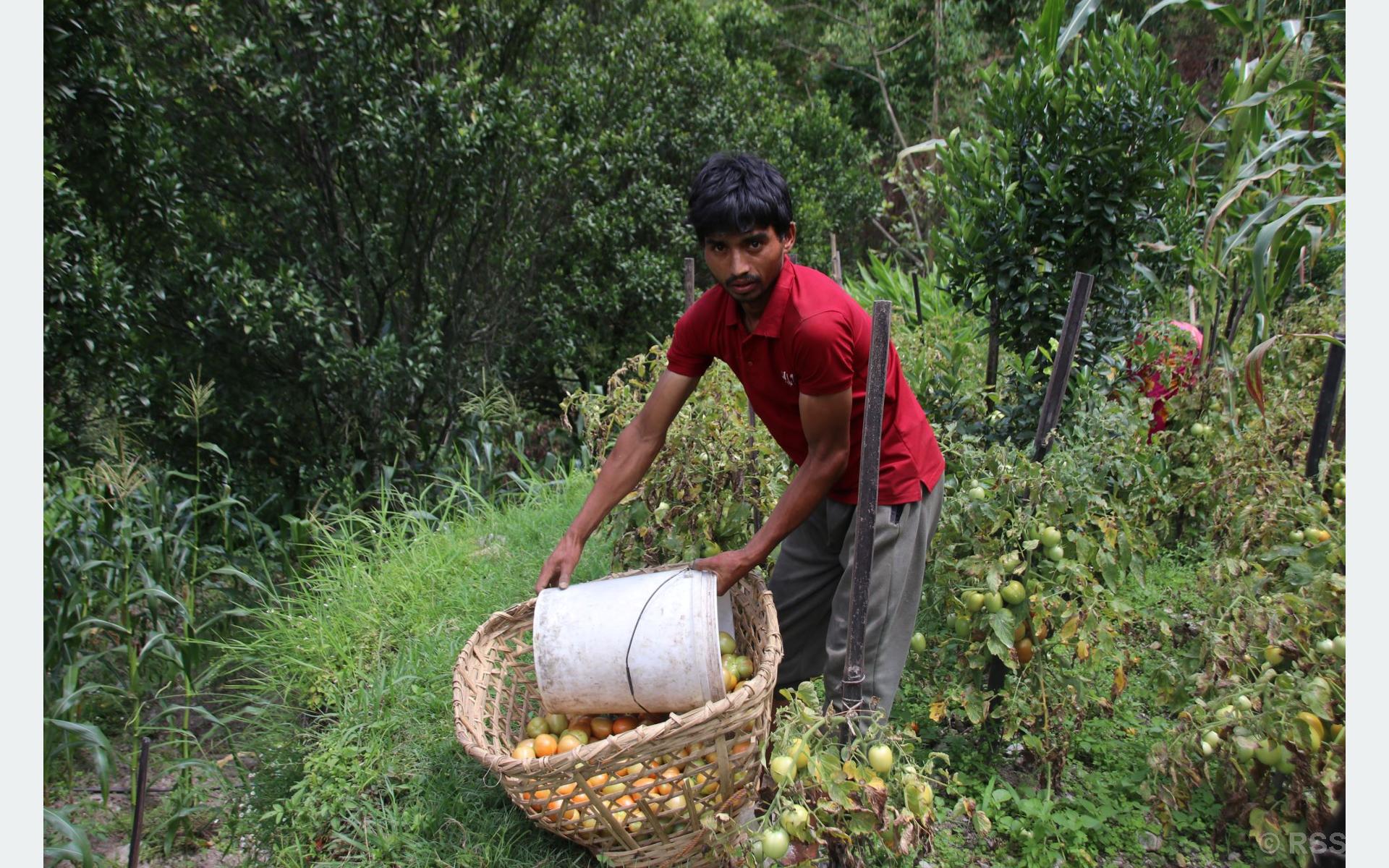
PANCHTHAR: While many youths are eager to go abroad in search of better opportunities, Kamal Timsina from Ramite, Yangwarak Rural Municipality-6, Panchthar, has chosen to stay in his village and pursue farming. He and his family have been earning a decent income through tomato cultivation.
Kamal’s daily life revolves around his tomato fields. His family struggles to keep up with the workload—harvesting ripe tomatoes from 20 ropanis before it’s time to pick the next batch. “There’s more work now than before,” Kamal said. “Work never stops in the village.”
The Timsina family cultivates around 40 ropanis of land across Yangwarak-6 and Hilihang Rural Municipality-1, Fedapa. Some land is owned, and some is leased. They grow cash crops like tomatoes, chillies, and oranges, and raise livestock on both sides of their property.
“We are a family of five and manage everything ourselves,” said 27-year-old Kamal. “We’re satisfied with what we earn from vegetable farming and animal husbandry.”
Originally from Chaksibote in Taplejung, the family migrated to Panchthar 11 years ago and started commercial tomato farming 10 years ago.
They produce 20 to 60 crates of tomatoes per harvest, with each plant yielding an average of 23 kilograms. Tomatoes are harvested three to seven times per planting.
Currently, tomatoes are being sold at Rs 20 per kg. Over the years, prices have fluctuated between Rs 2.50 and Rs 70 per kg. “As long as the price is Rs 20 or more, we don’t face a loss,” Kamal said. “Above Rs 30, we start saving.”
Despite the ups and downs in market prices, the family has remained committed. This year, they planted 6,000 tomato plants and Rs 8,000 worth of chillies. After expenses, Kamal estimates their annual income exceeds Rs 200,000.
Tomatoes are planted twice a year and treated with basic pesticides to combat frequent diseases and pests. Although the produce often sells at low prices, the crops always find buyers—usually the same local traders.
Kamal once considered going abroad, but the high cost of migration discouraged him. “At first, I wanted to go,” he said. “But when I learned how much investment it required, I chose to stay. I can earn here while being with my family—why leave?”
His mother, Tikadevi Timsina, supports his decision. “I’d suffer abroad too,” she said. “We may not save much here, but we still earn something while staying together.”
In this region, nearly every household grows vegetables. Kamal’s neighbor, Dil Bahadur Rai, noted that each family produces two to three pickup trucks of tomatoes.
However, fluctuating market prices can be disheartening. Last year, chillies sold for Rs 130 per kilo; now they fetch only Rs 30. Workers harvesting chillies can pick 40 kg per day and are paid Rs 500 per day.
“Now chillies aren’t even worth the cost,” Kamal said. “But we still have to sell them—we can’t let the harvest go to waste.”





Comment