




In a rapidly transforming geopolitical landscape, the Communist Party of China (CPC) has leveraged political diplomacy as a core instrument of statecraft. This approach was once again on full display during the recent high-level dialogue hosted in Beijing from 25–26 May, titled “Building a Community with a Shared Future with Neighboring Countries: Political Parties in Action.”
Organized under the aegis of the International Department of the Communist Party of China (IDCPC), the event aimed to enhance ideological and strategic cohesion among regional political actors from South Asia, Southeast Asia, Central Asia, and the broader Asia-Pacific region.
This marks a significant moment in China’s evolving diplomatic outreach. The core message was clear: China envisions a regional order shaped not just through state diplomacy, but through party-to-party dialogue—fostering mutual trust, development, and a shared future.
This gathering, while couched in the language of unity, connectivity, and development, signifies a deeper strategic recalibration in China’s neighborhood policy—one that blends political consensus-building with regional integration under the ideological umbrella of the CPC’s governance model.
For China’s 14 immediate continental neighbors—including those in South, Central, and Southeast Asia—this event represents not only an extension of Chinese influence but also a clear articulation of Beijing’s aspiration to shape the political and economic architecture of its periphery.
The central elements of China’s vision include:
▪ A Global Community of Shared Future
▪ The Belt and Road Initiative (BRI)
▪ The Global Security Initiative
▪ The Global Development Initiative
▪ The Global Civilization Initiative
China’s global governance strategies can also be considered alongside its New Border Law, which has implications for its immediate neighbors.
For South Asia—and Nepal in particular—this initiative holds both strategic promise and inherent caution. It signals China’s growing interest in shaping the regional narrative, especially through political mechanisms outside conventional diplomatic channels. For countries navigating between regional giants and shifting global power centers, such as Nepal, the implications are profound.
Nepal had two delegations: one, a 15-member team led by former President Bidhya Devi Bhandari; and the other, a press team that included a Nepali Congress party representative.
The Role of IDCPC: Beyond State Diplomacy
The IDCPC serves as the CPC’s principal foreign affairs body responsible for managing relations with foreign political parties, think tanks, and non-governmental political actors.
Unlike traditional diplomacy conducted through the Ministry of Foreign Affairs, the IDCPC’s mandate allows the Party to engage in “party-to-party diplomacy”—a less formal but highly effective tool for building political alignment and fostering elite-level influence abroad.
Since the early 2000s, the IDCPC has held dialogues with hundreds of political parties, especially from developing countries. These exchanges aim to promote the CPC’s governance philosophy, deepen support for China’s global initiatives like the BRI, and subtly embed China into the domestic political fabric of partner countries.
The May 2025 dialogue is a logical continuation of this strategy—focused specifically on China’s immediate neighborhood, where political stability and strategic alignment are paramount to Beijing’s long-term ambitions.
The CPC’s Message: Unity, Development, and Political Alignment
Held in Beijing, the high-level dialogue brought together political party representatives, intellectuals, and civil society leaders from South Asia, Southeast Asia, Central Asia, Northeast Asia, and Russia. The overarching theme is rooted in Xi Jinping’s global vision for a more interconnected and harmonious world—one that implicitly leans on Chinese leadership and norms. Discussions particularly focused on five themes:
- High-quality cooperation under the BRI
- Joint infrastructure development and regional connectivity
- Digital transformation and green development
- Cultural exchanges and ideological alignment
- Security cooperation and anti-interference narratives
Through this framework, the CPC offered a vision of regional cohesion led by political consensus rather than solely through bilateral treaties or economic compacts. It aims to shape a bloc akin to the Non-Aligned Movement, consisting of countries ideologically attuned to China’s view of international order—multilateral, non-Western, and development-centric.
At its core, the dialogue was framed around the vision of a “community with a shared future”—a central theme in President Xi Jinping’s foreign policy doctrine. The CPC emphasized that political parties play a critical role in realizing this vision through consensus-building on development, cooperation, and regional security.
The event focused on implementing the outcomes of the Belt and Road Forum and strengthening high-quality BRI cooperation. Key themes included infrastructure development, green energy, digital connectivity, and people-to-people ties.
For South and Southeast Asia, China’s model offers potential gains in connectivity and investment—but also demands careful navigation of sovereignty, strategic autonomy, and national interest. In building a “shared future,” the region must remain clear-eyed about what is shared, who leads, and how it ends.
However, the forum also served as a platform for deepening ideological alignment with China’s governance model and promoting a multipolar world order less reliant on Western-led institutions.
Broader Implications for South Asia
China’s focus on political parties—rather than purely on states—as vectors of influence is a strategic recalibration. In South Asia, where democratic transitions are frequent and political contestation intense, building long-term relationships with parties offers Beijing a more resilient form of engagement.
Deepening Soft Power via Political Institutional Ties:
By engaging with a spectrum of political parties from Bangladesh, Sri Lanka, Pakistan, and beyond, China is embedding itself into the domestic political processes of South Asia. These ties allow Beijing to maintain influence regardless of electoral outcomes and ideological shifts. This aligns with its broader global strategy of building elite consensus through diplomacy that transcends governments.
Counterbalancing Western Influence:
The CPC dialogue also offers South Asian states an alternative model of development and governance—one that contrasts sharply with Western liberal democratic frameworks. In doing so, China positions itself as a “non-interventionist” partner that supports development without political conditions. This appeals to many political elites in the region, particularly those wary of Western aid conditionality.
Ideological and Strategic Tensions Ahead:
While the promise of connectivity and cooperation is attractive, the initiative may also deepen ideological fault lines. India, for instance, remains cautious of China’s growing influence in neighboring countries through political and economic mechanisms. The CPC’s expanded engagement with South Asian political parties could be seen as an effort to reframe the regional discourse, challenging India’s traditional sphere of influence.
Strategic Implications for China’s Immediate Neighbors
China’s immediate continental neighbors—Nepal, Pakistan, Myanmar, Bangladesh, Laos, Cambodia, Vietnam, and the Central Asian republics—occupy a critical position in the CPC’s neighborhood diplomacy. Each country is either a recipient of BRI investment, a regional security partner, or part of forums like the Shanghai Cooperation Organization (SCO) or BRICS+.
- Pakistan: The “Iron Brother” in Strategic Sync
China’s relationship with Pakistan is historically deep-rooted and multidimensional. During the conference, Pakistan’s party representatives reiterated alignment with China’s “shared future” vision. Given Pakistan’s pivotal role in the China-Pakistan Economic Corridor (CPEC), the CPC’s political engagement secures internal support across party lines, insulating strategic cooperation from electoral uncertainties.
- Nepal: Between Development Promise and Strategic Caution
Nepal’s participation in the dialogue reflects a willingness to engage more robustly with China’s regional framework. However, Nepal’s foreign policy of non-alignment requires careful calibration. While there is strong interest in leveraging BRI-linked infrastructure and energy cooperation, Nepal remains wary of entanglement in regional rivalries, particularly between India and China.
Through Political Channels:
Nepali political parties across the spectrum have maintained active ties with the CPC. This dialogue reinforces Beijing’s approach to party diplomacy as a means of deepening influence and ensuring political goodwill, especially during government transitions.
Developmental Gains with Strategic Strings:
Projects such as cross-border railway connectivity, digital infrastructure, and hydropower development align with Nepal’s domestic priorities. However, these must be balanced with obligations to India, the U.S., and multilateral forums like the Millennium Challenge Corporation (MCC).
Navigating Sovereignty and Non-Alignment:
Nepal’s engagement must be carefully managed to avoid signaling alignment with any singular power bloc. As a landlocked country balancing relations with India and China, subtle shifts in party-level relations can carry major foreign policy implications.
- Myanmar and Bangladesh: Political Legitimacy and Economic Leverage
Both countries are vital for China’s access to the Bay of Bengal. In politically unstable Myanmar, party diplomacy ensures continuity of engagement. In Bangladesh, China’s long-standing ties with the ruling Awami League facilitate economic and political cooperation.
- Southeast Asia: Stabilizing the Periphery
For Southeast Asia, China’s model of infrastructure-driven, non-interventionist development appeals to governments wary of Western criticism. While Laos and Cambodia are firmly aligned with China, countries like Vietnam and Indonesia adopt a more cautious stance.
The Bigger Picture: A Shared Future or Strategic Contest?
By engaging directly with political parties rather than just governments, China is building a political ecosystem aligned with its regional ambitions. This strategy helps reduce reliance on transient administrations, creating long-term ideological rapport that can endure electoral cycles.
It also serves to counterbalance Western influence, especially as the U.S. and its allies increasingly frame Indo-Pacific diplomacy around democratic values and strategic containment of China. The CPC’s message is clear: development without conditionality, cooperation without intervention, and partnership anchored in political trust.
Conclusion: The Emerging Order in China’s Periphery
The CPC’s high-level dialogue was not just a diplomatic event—it was a strategic signal. China’s political outreach to its neighbors through party diplomacy marks a subtle but significant shift in regional engagement. It reflects a long-term effort to build a community of aligned political actors who share China’s vision of order, sovereignty, and development.
For Nepal and other South, Central, and Southeast Asian countries, participation in such forums opens doors for development, capacity building, and engagement—but it also requires a nuanced foreign policy that safeguards sovereignty and balances competing interests.
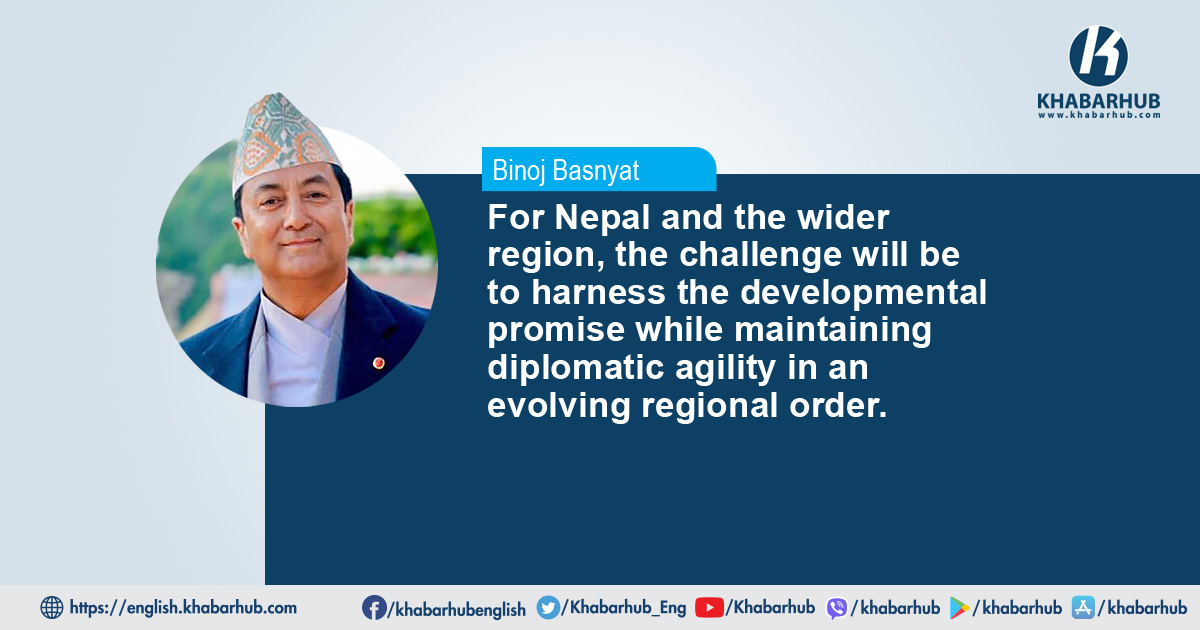
The coming years will reveal whether this political convergence results in meaningful cooperation or evolves into another arena of strategic competition. For Nepal and the wider region, the challenge will be to harness the developmental promise while maintaining diplomatic agility in an evolving regional order.
For South and Southeast Asia, China’s model offers potential gains in connectivity and investment—but also demands careful navigation of sovereignty, strategic autonomy, and national interest. In building a “shared future,” the region must remain clear-eyed about what is shared, who leads, and how it ends.
(Views expressed in this opinion are the writer’s and do not necessarily reflect the editorial stance of Khabarhub)





Comment