




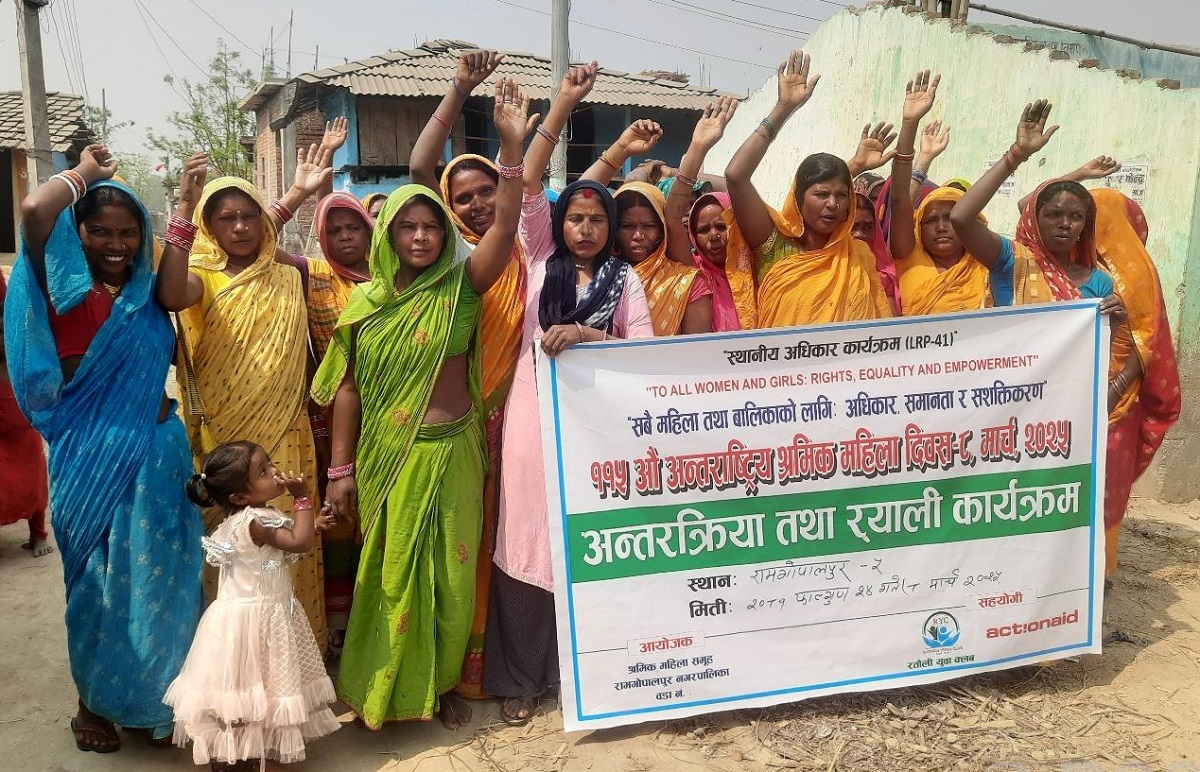
MAHOTTARI: Women in Mahottari, a district long affected by social, cultural, economic, and political discrimination, are increasingly organizing themselves to raise their voices collectively and assert their presence in local decision-making and development processes.
Women involved in empowerment campaigns say that collective organization has been key in challenging gender-based discrimination and strengthening movements for their rights.
“Organization and collective voices are not just for me, but for all women who have faced oppression,” said Phulodevi Sharma, a 40-year-old laborer from Gothbanouli, Ramgopalpur-9. Reflecting on the hardships she endured, Sharma said, “It was through organizing that I learned to raise my voice against social discrimination and mistreatment.”
Sharma recalls years of poverty, domestic neglect, and denial of basic necessities, including being prevented by her husband from going to work. She worked as a laborer in brick kilns, often carrying her young children on her back, and frequently faced abuse from family members.
“Even our wages were unfair,” she said. “While men doing the same work earned 500 to 1,000 rupees, women had to accept far less. If we protested, the employers threatened to fire us.”
Her awareness began to grow when local organizations started programs in the community to educate women about their rights and government provisions. “Through the local youth club’s initiatives, we learned to organize and submit petitions demanding justice and equity,” she said.
Currently, eight women’s groups operate in Ramgopalpur municipality, representing 197 women. These groups educate women in neighborhoods about state-provided facilities and encourage them to organize collectively. The groups also discuss women’s rights and apply pressure to implement government programs effectively.
“By forming groups, we can discuss problems together,” said Radhadevi Mandal, a 45-year-old from Lakshmipur, Ramgopalpur-1. “We also raise our collective voice to ensure laws and state provisions for women are enforced.”
Teenage girls are also forming their own groups to address adolescent health, education, child marriage, and skill-building opportunities. “By organizing, our voices are being heard, and local authorities are taking our concerns seriously,” said 16-year-old Bina Chamar from Ramgopalpur-9. Sangita Mandal, 17, added that her peer group now campaigns actively against child marriage and promotes awareness of rights.
Despite progress, many rural women remain unable to speak up independently. Active women in political and social spheres emphasize the need to involve these women in groups to amplify their voices and demand rights. “Encouraging women to organize makes them aware of their rights and responsibilities, and equips them to claim what is due,” said Saraswati Chaudhary, a member of the CPN-UML Madhesh Province Committee.
Chaudhary noted that involvement in social and economic groups has also helped women gain political awareness. “Even though domestic work falls on women, access to financial resources was limited. Participating in income-generating activities has given women some financial independence, which also earns them respect within their families,” she said.
Nepali Congress leader and Bhangaha Municipality Deputy Mayor Shantisingh Tharu echoed these views, stating that women’s organized voices have been essential in securing rights and ensuring the implementation of constitutional provisions. Social activist Doma Shahi Bista highlighted that political parties often prioritize loyal women over capable candidates, but initiatives that empower women collectively can achieve significant results in a short time.




Comment