




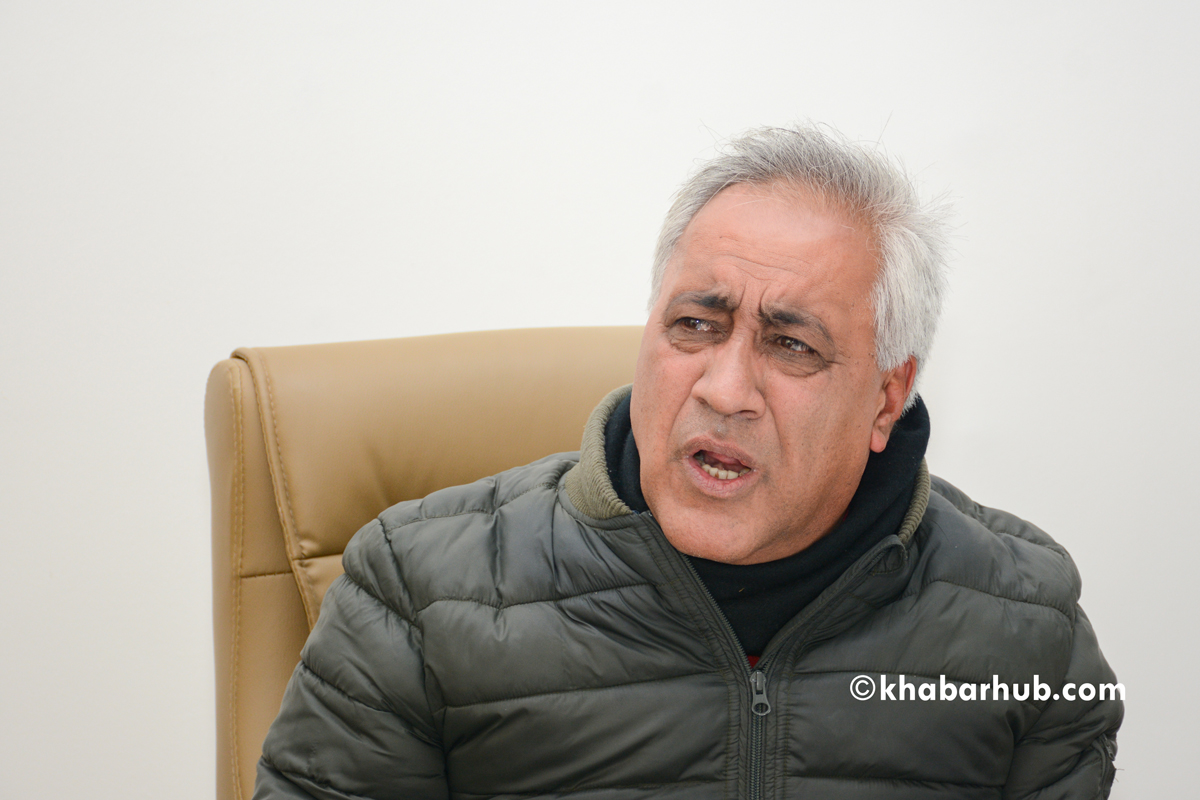
KATHMANDU: Dr. Chandra Bhandari has announced that he will run for the post of President at the Nepali Congress’ 15th General Convention. Speaking to Khabarhub, he said he will consult party leaders before moving ahead. According to Bhandari, some leaders have been projecting themselves as the sole power centers within the party, and his candidacy is meant to challenge that trend.
In the interview, Bhandari argued that merely holding elections will not solve the country’s problems unless the House of Representatives is restored and key constitutional amendments are made. He stressed that strengthening the political culture—not just individual leaders—is essential. Without amending certain constitutional provisions, he warned, the same problems will recur even after elections.
Bhandari further stated that local governments should be made partyless, and that the number of ministers should be capped at 10 at the federal level and three in each province. He also proposed that rural and municipal mayors and deputy mayors should automatically become members of the provincial assemblies.
Claiming that the economy cannot sustain the current administrative size, he argued that 60 percent of government employees should be reduced, which would free up an estimated Rs 1 billion annually for local development.
Below is an edited excerpt of his conversation with Khabarhub on current issues, including the party’s upcoming General Convention scheduled for January 11-13, 2026 and the call to restore the House of Representatives.
The Nepali Congress General Convention is approaching. Are you also contesting for the presidency?
Yes. I am also a candidate. But I will move forward by uniting everyone. The Congress is not anyone’s monopoly. I decided to contest because a trend has emerged where some are claiming to be the only ones capable. I could not allow a leadership vacuum to appear.
Many unnecessary things have been happening, and I feel compelled to present my own ideas. When the country is in crisis and people are frustrated with leaders constantly scrambling for positions, I am ready to take responsibility if the party opts for a new direction.
Candidates often enter the race for discussion and later withdraw. How do you view this?
My candidacy should be viewed from five perspectives, including positivity, coordination, ideas, new equations, and the opportunity it provides for everyone.
Given your influential role, could you withdraw and allow others to lead?
That matter has not been discussed yet. I am currently in Butwal. Once I return to Kathmandu, I will talk to General Secretaries Gagan Thapa and Bishwaprakash Sharma, as well as Dr. Shekhar Koirala. I will consult all former office-bearers and leaders before making a final decision.
The party spent 42 days confused about the General Convention agenda. How difficult is this for party functioning?
This is precisely my point. For 42 days the Congress remained confused over trivial matters, even as the country faced a crisis. The party failed to address national issues. The global landscape has shifted toward new geopolitical polarizations, yet we were preoccupied with procedural confusion. A General Convention is a routine process—getting stuck on it shows how far we’ve strayed from our core purpose.
Is there still uncertainty about holding the Convention before the March 5, 2026 election?
Yes. That is why the tenure of the current Working Committee was extended by one month. But if we fail to hold the Convention before the election, the party will face serious problems. Leaders may be laying the groundwork for complications, but this is not right.
Would it be difficult to face voters without holding the Convention?
We fully support holding the General Convention. But the constitution should also have been amended by convening Parliament for at least two months. Changing individuals is not enough—we must change the political trend itself. Elections have repeatedly failed to provide solutions. Parliament was dissolved multiple times, and people were left with nothing but slogans.
Let’s admit it: the Nepali Congress–UML government formed with the goal of amending the constitution ended up doing nothing. Einstein once said, “I spend 55 minutes understanding a problem and five minutes reaching a conclusion.” We failed to understand our own problems. The party carried unnecessary baggage. Unless we understand the people’s struggles and reform the party accordingly, the country cannot move forward.
The party president should easily step aside and convene the General Convention. But instead, we created these problems ourselves. If the Convention is not held, the party will suffer severe consequences. It is a regular process—it must take place.
How should the Nepali Congress move forward now?
The party must take up national issues. We should examine who is responsible for dissolving Parliament repeatedly. Is it right to seek elections simply because we have the funds to contest them? People lack basic medicines, yet we are caught up in pointless politics. The constitution must be amended.
Will there be an election on March 5, 2026?
There is still confusion. Ultimately, the government must make it happen. But I will say something others won’t: elections alone will not provide solutions. We must amend 4–5 key articles of the constitution.
What changes are needed?
The state structure has become too large for the available revenue. The provinces are also oversized—not in number, but in administrative structure. There should be 10 federal ministers and three provincial ministers. Rural municipality chairpersons and vice-chairpersons should automatically sit in provincial assemblies. The constitution should not allow more than two prime ministers at once. Local governments should be made partyless.
Local-level politics has become divisive, with citizens expecting services only through party connections. Party leaders should be selected only at the central level. There is excessive conflict at the grassroots. The bureaucracy must be reduced by 60 percent. The Dilliraj Khanal Commission’s report is sound and should be implemented.
If security agencies are reformed, the government can function regardless of who leads it. Parliament will not be dissolved again. We could channel Rs 1 billion annually into local development. With this restructuring, Nepal could develop significantly within five years, investing national resources into large projects.
Does this mean the House of Representatives should be restored and run for some time?
Yes. Even if it takes two months, Parliament must be reconvened to amend key constitutional provisions. The Congress has also moved to the court with this in mind.




Comment