




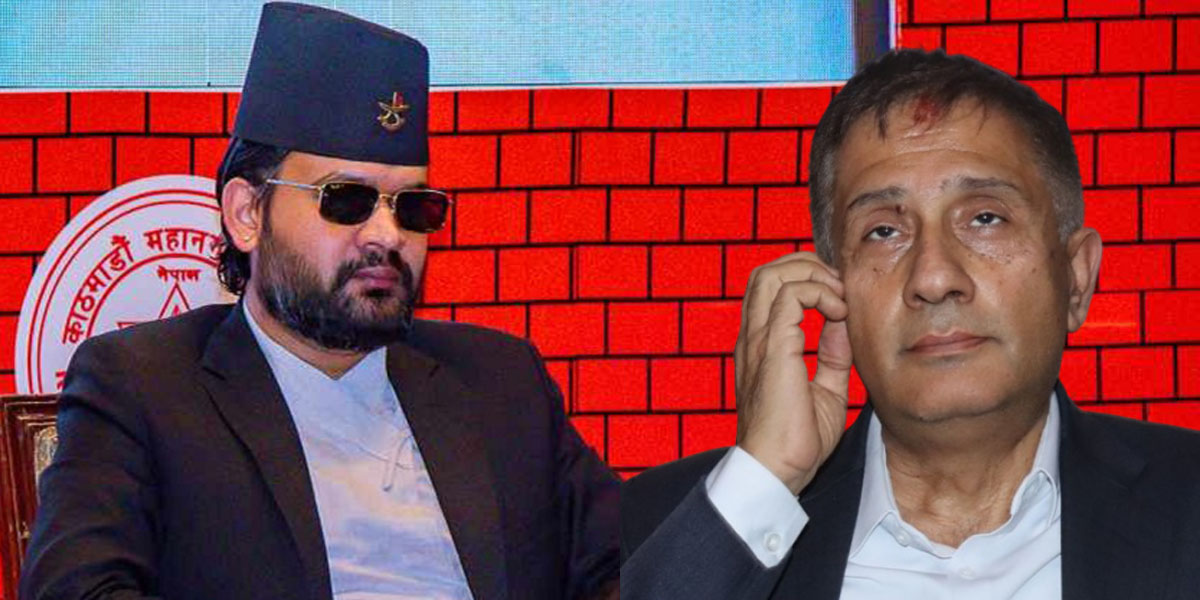
KATHMANDU: A fresh conflict has erupted within the Kathmandu Metropolitan City (KMC) office, as tensions between Mayor Balendra (Balen) Shah and Chief Administrative Officer (CAO) Saroj Guragain continue to escalate.
The dispute took a serious turn when Mayor Shah suspended Guragain for three months, resulting in employees not receiving their salaries during that entire period.
Mayor Shah had urged the Federal Government, led by Prime Minister KP Sharma Oli, to appoint a replacement for Guragain. However, the central government did not act on this request.
Instead, under instructions from the Ministry of Federal Affairs and General Administration, Deputy Mayor, ward chairpersons, and other staff members forcibly brought Guragain back into office.
Even though Mayor Shah deployed city police to block his entry, he was overruled, and Guragain resumed his duties, effectively sidelining Shah in the process.
Frustration has been mounting among municipal employees who have gone unpaid for three months.
On Chaitra 19, Mayor Shah took to social media and issued a stark warning directed at the federal government. In his post, he wrote, “I do not know what kind of movement they will start. If our employees do not receive their salaries within a week, I will bury them all in pieces! Then let’s see what kind of system you have!”
That meeting, part of efforts to update the list of PPP projects, was coordinated by Ward Chairman Prajapati. Guragain not only attended the meeting but signed the discussion minutes—without disclosing that he had already approved the building plan.
Despite this warning, more than two weeks have passed without the federal government sending a new CAO as requested by Shah. Instead, the Ministry reinstated Joint Secretary Saroj Guragain, who returned to the office on Chaitra 21 and has already resumed work, further fueling tensions inside the metropolis.
At the heart of the dispute between Shah and Guragain lies the controversial Kathmandu Tower project being constructed on the site of the old bus park.
Mayor Shah had earlier suspended Guragain, accusing him of being involved in irregularities related to the construction of this multi-storey commercial tower.
What was originally planned as a 12-storey building has allegedly been expanded to 19 stories, a change that Shah blames on administrative negligence and unauthorized approvals.
This tower, located in what was formerly Kathmandu-31 (now Ward No. 28), has become a symbol of the larger struggle within the Metropolitan City.
It has sparked institutional friction, employee unrest, and now even a political standoff.
The conflict over the tower is also directly tied to the salary crisis, as the absence of a functioning CAO has prevented salary disbursement, leaving municipal employees in limbo.
The Kathmandu Metropolitan City had signed an agreement with Shree Jaleshwor Swachhand Bikoi Builders Pvt. Ltd. on March 6, 2015, under a Public-Private Partnership (PPP) model to develop the tower.
As per the agreement, a 12-storey commercial complex was to be built on an 11,890 square meter plot.
The builder’s design allocated 55.08 percent of the space to parking, open areas, and roads, 39.99 percent to ground coverage, 4.93 percent to greenery, and 2.41 percent to the façade.
The agreement gave the builders five years to complete construction, after which they would operate the tower for 30 years and pay annual royalties to the city.
Initial construction approval was granted on August 23, 2015, permitting work up to the DPC level (foundation and beam) for two underground floors and ten upper floors.
However, the construction company went ahead and completed a 12-storey structure without receiving approval for the upper levels—a violation that has since triggered a series of investigations.
Ward chairman Birendra Prajapati, who also serves as the coordinator of the PPP Project List Preparation Committee, explained that construction blueprints are typically approved in phases.
First, the DPC phase is authorized, followed by a technical inspection, and finally, the completed structure is approved. In this case, while the blueprint for the basement was approved, the builders never received the go-ahead for the additional floors above.
Still, they went ahead with the construction and submitted a 12-storey plan after the fact.
In response, the metropolis formed an investigative committee led by Harishchandra Lamichhane, Basanta Acharya, and Suraj Shakya.
The committee confirmed that the building had been constructed beyond the approved blueprint. Based on the findings, Mayor Shah fined the builders Rs. 500,000 on December 18, 2023.
Now, the Kathmandu Tower stands not just as a building under scrutiny, but as the central symbol of a deepening rift between local and federal governance.
As the political storm continues to swirl, the tower remains both the physical and metaphorical center of a crisis that has paralyzed one of Nepal’s most important municipal offices.
Why is Saroj Guragain Embroiled in Controversy?
The controversy surrounding Joint Secretary Saroj Guragain, the Chief Administrative Officer (CAO) of Kathmandu Metropolitan City, began with alleged irregularities in the construction of the Kathmandu Tower—a project that replaced the historic old bus park.
Tensions between Mayor Shah and CAO Guragain escalated when accusations surfaced that the builders had violated key terms of the project, prompting Mayor Shah to suspend Guragain from his post.
Saroj Guragain, a Joint Secretary of the Government of Nepal, was officially appointed as CAO of the metropolis on September 12, 2024 by the Cabinet and took charge on September 23, 2024. However, controversy quickly followed.
Despite the builders’ failure to complete the construction of the Kathmandu Tower even two years beyond the agreed deadline, the city had not taken significant action until recently.
In response, the metropolis formed an investigation committee chaired by Mayor Balendra Shah, with Deputy Mayor Sunita Dangol and ward chairpersons serving as members.
According to Birendra Prajapati, coordinator of the investigation subcommittee, on August 14, 2023, the builders submitted a proposal to expand the originally approved 12-storey tower to include an additional seven floors.
Documents obtained by Khabarhub reveal that the construction proposal for a 17-storey tower was submitted to the metropolis on February 5, 2024. The same documents were reportedly examined and approved on Fbruary 11, within the same week.
The controversy deepened when it was revealed that CAO Guragain approved the building’s map on September 27, 2024—just four days after assuming his position.
Guragain defended his decision by citing a Rs. 5,000 fine imposed by Mayor Shah and referred to instructions from former CAO Basanta Adhikari, which had called for the resubmission of the map for legal approval.
However, the investigation committee’s findings highlight serious lapses in this process.
The report states that Guragain approved a revised plan that extended the building to 19 floors.
“On September 27, 2024, the Chief Administrative Officer approved the map beyond the fifth level. According to the plan, the building includes two basement floors and 17 upper floors, covering an area of 59,369.84 square meters,” the report notes.
Coordinator Prajapati argues that while the CAO has the authority to approve private residential maps, this authority does not extend to projects under the Public-Private Partnership (PPP) model.
“If the original agreement was for 12 storeys, where did the extra seven come from?” Prajapati asked. “Who authorized that? The CAO can approve an individual’s house plan, but for a PPP project, any amendment requires a supplementary agreement. This should have gone through the city’s working committee.”
He emphasized the need for a technical report to assess whether the structure could support the additional seven floors.
“While we were reviewing the case, we heard that a 19-storey map had been approved,” Prajapati added. “We haven’t found the full document yet. We only managed to obtain a photocopy from an external source.”
Further controversy surrounds Guragain’s role in the approval process. Despite having signed off on the building’s map, he later participated in an internal committee meeting to discuss unresolved issues regarding the Kathmandu Tower.
Following the action against Guragain, the Metropolitan City has faced a financial standstill. For over three months, city employees have gone without salaries, and the city has been unable to meet its financial obligations.
That meeting, part of efforts to update the list of PPP projects, was coordinated by Ward Chairman Prajapati. Guragain not only attended the meeting but signed the discussion minutes—without disclosing that he had already approved the building plan.
“He had already signed the approval certificate before attending the meeting,” Prajapati said. “Yet, during the meeting, he gave no indication that the map had been passed. Once the matter came to light, we held a press conference to inform the public that this map is not legally valid.”
In this ongoing saga, Guragain is being accused of playing a double role—on one hand, approving a highly contested building plan, and on the other, participating in official proceedings as if he were unaware of his own actions.
As the controversy deepens, questions are mounting over accountability, transparency, and the governance of one of Nepal’s largest urban infrastructure projects.
Controversy Deepens: Questions Surround Guragain’s Approval of Kathmandu Tower Map
Ward Chairman Birendra Prajapati has raised serious concerns about the conduct of Chief Administrative Officer (CAO) Saroj Guragain, questioning whether someone drawing a salary funded by the taxpayers of Kathmandu Metropolitan City can act in a way that directly undermines the city’s interests. “That’s exactly what Guragain has done,” said Prajapati.
One major issue raised is the lack of transparency and adherence to the official system in approving the blueprint for the additional seven floors of the Kathmandu Tower.
According to the metropolis’ regulations, all blueprints must be submitted and processed through the city’s online system before any formal approval can be granted.
While there is general consensus that the Kathmandu Tower was originally approved as a 12-storey structure, there was no agreement to expand it beyond that.
“Construction was supposed to be completed by 2078 BS. We are now nearing 2082 BS, and the project still isn’t finished,” Prajapati said.
“Should we not take action against the construction company for breaching the original agreement?”
In 2081 BS, when the controversial map for the Kathmandu Tower was approved, CAO Guragain recommended action be taken—acknowledging himself that the map authorized 19 floors instead of the agreed 12.
During an emergency press conference, Metropolitan spokesperson Nabin Manandhar and Mayor Balendra Shah’s chief personal secretary, Bhupdev Shah, confirmed that Guragain had approved the building’s map in violation of established procedures.
“The approval bypassed the city’s standards and system, prompting the need for investigation and disciplinary action,” they stated.
In response, the Metropolitan City formed an investigation committee chaired by former Supreme Court Justice Shekhar Prasad Poudel, with former Secretary Shankar Prasad Pandey and Dr. Suman Narsingh Rajbhandari, Vice President of the Metropolitan City’s Urban Planning Commission, as members.
However, Justice Poudel later resigned after being asked to submit a conclusive report within 15 days. Subsequently, another committee was formed, led by former Secretary Pandey, with Rajbhandari and Mahesh Nepal, the city’s legal advisor, as members.
According to city officials, Mayor Balendra requested that Guragain take a leave of absence pending the outcome of the investigation.
In his absence, Govinda Prasad Sharma was appointed acting CAO, but he too resigned shortly after. Nurnidhi Neupane from the Department of Agriculture and Livestock then assumed the role of acting CAO and continues to serve in that capacity.
On January 8, 2025, Mayor Balena formally requested the Ministry of Federal Affairs and General Administration to appoint a new chief administrative officer.
When the ministry failed to act, he further asked that financial authority be granted to the acting CAO, Neupane.
However, the ministry refused, stating that financial authority could not be delegated while Guragain officially remained in his post. Instead, the ministry demanded that Guragain provide a formal explanation for the disciplinary action taken against him.
Even though Balen was elected as the mayor of Kathmandu as an independent candidate, he has the challenge of ‘showing by doing work’. However, the quarrel over the Chief Administrative Officer has brought the metropolis’ work to a standstill for more than three months.
Surendra Bajgain, the mayor’s press coordinator, revealed that after the initial investigation committee failed to submit its report on time, a second, three-member committee was tasked with presenting their findings. “The mayor then forwarded their opinion to the ministry,” Bajgain said.
“I will bury them in Tukucha!”
Following the action against Guragain, the Metropolitan City has faced a financial standstill. For over three months, city employees have gone without salaries, and the city has been unable to meet its financial obligations.
Spokesperson Manandhar confirmed that the absence of a chief administrative officer has paralyzed the city’s financial operations. “Nothing is moving forward without the CAO,” he said. “It’s directly affecting our financial processes.”
Had the ministry granted financial authority to the acting CAO, Neupane, these issues could have been avoided. But the ministry stood firm. Spokesperson Kali Prasad Parajuli explained that no new appointment would be made until Guragain’s position was officially vacated.
“Guragain hasn’t been transferred. Unless his post is vacant, we cannot send someone else,” he said. “Whether or not he is on leave, we haven’t received the necessary documentation.”
The position of Chief Administrative Officer is held by a Joint Secretary of the federal government and can only be reassigned by the Cabinet.
Currently, that power lies with Prime Minister KP Sharma Oli. Tensions between Mayor Balen and PM Oli are no secret. The two have frequently clashed, especially on social media, where Balendra—who enjoys strong support among Nepal’s youth—has made several pointed remarks criticizing the prime minister.
As the dispute continues, the administrative gridlock in Kathmandu Metropolitan City remains unresolved, with real consequences for governance, accountability, and the livelihoods of hundreds of employees.
The UML cadre has also formed a strong front against Balendra, who won the election by defeating his independent candidate Keshav Sthapit badly, from the government to the network.
The UML cadre has been trying its best to obstruct Balendra in the metropolis through the federal government and the winning ward chairmen of its party.
However, in the meantime, Balen was taking the initiative with Oli to bring in a new Chief Administrative Officer through Kathmandu-32 Ward Chair Nawaraj Parajuli.
Parajuli, who was elected by the UML, had not been able to bring in a Chief Administrative Officer in the metropolis.
Prime Minister Oli has been making statements from the public forum that Balendra has not allowed the officer he had to work and has blamed others.
Amidst the escalating tension, Mayor Balendra Shah intensified the dispute by posting a strongly worded status on Facebook, threatening to “bury him in a Tukucha.”
Meanwhile, the progress of the metropolis has remained zero in the absence of a Chief Administrative Officer.
Even though Balen was elected as the mayor of Kathmandu as an independent candidate, he has the challenge of ‘showing by doing work’. However, the quarrel over the Chief Administrative Officer has brought the metropolis’ work to a standstill for more than three months.
After this situation arose, the ward chairmen of the metropolis had submitted a letter to Mayor Balen to call an executive meeting to discuss the issue of the Chief Administrative Officer.
18 ward chairmen, including No. 17 chair Nabin Manandhar, who is also the spokesperson of the metropolis, had submitted a memorandum demanding an executive meeting.
Meanwhile, Deputy Mayor Sunita Dangol, who won the election on the UML ticket, also took a dig at Balendra. Dangol, responding to some media persons, had said that it was not right to blame, take action against the Chief Administrative Officer sent by the central government, or constantly accuse him of why a new administrative officer was not sent in his place until the investigation committee decides what to do.
“First and foremost, the investigation committee’s report should be made public,” said Deputy Mayor Sunita Dangol.
“If the report reveals shortcomings on his part, there should be no hesitation in taking immediate action. But withholding the report while protesting the federal government’s refusal to appoint a new Chief Administrative Officer serves no purpose.”
Amidst the escalating tension, Mayor Balendra Shah intensified the dispute by posting a strongly worded status on Facebook, threatening to “bury him in a Tukucha.”




Comment