




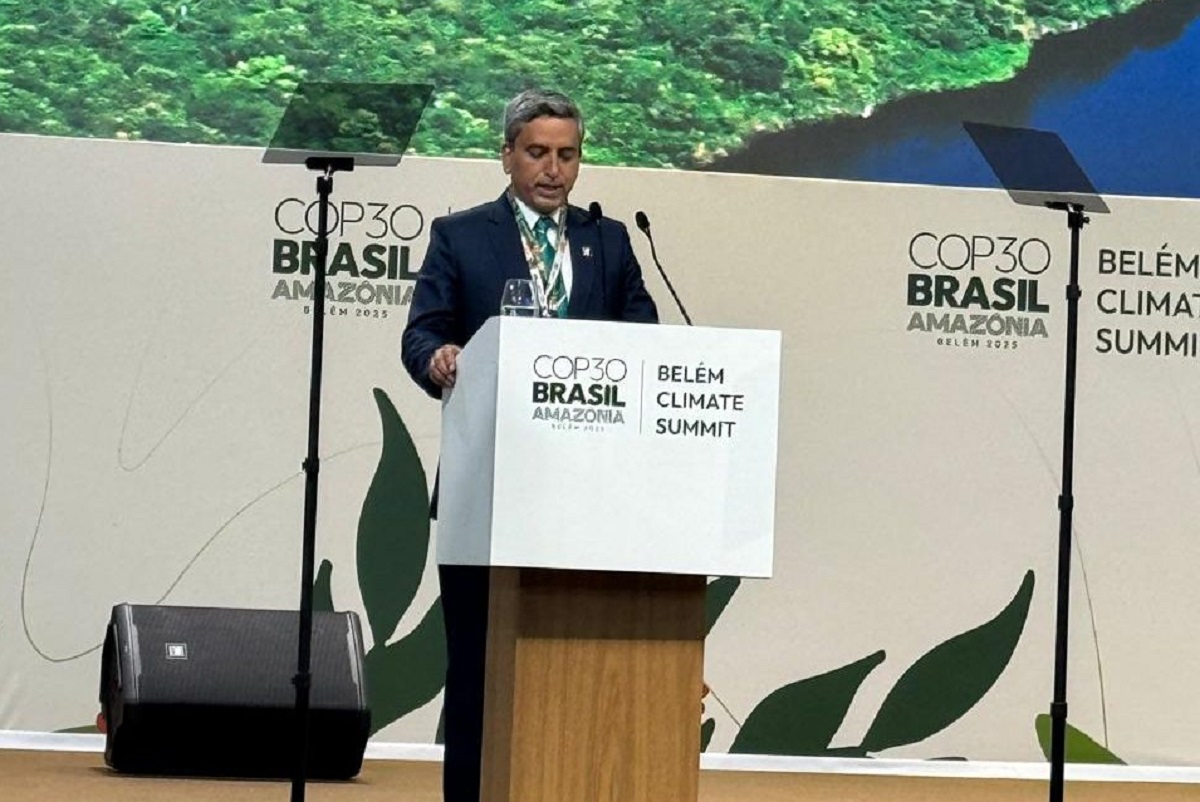
KATHMANDU: Nepal has urged the global community to work together for climate justice and a sustainable future, calling for immediate and collective action to address the climate crisis.
The appeal was made during the Leader’s Summit held on November 5–6 ahead of the 30th Conference of Parties (COP-30) to the UN Framework Convention on Climate Change. Speaking on behalf of Nepal, Dr. Rajendra Prasad Mishra, Secretary at the Ministry of Forests and Environment, said Nepal has always prioritized eco-friendly systems and environmental protection.
“Our 46 percent forest cover has been preserved through the active participation of local communities and Indigenous peoples,” Dr. Mishra said. “The Himalayas, including Mount Everest, are not only our identity but also a vital source of biodiversity, clean air, and water for billions. Nepal is a key contributor to the global climate balance.”
He highlighted Nepal’s minimal carbon emissions but noted its strong commitment to the Paris Agreement through policies and action. “Our NDC 3.0 and NAP reflect this commitment. Nepal is phasing out fossil fuels and accelerating the transition to electric mobility and clean energy,” he said.
Sagarmatha Dialogue and climate impact in Nepal
Recalling the recent Sagarmatha Dialogue held in Kathmandu, Dr. Mishra said it reaffirmed global commitment to multilateralism and the 1.5°C temperature goal. Despite these efforts, he warned that climate impacts are intensifying in Nepal, with over 300 lives lost this year alone due to floods, landslides, droughts, glacial lake outbursts, and wildfires.
He emphasized that while the Paris Agreement has started showing results, progress remains slow. Access to climate finance and technology continues to be complex and costly for vulnerable nations, he said, stressing the need for more equitable systems.
Nepal expects COP-30 to ensure the implementation of a roadmap to keep global temperature rise within 1.5°C, mobilize USD 1.3 trillion in climate finance under the “Baku–Belem Roadmap,” triple adaptation funding, and make the Loss and Damage Fund easily accessible to vulnerable nations.
“We have no time to lose,” Dr. Mishra said. “Nepal stands ready to act with the global community to protect our people, livelihoods, and the planet.”
Nepal’s participation in COP-30
COP-30 will be held in Brazil from November 10–21. Unlike past conferences, the high-level political sessions are being held three days before the main technical sessions.
Due to Nepal’s current political situation, the country will be represented by Minister for Agriculture and Livestock Development Dr. Madan Prasad Pariyar, leading a nine-member delegation, according to Dr. Maheshwar Dhakal, Chief of the Climate Change Management Division.
Nepal will present its agenda focusing on findings from the Sagarmatha Dialogue, the global stocktake, loss and damage, adaptation, mitigation, carbon finance, and Article 6 of the Paris Agreement.
The delegation also plans to raise issues of transparency, mountain ecosystems, capacity-building, technology transfer, and climate justice. The ministry has already prepared Nepal’s national position paper through consultations with government bodies, NGOs, and development partners.
Experts note that Nepal has recently faced unpredictable monsoon patterns, shifting rainfall timelines, and increasing climate-induced disasters, underscoring the urgency for Nepal to strongly advocate for loss and damage mechanisms at COP-30.





Comment