




In the twenty-first century, national security is no longer confined to borders, armies, and arsenals. Power today extends into digital spaces where narratives shape perceptions and influence policy—and therefore, the greater competition among major powers increasingly plays out online.
The use of information as a weapon—whether through misinformation, disinformation, or influence operations—has become a defining feature of hybrid warfare. Unlike conventional threats that target physical infrastructure, these invisible assaults erode trust, manipulate societies, and weaken states from within.
Globally, hybrid threats combine multiple instruments of power—military, economic, cyber, and informational—deployed in coordinated ways to achieve strategic objectives without overt warfare.
From Russia’s disinformation campaigns in Eastern Europe to coordinated influence operations in Southeast Asia, states have learned that the most effective wars are often fought in the minds of citizens. In this evolving environment, truth itself becomes contested terrain.
For smaller and developing nations like Nepal, the stakes are even higher. With limited institutional capacity, a fragmented media ecosystem, rising social media dependency, and a polarized global order, Nepal is particularly vulnerable to information manipulation.
As the lines between fact and fiction blur, the challenge is not only about countering falsehoods but also about safeguarding national sovereignty and democratic resilience in a rapidly digitizing world.
Nepal’s Digital Vulnerabilities and Strategic Exposure
Over the past decade, Nepal has undergone a digital revolution. Social media platforms such as Facebook, TikTok, X (Twitter), and YouTube have become the primary sources of news and political debate for millions of Nepalis. Yet this transformation has not been matched by equivalent investments in digital literacy, cyber governance, or accountability mechanisms. As a result, misinformation and disinformation have become embedded in Nepal’s public discourse.
To safeguard its sovereignty and democracy, Nepal must redefine national security to encompass the digital domain. Protecting information integrity is as vital as defending borders.
During the 2022 general elections, for instance, social media platforms were flooded with manipulated videos, misleading political ads, and deepfake content targeting parties and candidates. False claims regarding vote rigging and foreign funding circulated widely, shaping narratives and inflaming public distrust in the electoral process.
Nepal’s Election Commission, though aware of these challenges, lacked both the technological tools and the legal framework to monitor online propaganda effectively.
Foreign actors have also recognized the strategic value of Nepal’s digital space. China’s digital influence operations, which have been reported in South Asia, aim to promote pro-Beijing narratives while discrediting voices critical of its policies, including those on Tibet or Taiwan.
During Nepal’s debates over the Belt and Road Initiative (BRI) and the Millennium Challenge Corporation (MCC) compact, pro-Chinese content proliferated across Nepali Facebook groups and TikTok accounts—often using Nepali-language pages managed from outside the country. Such campaigns, subtle but persistent, seek to shape perceptions of China as Nepal’s most reliable partner while framing Western support as exploitative.
Similarly, Russian propaganda networks—particularly state-backed media and bot accounts linked to RT and Sputnik—have begun to penetrate South Asian digital ecosystems. During global events such as the Russia–Ukraine war, these channels spread narratives positioning Russia as an anti-imperialist power and depicting Western democracy promotion as hypocritical.
These narratives have found traction in Nepal’s social media space, blending with domestic populist sentiments and eroding confidence in democratic institutions.
Fake news incidents during crises—such as the 2015 earthquake, the 2020 COVID-19 pandemic, and recent border tensions with India—show how disinformation can spread faster than facts, creating confusion and panic. Such cases expose the fragility of Nepal’s information ecosystem, where unverified content often goes viral long before state agencies can issue clarifications.
On the other hand, recent Gen Z–led movements in Nepal exemplify how digital platforms can mobilize collective action. Harnessing social media’s reach, young Nepalis rapidly organized protests, challenged political elites, and exposed corruption—demonstrating both the empowering potential of digital connectivity and the risks of information manipulation in shaping national narratives and state responses.
Nepal’s institutional response remains inadequate to deal with these kinds of challenges. The lack of a dedicated cyber command, poor coordination among government agencies, and the absence of a comprehensive cyber law leave major gaps in the country’s security architecture.
The draft National Cyber Security Policy (2023) remains largely aspirational, and the Information Technology Bill has not yet integrated provisions to combat hybrid disinformation threats.
Compounding these issues is Nepal’s strategic geography
Sandwiched between two digital powers—India and China—Nepal often becomes a recipient of competing influence campaigns. While Beijing promotes narratives around stability and economic development, New Delhi seeks to maintain informational dominance in Nepali-language media.
These competing discourses—whether on religion, trade, or infrastructure—can polarize Nepali society and complicate its foreign policy positioning.
Hybrid Threat Landscape: Beyond Cyberattacks and Propaganda
Disinformation is part of a wider hybrid threat ecosystem that operates across multiple domains. Hybrid threats blend cyberattacks, psychological operations, economic leverage, and diplomatic coercion to achieve strategic outcomes without direct confrontation. For Nepal, these threats appear not as open aggression but as the gradual corrosion of trust and governance.
Cyber vulnerabilities have expanded with the digitization of Nepal’s banking, telecom, and government systems. Several Nepali banks have faced phishing and ransomware attacks, allegedly originating from foreign servers, underscoring weak cybersecurity protocols.
Meanwhile, online propaganda networks exploit Nepal’s open information environment to promote divisive narratives—ranging from anti-Western sentiment to communal tension.
The election cycle offers fertile ground for manipulation. During the 2022 and 2017 polls, researchers observed coordinated inauthentic behavior on social media that mirrored tactics used by Russia and China elsewhere—using fake pages, bots, and micro-targeted ads to influence voters. Although Nepal’s domestic actors are also active in spreading disinformation, the presence of foreign narratives embedded within these campaigns raises legitimate questions about sovereignty and external interference.
The danger of hybrid threats lies in their ambiguity. A viral video questioning the credibility of an election can delegitimize the outcome more effectively than a cyberattack on the Election Commission’s servers. Such operations exploit Nepal’s social divisions—between political parties, generations, and ethnic groups—turning internal polarization into an external vulnerability.
The digital age has blurred the boundaries between peace and conflict; the war for truth is already underway. Nepal must now ensure that this war does not compromise its sovereignty or the integrity of its democracy.
Nepal’s traditional security architecture, focused on military and border defense, remains ill-equipped to deal with such hybrid challenges. Cyber and information warfare remain outside the scope of national security doctrine. Civil institutions, journalists, and think tanks are yet to be integrated into a coordinated national response, even though they are on the front lines of information battles.
Rethinking National Security in the Digital Age
To safeguard its sovereignty and democracy, Nepal must redefine national security to encompass the digital domain. Protecting information integrity is as vital as defending borders.
First, Nepal should establish a National Centre for Cyber and Information Security, integrating intelligence, defense, and communication agencies to monitor and respond to hybrid threats. This institution must have both the technical capacity and legal authority to address disinformation, election interference, and cross-border cyber intrusions.
Second, digital and media literacy must be prioritized. Citizens are the first line of defense in the information war. Integrating digital literacy programs in schools and civic education can create a more informed and critical citizenry.
Third, media responsibility is crucial. Journalistic institutions must strengthen editorial oversight and collaborate with fact-checking platforms such as Nepali Check, South Asia Check, and Kathmandu Facts to ensure the credibility of public information. Partnerships between media houses, academia, and tech companies could help develop an early warning system for online propaganda.
Fourth, regional cooperation is indispensable. Nepal can work within SAARC, BIMSTEC, and Indo-Pacific frameworks to share cyber intelligence, coordinate on election integrity, and build digital defense capabilities. Learning from countries like Estonia and Singapore—who have built resilient information ecosystems—can help Nepal chart its own model.
Finally, political leadership must treat disinformation as a national security threat rather than a partisan issue. Without proactive policy and institutional readiness, Nepal risks becoming a testing ground for foreign influence operations and proxy information wars.
Building Societal Resilience
Disinformation and hybrid threats thrive where societies are divided and institutions are weak. Nepal’s stability depends not only on technological defense but also on societal cohesion. Combating these threats is not about censorship—it is about strengthening the democratic fabric through truth, transparency, and trust.
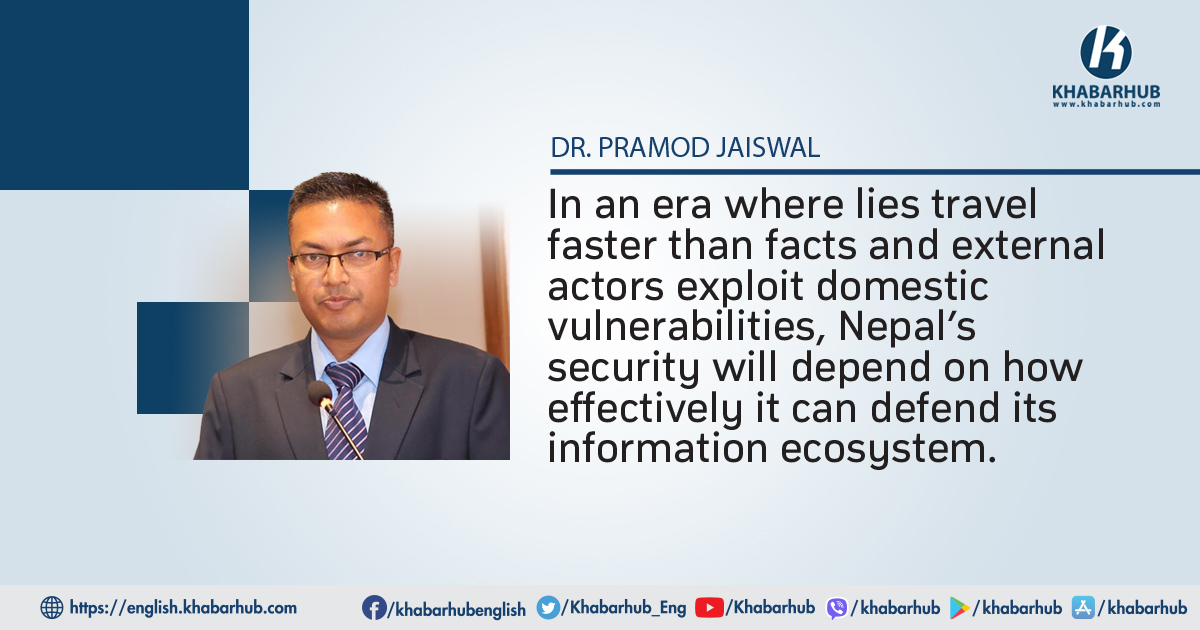
In an era where lies travel faster than facts and external actors exploit domestic vulnerabilities, Nepal’s security will depend on how effectively it can defend its information ecosystem.
The digital age has blurred the boundaries between peace and conflict; the war for truth is already underway. Nepal must now ensure that this war does not compromise its sovereignty or the integrity of its democracy.
(Dr. Jaiswal is a Research Director at the Nepal Institute for International Cooperation and Engagement (NIICE).






Comment