




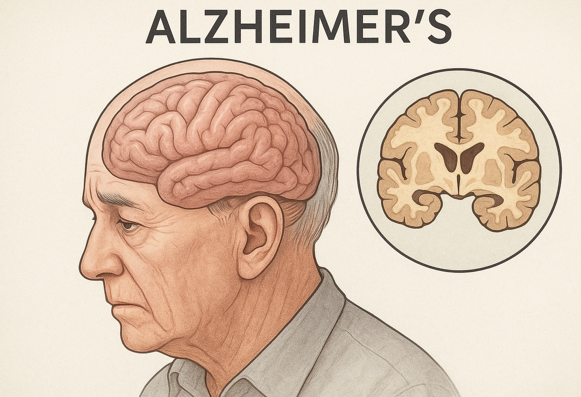
HOUSTON: New research from Houston Methodist reveals how obesity may directly drive Alzheimer’s disease. Scientists discovered that tiny messengers released by fat tissue, called extracellular vesicles, can carry harmful signals that accelerate the buildup of amyloid-b plaques in the brain.
These vesicles even cross the blood-brain barrier, making them powerful but dangerous connectors between body fat and brain health.
The study, “Decoding Adipose-Brain Crosstalk: Distinct Lipid Cargo in Human Adipose-Derived Extracellular Vesicles Modulates Amyloid Aggregation in Alzheimer’s Disease,” was published on October 2 in Alzheimer’s & Dementia: The Journal of the Alzheimer’s Association.
It explores the link between obesity, which affects about 40% of the U.S population, and the dreaded neurodegenerative disease affecting more than 7 million people in the U.S.
The research was led by Stephen Wong, Ph.D., the John S. Dunn Presidential Distinguished Chair in Biomedical Engineering . Alongside Wong, Li Yang, Ph.D., a research associate at Houston Methodist, and Jianting Sheng, Ph.D., an assistant research professor of computational biology and mathematics in radiology at the Houston Methodist Academic Institute, provided leadership in experimental design and cross-institution coordination.
“As recent studies have underscored, obesity is now recognised as the top modifiable risk factor for dementia in the United States,” said Wong, corresponding author and director of T. T. & W. F. Chao Centre for BRAIN at Houston Methodist.
The researchers found that the lipid cargo of these cell messengers differs between people with obesity and lean individuals, and that the presence and levels of specific lipids that differed between the groups changed how quickly amyloid-b clumped together in laboratory models.
Using mouse models and patient body fat samples, the researchers examined the vesicles, which are tiny, membrane-bound particles that travel throughout the body and act as messengers involved in cell-to-cell communication.
These minuscule communicators are also capable of crossing the blood-brain barrier. Targeting these tiny cell messengers and disrupting their communication, which leads to plaque formation, may help reduce the risk of Alzheimer’s disease in people with obesity.
The researchers said future work should focus on how drug therapy could stop or slow the build-up of Alzheimer-related toxic proteins (such as amyloid-b) in at-risk individuals.
The research was coauthored by Michael Chan, Shaohua Qi, and Bill Chan from Houston Methodist; Dharti Shantaram, Xilal Rima, Eduardo Reategui, and Willa Hsueh from The Ohio State University’s Wexner Medical Center; and Xianlin Han from the University of Texas Health Science Center at San Antonio. (ANI)






Comment