




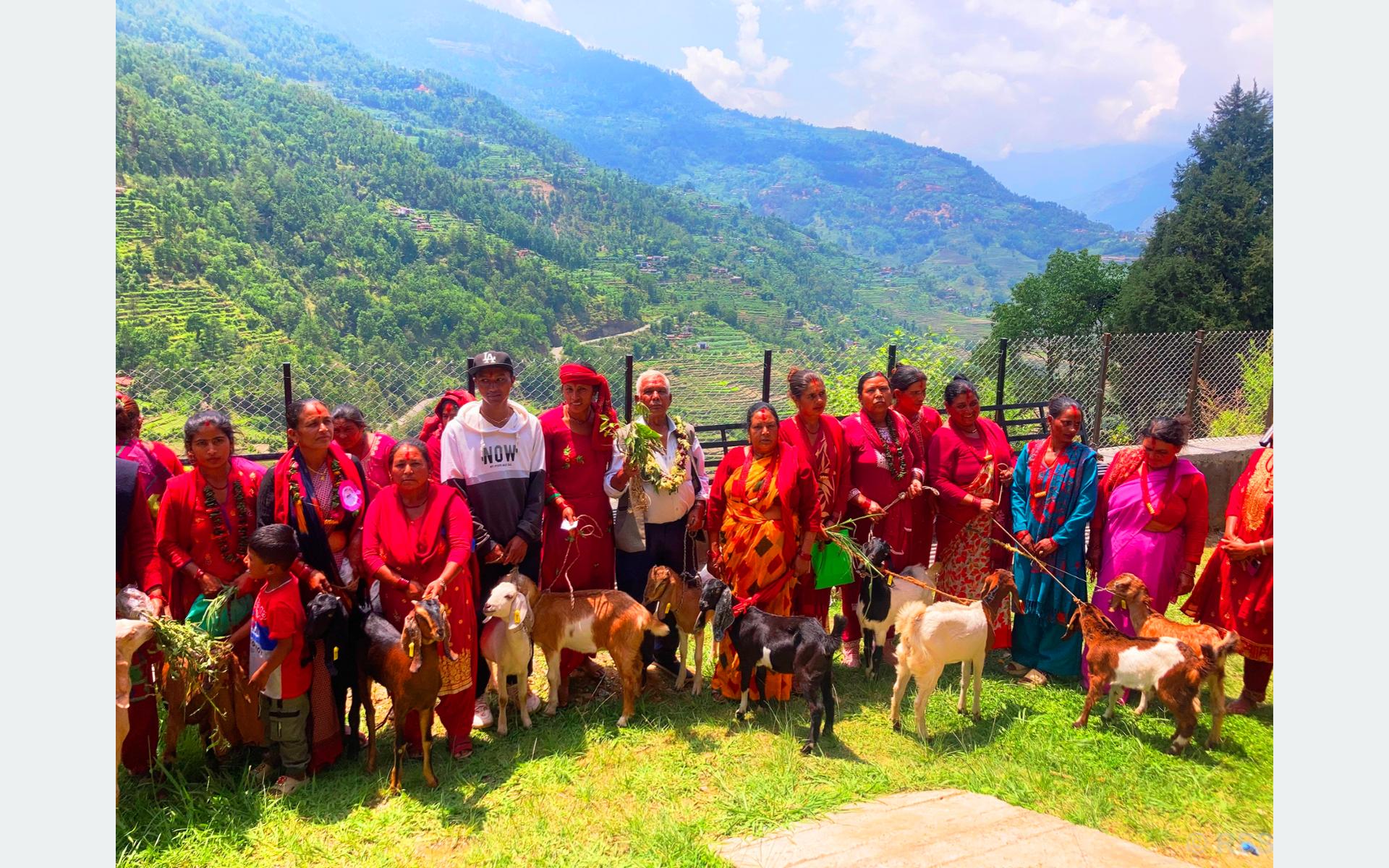
BAGLUNG: A farmer from Malika, Baglung Municipality-5, has gifted a six-month-old goat to Tulsi Sapkota—one she raised herself at home.
The gift is part of the ‘Self-reliant Baglung’ program under which Baglung Municipality, with technical support from the Heifer Project, has distributed 104 goats to local women.
Sapkota received her goat as a gift from a fellow beneficiary who had received goats through the program last year and is now passing on the offspring.
Launched in 10 wards of Baglung Municipality, the program is supported financially by the municipality, technically by Heifer, and managed by the Nepal Gaja Development Foundation.
Women who received 19 goats last year through three leading mother groups in Malika have now passed on 19 goats to their neighbors, continuing the chain of support.
Under program rules, each recipient is required to gift the first offspring of their goat to another woman in the community. By the end of Asar (July), 104 goats had been shared in this way across the 10 wards.
Baglung Municipality Mayor Basanta Kumar Shrestha, who personally distributed the initial 19 goats, said the initiative was designed to support women’s income generation.
“There’s great potential for goat farming in the highlands of Malika. Traditional practices exist, but turning them into a professional venture requires attention to improved housing and animal health,” he said.
The program also offers training on goat farming, barn management, and financial savings. It currently operates in 10 of the municipality’s 14 wards.
Over the last two years, 208 women have benefited from seed support, and 72 sub-groups have been formed under 18 main groups.
Mamita Pun, Program Manager of Nepal Gaja Development Foundation, said many women have successfully turned goat farming into income-generating ventures. “In other municipalities, women have even formed cooperatives, bringing millions of rupees into their villages. In Tangram of Kathekhola Rural Municipality, for instance, women earn around Rs 10 million annually from goat farming,” she said, adding that the initiative could be transformative if expanded further.






Comment