




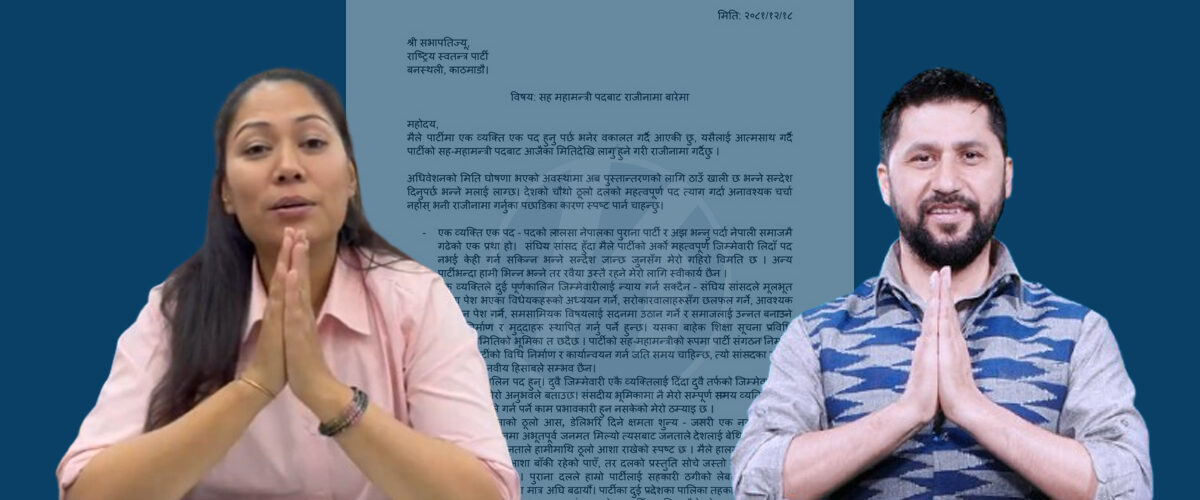
KATHMANDU: Rastriya Swatantra Party (RSP) MP and leader Sumana Shrestha’s resignation from the post of Joint General Secretary has been put on hold following intervention by party Chair Rabi Lamichhane.
According to RSP leaders, Lamichhane personally requested that Sumana postpone her decision until the party’s general convention, asking her not to insist on stepping down for the time being. As a result, her resignation has not been formally accepted.
Sumana had submitted her resignation to Lamichhane on Chaitra 17, citing her unwillingness to continue in the leadership role. However, the letter was only discussed at the Central Committee meeting on Baisakh 4.
During that meeting, the majority of central members urged her to reconsider and stay in the position until the convention.
Following the discussion, the meeting concluded with Acting President DP Aryal, Vice Chair Dr. Swarnim Wagle, and General Secretary Kabindra Burlakoti agreeing to further consult with Sumana.
Aryal, who had initiated discussion on the matter during the meeting, reportedly met with Sumana once to persuade her to withdraw the resignation.
“The Acting Chair asked her once to reconsider. Since then, there has been no follow-up discussion,” a party leader told Khabarhub.
“Around the third week of Baisakh, Aryal is believed to have formally requested her to hold off on her resignation until the general convention. Since then, Sumana has been busy with meetings of the education subcommittee.
Meanwhile, Aryal is engaged in work related to the India-Nepal Liaison Department, and Vice Chair Wagle is currently touring, so further conversations have been delayed. The issue will likely be discussed again once everyone is available.”
Aryal reportedly told Sumana that the party lacks sufficient leadership to implement the ‘one person, one post’ policy and requested her continued involvement.
However, Sumana stood firm, saying she had already made her decision and that her resignation should be accepted. According to party insiders, their conversation ended with a mutual understanding to revisit the issue later.
Interestingly, party president Rabi Lamichhane had already asked Sumana to consider stepping down even before his arrest in the cooperative fraud case. Sumana did not immediately comply, and her resignation remained pending.
The issue resurfaced at the Central Committee meeting after Sumana did not withdraw her resignation by early Baisakh.
“The President had requested her on the day she submitted the letter to wait until the general convention and reconsider,” another party leader said. “Had she withdrawn it, this issue would never have been raised again.”
As per the party’s statute, resignation letters must be submitted to the General Secretary and require approval from the President.
With Lamichhane currently in custody, the authority to accept resignations lies with Acting Chair Aryal. However, Aryal, Vice Chair Wagle, and General Secretary Burlakoti appear to be working quietly to persuade Sumana to retract her resignation.
Aryal, however, downplayed the matter. “I see her every day in Parliament; she’s working, and so are we. There hasn’t been any formal discussion on this,” he said. “The party respects her views, but further dialogue is yet to take place.”
No serious talks yet on Sumana’s resignation
Meanwhile, Sumana Shrestha’s secretariat has confirmed that there has been no substantial discussion regarding her resignation. A source close to her said, “Although there have been meetings with the Acting President, no serious discussion has taken place. She has only been asked to wait until the general convention.”
Why did Sumana resign?
In her resignation letter, Sumana outlined several reasons for stepping down from the position of Joint General Secretary.
First, she cited the need to implement the party’s “one person, one post” policy. Second, she expressed concern that the party must improve its delivery capacity to meet public expectations.
Third, she called for an end to the party’s internal “ritualistic” processes, which she believes hinder progress.
During the Central Committee meeting on Baisakh 4, Sumana further clarified her stance. She requested that another leader be appointed to her post, stating that she preferred to focus on parliamentary work.
She also signaled her willingness to compete for the leadership of the parliamentary party if necessary.
“My nature is to concentrate on parliamentary work rather than party administration. I believe in results,” she reportedly said. “I’m not hiding anything—if there’s a formal contest for the parliamentary party leader, I’m ready. But I haven’t demanded it.”
Sumana also said she had no intention of competing for any leadership position at the upcoming general convention in Falgun. This has led to speculation that she is eyeing the parliamentary party leadership instead.
Her recent statements suggest she may be positioning herself for that role, while avoiding a direct power struggle within the party’s central structure.
Following the suspension of President Rabi Lamichhane’s MP status, deputy parliamentary party leader Biraj Bhakta Shrestha assumed coordination duties. According to the RSP statute, the deputy leader takes charge in the absence of the leader.
However, after Lamichhane’s suspension, Sumana expressed interest in leading the parliamentary party, prompting internal discussions. The party ultimately chose not to pursue the matter, citing the possibility that Lamichhane could return to his position.
There are also indications that Sumana may be interested in the role of Chief Whip, currently held by Santosh Pariyar.
The resignation’s significance
Among the RSP’s 12 office bearers, four are women, with Sumana being one of the most prominent. As a former Minister for Education, she enjoys broad recognition among party supporters and the general public.
Known for her action-oriented leadership style and ideological clarity, Sumana holds significant influence within the party. Some leaders, however, are unhappy with her decision to resign. If she considers their feedback, her resignation may yet be reversed.
Still, if she holds firm, the party appears ready to reconsider her future role more critically.
“Rather than focusing on resignations, the party should be concentrating on the Janayatra campaign and the general convention,” said one senior RSP leader. “Sumana understands this. During the parliamentary recess, she should be traveling district to district to help build the party.”
Another leader emphasized that with so few senior leaders in the party, it’s not the right time to let her go. “We have not yet produced a second or third generation of leaders. The ‘one person, one post’ principle may be implemented after the convention, but not now,” the leader said. “The President agrees with this view as well.”
The broader context
The RSP is currently conducting the first phase of its Janayatra campaign across 25 districts. The campaign began on Chaitra 23 from Chitwan-2, President Lamichhane’s constituency.
A day earlier, the Tulsipur-Butwal bench of the High Court ordered Lamichhane to be taken into custody for trial in the Supreme Cooperative fraud case. He was arrested the same day from his residence and remains in jail.
Despite the legal troubles facing its top leader, the RSP has resolved to proceed with its first general convention, which is scheduled for Falgun 7–9 in Chitwan.




Comment