




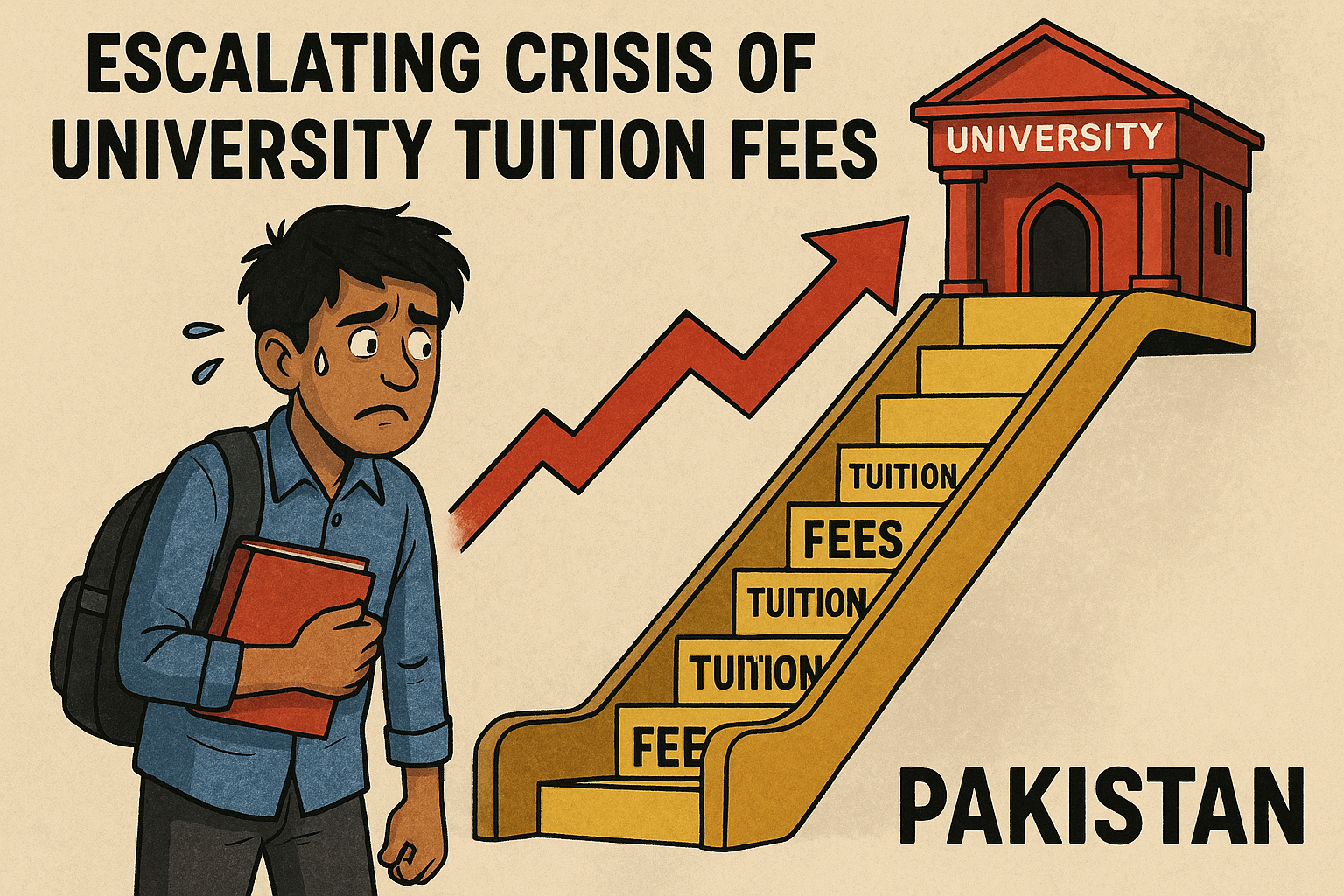
In recent years, Pakistan’s higher education sector has been grappling with a significant challenge — the relentless rise in university tuition fees.
This surge has placed an immense financial strain on students and their families, threatening to make higher education an unattainable dream for many.
The issue has sparked widespread concern, prompting governmental intervention and public outcry.
The escalation of tuition fees has been particularly pronounced in medical and dental colleges.
For instance, the Karachi Medical and Dental College (KMDC) implemented a staggering fee increase exceeding 150% in December 2023. The tuition fee for open merit seats was raised from Rs 50,000 to Rs 117,600, while the admission fee surged from Rs 20,000 to Rs 50,000.
As of late March 2025, the committee imposed a firm annual ceiling of Rs 1.8 million on tuition fees for private medical and dental colleges, with provisions for annual increases based on the Consumer Price Index (CPI) over a period of five years.
Additionally, new charges such as development fees were introduced, further amplifying the financial burden on students.
Similarly, Abdul Wali Khan University Mardan (AWKUM) in the Khyber Pakhtunkhwa province significantly increased its tuition fees across various programmes in November 2023.
The per-semester fee for BS programmes in disciplines like English, Psychology, Zoology, and Banking was elevated from Rs 37,000 to Rs 65,000.
The LLM fee saw an increase from Rs 54,480 to Rs 90,000, and the PhD fee rose from Rs 69,000 to Rs 100,000, while hostel fees were also hiked to Rs 50,000, exacerbating the financial challenges faced by students.
In response to the public outcry over soaring tuition fees, the government has initiated steps to regulate and cap these costs.
A notable development occurred in February 2025, when a special committee comprising officials from the Federal Ministry of Health and the Pakistan Medical and Dental Council (PMDC) proposed capping the annual tuition fee for private medical and dental colleges at Rs 1.2 million.
This recommendation aimed to curb the rapid fee hikes, as some institutions were charging between Rs 2.5 million and Rs 3 million annually.
The proposal included measures for strict monitoring, heavy penalties for violations, mandatory annual audits, and a dedicated complaint system for students and parents.
However, progress on implementing these recommendations has been sluggish.
Delays in approval from the Committee on Medical Education, chaired by Deputy Prime Minister Ishaq Dar, have hindered enforcement.
The government’s proposed fee caps and regulatory measures aim to strike a balance, ensuring that institutions remain financially viable without compromising students’ access to affordable education.
As of late March 2025, the committee imposed a firm annual ceiling of Rs 1.8 million on tuition fees for private medical and dental colleges, with provisions for annual increases based on the Consumer Price Index (CPI) over a period of five years.
Institutions seeking to charge up to Rs 2.5 million were required to submit detailed financial justifications to the PMDC.
Compounding the tuition fee crisis is the significant reduction in funding for the Higher Education Commission (HEC).
In May 2024, the federal government slashed the HEC’s budget from Rs 65 billion to Rs 25 billion, restricting this allocation solely to federal universities.
Consequently, public sector universities in the provinces were directed to secure their own funding.
This drastic cut has raised concerns about the potential impact on the quality of education and the likelihood of further tuition fee increases as institutions seek alternative revenue sources.
The relentless rise in tuition fees has profound implications for students and their families.
Education, particularly in specialised fields like medicine and dentistry, is becoming increasingly unaffordable.
Many students are compelled to take on substantial debt, while others are forced to abandon their educational aspirations altogether.
The financial strain extends to families, who must navigate the challenge of supporting their children’s education amidst rising costs and economic uncertainties.
Private educational institutions often justify fee hikes by citing rising operational costs, inflation, and the need to maintain quality standards.
A concerted effort involving policy reforms, increased funding, and stakeholder collaboration is essential to ensure that higher education remains accessible and affordable for all Pakistanis.
While these factors are valid, the magnitude of recent increases suggests a potential prioritisation of profit over accessibility.
The government’s proposed fee caps and regulatory measures aim to strike a balance, ensuring that institutions remain financially viable without compromising students’ access to affordable education.
Addressing the tuition fee crisis requires a multifaceted approach. Beyond implementing fee caps, there is a pressing need for comprehensive reforms that include enhanced funding for public universities, transparent financial practices, student support programmes, and stakeholder engagement.
The rising cost of university tuition in Pakistan is a pressing issue that demands immediate and sustained attention.
While governmental proposals to cap fees represent a step in the right direction, delays in implementation and budgetary constraints pose significant challenges.
A concerted effort involving policy reforms, increased funding, and stakeholder collaboration is essential to ensure that higher education remains accessible and affordable for all Pakistanis.
The future of the nation’s youth, and by extension, the country’s socio-economic development, hinges on the resolution of this critical issue.






Comment